



Pinned Tweet
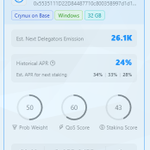
A second post, on the $CNX Crynux Team and brief summary of the project and what sets us apart. Check out my first pinned post on setting up a node & staking balances for rewards. 👌📈🚀
Luke W. – Core Developer: Brings 8 years of experience in blockchain, zero-knowledge cryptography, and multiparty computation. Holds five patents and publications and developed an early open-source blockchain AI framework in 2019.
Aaron Y. – Core Developer: Former Google AI machine learning engineer with 10 years of experience, over 10 publications and patents, and experience developing large-scale AI products serving billions of daily users.
What Is Crynux?:
Crynux is building a decentralized AI computing network, similar to some projects in the space, but with a greater focus on supporting custom, open-source, and uncensored AI models.
Unlike platforms that restrict users to a predefined selection of models, Crynux aims to let users host and run virtually any AI model available on Hugging Face, provided the network has GPUs capable of supporting it.
The platform supports AI text and image generation, with video generation planned.
CNX Token & Ecosystem:
CNX is currently traded on Uniswap (Base), Robinhood and SafeTrade.
Token holders can participate in the network by:
Providing GPU Compute -- Contributing GPU computing power to earn rewards.
Delegating & Staking -- Assigning CNX to your own node or existing GPU operators to earn a share of rewards.
AI Services -- Eventually using CNX to pay for text, image, video and other AI generation services.
Why Crynux Is Interesting:
Crynux combines decentralized GPU infrastructure, AI model flexibility, and a token-based incentive system. Its goal is to create an open AI ecosystem where anyone can contribute computing resources, earn rewards, or access AI services without relying entirely on centralized providers.
Development is ongoing, with regular GitHub updates and additional capabilities planned, check out GitHub or Discord for full updates.
@crynuxio @crynux_dao @safetrade @base @RoninHood__ $CNX #cnx #crynux – at Ponoka County, Alberta

rugrum retweeted

The goat is back.

BREAKING: Nvidia board reinstates Jensen Huang as CEO
$NVDA adds nearly $500,000,000,000 in ten minutes


rugrum retweeted

Bitcoin vs Nvidia, $10k in each.
Both turned into millions. Both just crashed.
Guess which one is ahead.
rugrum retweeted

“If someone breaks into your house, knowingly and unlawfully, you should be allowed to use any force that you deem necessary to protect your family. It's time for this govt and this country to stand on the side of law-abiding Canadians, especially in their home.” @PierrePoilievre

rugrum retweeted

DAGKnight Status Update (November 2026): Where It Stands dagknight.com/blog/dagknight…

rugrum retweeted

Hunters, farmers, sport shooters and collectors are not the problem.
Alberta is intervening in the Supreme Court of Canada appeal of Ottawa's 2020 firearms ban, because targeting law abiding firearms owners does nothing to make our communities safer. Real public safety means going after violent criminals and illegal gun traffickers.
Alberta has already said no to the federal confiscation scheme under the Alberta Sovereignty within a United Canada Act. Now we're taking Alberta's case to the highest court in the country.
To every Albertan who owns firearms safely and responsibly: your provincial government has your back.
See more details: alberta.ca/release.cfm?xID=9…


rugrum retweeted

We built Crynux so anyone could use AI powered by a decentralized GPU network. Now you can see it in action.
Thanks to @MiningRabid for putting Crynux Chat, image generation, and our OpenAI-compatible API to the test.
Watch the walkthrough below and then give it a spin yourself👇

Decentralized AI is now live on @crynuxio 🤖
5,000 FREE credits for about two weeks. I tested the chat, the OpenAI-compatible API and the image generator 👇
youtu.be/QCagUqyzFuo
my Crynux link is a referral link. @t_allfather

rugrum retweeted

Finally @crynuxio has launched Crynux AI services and Crynux Chat.
If you've been following us, you know we've been supporting $CNX for a very long time and this is perhaps their biggest update since mainnet.
Decentralized AI at its peak - fully transparent on what is going on behind the scenes while your prompt is being processed.
Highly recommend you guys check it out at chat.crynux.io/ and if you are builder check out crynux-as.xyz


Crynux AI Services and Crynux Chat are officially live.
For the first time, Crynux-powered AI is available directly to developers and everyday users.
Crynux AI Services build applications using decentralized AI compute
crynux-as.xyz
Crynux Chat use AI powered by the Crynux Network
chat.crynux.io
5,000 free credits are up for grabs so you can jump in, test the services, and see Crynux in action.
We’ve also launched a referral system. Invite others, help grow the community, and bring more real users and activity to the Crynux Network.
Until now, we’ve focused on building the foundation: a decentralized GPU network, reliable task execution, and results that can be verified without blind trust.
Now we’re putting that infrastructure to work.
The long-term value of Crynux comes from real utility; people using the network, developers building on it, and applications generating real compute demand.
AI Services and Chat are our first step toward that goal.
And to everyone who has supported Crynux and stayed with us along the way: thank you. Your trust and patience helped us get here.
This is only the beginning. More users. More developers. More applications. More real usage of the Crynux Network.
Try it. Build with it. Share it. Help us grow Crynux.

rugrum retweeted
Crynux AI Services and Crynux Chat are officially live.
For the first time, Crynux-powered AI is available directly to developers and everyday users.
Crynux AI Services build applications using decentralized AI compute
crynux-as.xyz
Crynux Chat use AI powered by the Crynux Network
chat.crynux.io
5,000 free credits are up for grabs so you can jump in, test the services, and see Crynux in action.
We’ve also launched a referral system. Invite others, help grow the community, and bring more real users and activity to the Crynux Network.
Until now, we’ve focused on building the foundation: a decentralized GPU network, reliable task execution, and results that can be verified without blind trust.
Now we’re putting that infrastructure to work.
The long-term value of Crynux comes from real utility; people using the network, developers building on it, and applications generating real compute demand.
AI Services and Chat are our first step toward that goal.
And to everyone who has supported Crynux and stayed with us along the way: thank you. Your trust and patience helped us get here.
This is only the beginning. More users. More developers. More applications. More real usage of the Crynux Network.
Try it. Build with it. Share it. Help us grow Crynux.


rugrum retweeted

The Binance Hack: Security, Control and What Comes Next
The @binance hack has me thinking about three things: how vulnerable our financial infrastructure is, how much control we actually have over our assets, and whether we’ll absorb this disaster and turn it into another buying opportunity.
Binance estimates approximately $6.3B impacted in the largest crypto theft on record by dollar value.
The preliminary explanation? A compromised DevOps engineer’s laptop that enabled unauthorized withdrawals. That feels like an easy thing to blame. I’d like to see the technical post-mortem explaining how that access translated into withdrawals across multiple networks.
The attacker’s most concerning move:
Depositing $60M in stolen USDT into @aave and borrowing 19,762 WETH, nearly $45M at the time, before that route closed.
@tether froze $1.56B in USDT.
@circle froze another $823M in USDC.
@arbitrum’s Security Council went a step further, forcibly moving $30.5M out of the attacker’s control.
That capability deserves attention, too. I’m not criticizing the recovery effort, but the ability to freeze, or forcibly move, assets exists. Something worth considering for those who assume self custody means complete, autonomous control 👀
Native $ETH on @ethereum and native $BTC have no issuer operated blacklist, so they cannot be frozen through the same mechanism.
What remains under attacker control in reported snapshots? Approximately 18,270 BTC, reportedly distributed across 19 addresses. TRM’s analysis also identified broader holdings above 420,000 ETH.
Binance suspended deposits and withdrawals, revoked the affected authorization, engaged law enforcement and blockchain intelligence partners, and promised updated Proof of Reserves. It has also repeatedly promised to cover customer losses through SAFU and company funds.
Meanwhile, approximately $1.55B in crypto positions were liquidated over 24 hours as BTC fell below $78,000.
These consequences reached people nowhere near the compromised wallets.
The Bullish Case:
Bitcoin reached new highs after Mt. Gox, Bitfinex, Coincheck, Binance’s 2019 hack, FTX’s collapse and Bybit’s 2025 hack.
Recovery sometimes took years and didn’t guarantee customers recovered their money, but BTC eventually went on to do what BTC does.
Replacing missing assets could also create buying demand if Binance continues to purchase what it cannot cover with existing company owned holdings.
Why you might not want to rush into this dip:
TRM attributes the attack to North Korea’s TraderTraitor, also linked to the Bybit theft. That remains just assessment.
After Bybit, stolen ETH was converted into BTC through routes including THORChain. That process involved acquiring BTC.
This time, the attacker already holds approximately 18,270 BTC alongside substantial ETH. We cannot assume the same laundering related buying demand will repeat.
These assets could still create selling pressure. Their traceable origins may complicate cashing out through regulated exchanges, but tracing doesn’t automatically prevent swaps, transfers or sales.
Replacement buying and attacker selling could happen simultaneously. A rebound is possible. So is further disruption.
Then there’s the “financial reset” speculation: that repeated breaches, shaken confidence and emergency interventions could accelerate changes in financial infrastructure, regulation and control.
I’m not personally ruling out broader changes as a long-term possibility, as I think that’s the direction the world is heading anyway.
What happens next depends on Binance’s ability to cover losses, transparency and whether the confidence holds.
Time will tell.

rugrum retweeted

The chances of being killed by a landmine delivered by a bear are low, but they are never zero.


rugrum retweeted

🚨🚨🚨 kaspa:native Family
This could go down as the biggest hack in crypto history.
$6 BILLION.
For perspective:
• LuBian (2020) — $3.5B
• Bybit (2025) — $1.5B
• Ronin (2022) — $624M
• Poly Network (2021) — $611M
We're talking about a single incident potentially exceeding every previous major crypto hack.
And here's the scary part:
Binance still hasn't confirmed the full figure.
If the $6B estimate is accurate, we're not just talking about another exploit.
We're talking about a historic moment for the entire crypto industry.
Let that sink in. #CryptoNews #cryptocurrency
rugrum retweeted
$CNX | @crynuxio might be one of the more overlooked projects in the decentralized AI sector.
55 million tasks completed during testnet.
1,785 participating nodes.
A working AI chat and image-generation application.
And 71% of $CNX supply allocated to task mining tied to network usage.
Here’s why I’ve been paying attention 🔽
1️⃣ Turning idle GPUs into productive infrastructure
There are millions of GPUs sitting inside gaming PCs and other computers around the world.
Many of them remain underutilized for significant portions of the day.
Crynux is building a decentralized network that allows GPU owners to contribute their computing resources to AI workloads.
Instead of relying entirely on centralized infrastructure providers, developers can access computational power supplied by independent operators.
The arrangement is straightforward:
→ GPU owners contribute computing power.
→ Developers use that power to run AI applications.
→ Operators earn $CNX for completing tasks.
The interesting part is that a computer in one part of the world can process an AI request originating from an application thousands of kilometres away.
And the network handles the coordination.
2️⃣ But does decentralized AI actually work?
This was the question I wanted answered.
A decentralized computing network sounds promising in theory, but the real test is whether it can deliver something people can actually use.
That’s where Crynux Chat comes in.
It’s a working AI application powered by the Crynux network, with a free demo that anyone can explore.
You can interact with AI models, ask questions, generate content, and even create images.
For example, one of the demonstrations involves generating an image of a small red lighthouse on a snowy cliff at dusk.
Here’s what happens behind the scenes.
When you submit the prompt:
→ Crynux-AS submits the task to the network.
→ The blockchain assigns an available GPU node.
→ The node receives the task through a relay and runs the AI model.
→ The network performs the required validation.
→ The generated image returns to your chat.
And you can actually follow the progress.
The interface shows the different stages: In Queue, Generating, Verifying, Uploading, and Finishing.
The example uses Qwen Image 2.1, with the actual computation performed by a GPU node participating in the network.
It’s a simple demonstration, but it makes the underlying technology much easier to understand.
3️⃣ Solving the trust problem
Now comes one of the more interesting technical challenges.
If anyone can contribute hardware, how does the network know that operators are completing tasks correctly?
After all, decentralized infrastructure can’t simply assume every participant is honest.
Crynux addresses this through its verification system, vssML.
Rather than duplicating every computation, the network uses unpredictable checks.
Approximately 10% of tasks are selected for independent verification, with results compared across three nodes.
Operators don’t know beforehand which tasks will be checked.
And because they have $CNX at stake, submitting dishonest results carries financial consequences.
The objective is to make dishonest behaviour economically unattractive while avoiding the enormous cost of independently repeating every computation.
4️⃣ More than just AI chatbots
Crynux Chat is one application built on the network, but the potential use cases extend considerably further.
The infrastructure supports workloads involving:
→ AI chatbots and virtual assistants
→ Text generation, translation, and summarization
→ Code generation and debugging
→ AI image generation and editing
→ Model fine-tuning
→ LoRA training and customization
For developers, another important feature is compatibility with familiar AI development tools and request formats.
That means existing applications can potentially integrate Crynux without rebuilding their entire AI infrastructure.
And this is important because the easier it becomes for developers to access decentralized computing, the easier it becomes for the network to attract real workloads.
5️⃣ The $CNX economics are particularly interesting
This is one aspect I think deserves more attention.
71% of the maximum $CNX supply is allocated to task mining.
But unlike conventional token emission schedules, these allocations are linked to network demand and completed work.
In other words, the task-mining allocation isn’t simply released because another month has passed.
Actual network activity drives its distribution.
Why does this matter?
Because many crypto projects experience supply expansion regardless of whether their products attract meaningful adoption.
Crynux takes a different approach with its task-mining allocation.
Of course, this doesn’t eliminate dilution altogether. Other token allocations and circulating supply dynamics still matter.
But linking a substantial portion of token distribution to actual computational work creates an interesting relationship between network usage and token issuance.
It’s a model worth watching as adoption develops.
6️⃣ Where does Crynux stand today?
Crynux launched its mainnet in June 2026.
Before that, its testnet recorded:
→ 1,785 participating nodes
→ 55 million completed tasks
Those figures provide some early evidence of network activity, although sustained mainnet usage will ultimately be the more important measure.
There’s also a fairly accessible way for newcomers to explore the ecosystem.
Crynux Chat offers a free demo with a limited daily allowance.
Users can try AI conversations and image generation without immediately needing to purchase tokens.
Wallet connectivity is optional for users who want to access their own Crynux credits.
One important detail: conversations are stored locally in the browser, and GPU node operators may have access to the information necessary to process requests. Sensitive information should therefore never be submitted.
✦ My perspective
I’ve always been more interested in crypto projects that build technology people have a practical reason to use.
And decentralized AI computing is an area I believe deserves serious attention.
The demand for AI computation is real. The hardware needed to supply it already exists.
The opportunity lies in connecting those resources efficiently, making the computation reliable, and building an ecosystem that developers actually want to use.
That’s the opportunity Crynux is pursuing.
The next questions are whether the network can attract sustained developer demand, remain cost-competitive, and scale reliably.
Those are the metrics I’ll be paying attention to.
For now, @crynuxio is firmly on my radar.
And $CNX is one I’ll be watching closely.


I know I’ve been quiet lately. I spend most of my days working behind the scenes and apparently, I’m better at keeping everyone else busy than keeping my own X updated 😁
As many of you know however, I’ve always been drawn to projects that give people a reason to use their product or technology, and I think I’ve found the next gem.
Every generated image. Every chatbot response. Every AI feature running inside an app. Somewhere, hardware had to do that work… and someone had to pay for it.
@crynuxio has built a different way to supply that computing power: a decentralized network of independently operated GPUs.
It starts with hardware people already own. A graphics card in a gaming PC that can also be used to run AI models. Crynux lets operators connect that hardware to a network and subsequently complete AI tasks and earn $CNX.
Developers get access to computing power for their applications. Hardware owners get a way to earn from capacity that otherwise sits unused.
Think about that connection: someone’s computer can help power an application used by someone on the other side of the world, with the network coordinating the work and payments.
But connecting computers is only half the problem. How can we trust that someone actually did the work correctly?
Crynux uses vssML, a verification system built around secret spot checks. Roughly 10% of tasks are selected for other nodes to repeat and cross-check. Operators cannot predict which tasks will be checked, and dishonest results put their staked CNX at risk.
That gives the network a way to check the work without paying to repeat every single task multiple times.
The video below shows what this looks like in practice.
This is Crynux Chat, an AI assistant powered by the Crynux network.
Choose an open AI model and start a conversation. Ask it to explain something, help with code, or work through an idea.
In the demo, someone asks for a blue origami fox and gets a generated image back. They also upload a photo and ask the AI to describe it and write an Instagram caption.
Those requests are processed by independently operated GPU nodes on the network.
Crynux Chat is one example of what developers can build using that computing power. The broader network supports other work such as:
• Running AI models for chatbots and assistants.
• Writing, summarizing, translating, and answering questions.
• Generating, explaining, and debugging code.
• Creating images and editing existing images.
• Fine-tuning models for particular tasks or styles.
• Training LoRA adapters to customize models.
Image understanding is also demonstrated in Crynux Chat, with audio and video among the capabilities covered in the broader roadmap.
Developers with compatible AI apps can connect by changing where their app sends its requests. They can keep the familiar tools and request format they already use, while Crynux supplies the computation behind them.
And let’s not forget the part of their tokenomics that caught my attention.
71% of the maximum CNX supply is allocated to task mining, with releases tied to demand and completed work
Why does that matter?
Because that allocation doesn’t enter circulation just because another day, month, or year has passed. Its release depends on actual network usage.
From an investor’s perspective, that makes actual adoption an important part of the supply story and it means my investment won’t be diluted simply by time passing.
Crynux launched its mainnet in June 2026, following a testnet that recorded 1,785 nodes and 55 million completed tasks.
What gets my attention is the problem Crynux is solving: developers need reliable, cost-efficient computation, GPU owners can supply it, and Crynux gives them a way to make that happen.
Check out the video yourself.
That GPU sitting idle could help someone get their next big idea off the ground.
