

PhD candidate studying context-specific gene regulation @StanfordMed | @StanfordBioX fellow 🇵🇭🇧🇷 | Buying coffee and doing my best to be kind
California, USA
Joined November 2020
- Tweets84
- Following344
- Followers187
- Likes962




Pinned Tweet
I’m amped to share our new work to decrypt transcriptional repressors, now on bioRxiv: biorxiv.org/content/10.1101/…
We paired deep mutational scans with machine learning to predict and even tune repressor activity. (1/8)

Raeline Valbuena retweeted

Incredibly excited that our paper linking single molecule states of TF binding to gene expression using quantitative thermodynamic models is out in Nature today. An amazing collaboration with the Bintu Lab. Congrats to Ben, Michaela, and Julia! nature.com/articles/s41586-0…

Raeline Valbuena retweeted

Our new paper on non-coding CRISPRi screens to functionally characterize enhancers just came out in @NatureMethods !
nature.com/articles/s41592-0…

Defended my PhD dissertation on halloween, and the verdict is unanimous - thank you everyone for your support, spirit, and cheers. 💌

2
31
1,633
Raeline Valbuena retweeted

Machine-guided design of cell-type-targeting cis-regulatory elements nature.com/articles/s41586-0… #journals #feedly

Raeline Valbuena retweeted

UPDATE: Our research and my artwork are featured on cover of Nature Immunology’s October 2024 Issue!
See the feature and read our paper here: nature.com/ni/. So proud to have been a part of this amazing team @KarmiWarmii Olivia Laveroni @BrookeHowittMD @LivnatJerby

Raeline Valbuena retweeted

The paradox of poetry and information theory


'Paradoxes in Probability Theory and Mathematical Statistics' - Gábor J. Székely (1984, PDF):
archive.org/details/paradoxe…
Having a lot of fun with this one so far.

Lastly, another key takeaway from our work is conceptual: we HAD to consider our computational goals when designing our experiments, and biological motivations when designing our models. Interdisciplinary cross-talk could be the foundation for more collaborations to come. (7/8)
This was such cool and ultimately rewarding experience, with @akshat_ai especially, and the whole team. (8.1/8)
1
5
326
Thank you all for showing me how to be an authentic and curious scientist, and for making this work possible - @JoshTycko, @RoshniAPatel, @PeterSuzuki8, Kaitlyn Spees, Aradhana, Sophia Arana, Peter Du, @RoshniAPatel, @BintuLab, @anshulkundaje, and @MCBassik. (8.2/8)
6
316
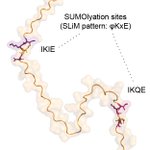
We also used our data to functionally annotate small linear interacting motifs (SLiMs) in disordered domains: these are critical for repressor activity in the context of our screens, and give us insight into how disorder effectors function in a cell. (5/8)

1
3
326

Then, we developed TENet (Transcriptional Effector Network) to integrate sequence, structure, and biochemical features of repressors. After training on our data, our model can accurately predict repressor activity of holdout sets, even in one-shot contexts. (6/8)

1
3
302
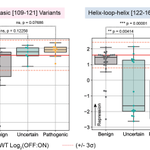
First we mined these data for relevant functional insights. We found thousands of coding variants with measured gain or loss of function. For example, known pathogenic variants and variants of unknown significance the TWIST1 HLH domain show significant loss of function. (4/8)

1
3
312
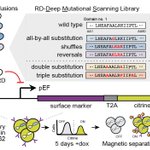
So we’d need really fine-grained and suitably rich data to power anything useful — we designed deep mutational scans of over 50 repressor domains. Then we measured the activities of these hundreds-of-thousands of protein variants in human cells. (3/8)

1
2
325
Repressor domains are super diverse because transcriptional repression happens in many different ways. But it has been difficult to develop accurate functional models for what can be (lovingly) considered an eclectic (and often disordered) class of proteins. (2/8)

1
3
412


Raeline Valbuena retweeted

Great excerpt. Unfortunately, we’ve made the job of a scientist, above all else, to keep the job of being a scientist — even if that path becomes increasingly unrecognizable from the work of science. While many earnestly care about expanding knowledge or ushering in the next generation of scientists, we’ll often will do literally whatever box-checking, pyramid-climbing, ego-stroking exercises are perceived to keep the doors open to clutch on to the dregs of what looks like science that remain.
Good news is it’s actually in our hands but it’s a prisoners dilemma and, when it comes to science and publishing, we’re in our own way to improve it.

"The majority of science published isn't consumed by its intended audience...instead most scientists just skim new titles...We’re running around publishing for the sake of [it]...exactly the kind of environment where fraud not only exists but abounds" arstechnica.com/science/2024…


