

Proud member of BT Global as a Senior Network Specialist, and amateur enthusiast of physics, math and everything computer science related.
Wiltshire, UK
Joined November 2022
- Tweets6.1K
- Following368
- Followers748
- Likes2.5K
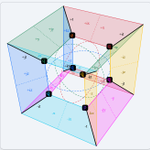
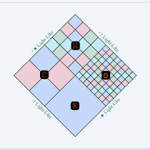




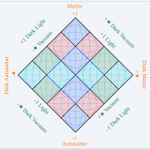
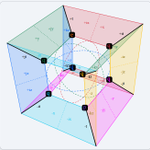

Showing how the 4D universe of matter (and antimatter) have time based around γ⁰, with dark matter and dark antimatter they are instead parallel to γ⁵
As you can see the time-like axis for matter is vertical, and for dark matter it is horizontal, which is why they never interact, except via virtual particles that can cross event horizons. Be they the ones we see as vacuum fluctuations, or the ones that cause Hawking radiation.
Given this is 𝕆² it is 8Dx8D and has an overall clockwise rotation, which gives the flow of time and why virtual particles decay, but real ones don't, as flow is from imaginary (vacuum) to real event horizons.

120
Understanding the difference between parabolic and hyperbolic spacetimes.
Every parabolic spacetime is encapsulated by ∞, shown in Penrose diagrams as ±½π.
Every hyperbolic spacetime has ∞ at ±½iπ, but more so you can see how the hyperbolic spacetime connects to parabolic, just diagonally displaced by ±½π or ±i.
This is why there can only be Dₛ = 2ˢ dimensions, hence ℂ = ℝ², ℍ = ℂ², 𝕆 = ℍ², 𝕊 = 𝕆², etc.
What we call dark matter and dark energy is this hyperbolic connection to other parabolic spacetimes. Hence dark as we only see the mutual effect of how they manipulate spacetime around them but not the cause as they exist in completely disconnected spacetime to us, just we share a mutual event horizon.
Every dimension (or field) should be looked at as complex, or U(1) and nested by how many dimensions they manipulate.
E.g. Spin 1 = U(ℂ), Spin 2 is SU(ℍ), Spin 3 is SU(𝕆) with real and imaginary variants for vector and covector or gauge and virtual particles.
E.g. so to understand gravity, both real and virtual being 4D you need to think in terms of Octonions. And hyperbolic connectivity over event horizons, but that counts just as much for vacuum energy floor (what is referred to as pre-big bang, virtual/vacuum or imaginary light-like event horizon) as well as black hole event horizons (real light-like).
Which is you take the cyan/green hyperbolic spacetime diagram would be the left and right most cyan squares, which are space-like to time in our reality. Likewise the space-like in our universe connects to time-like in connected universes, but its not 3D+1T real and 3T+1D imaginary as the 3T are all separate universes of there own, and will locally look as 3D+1T, because no matter how you orient them together, spacetime can only ever have one real time dimension, be it 2D, 4D, 8D, etc.


1
1
94
Same is true between quarks and electrons, they too have a hyperbolic connection, the only way anything can communicate between them is via virtual particles like the W and Z for spin 1, and there will be massive spin 2 bosons equivalent for black hole event horizon and vacuum energy equivalents.
48
0 := parabolic/elliptic centre of rotation, with Penrose conformal ∞ at ±½π
∞ := hyperbolic centre of rotation, with Penrose conformal 0 at ±½iπ
People think of these as numbers, they are not, they are pointer to the centre of rotation, one time-like (0) and the other space-like (∞).
You can never reach either, as you are curved away from them, and if you get close you can tunnel through them - so they act like a barrier or wall. Only bosons that act perpendicular to them can tunnel through, such as the weak force. for spin 1 and there will be similar massive boson for spin 2.
86
Just watched this, and if I hadn't seen the title first, I would have assumed it is a remake of the Exorcist, not Mummy movie.
Also very slow.
imdb.com/title/tt32612507/

1
115


Been looking at a way to visualise how bark matter and matter interact (red=space, blue=time, green=hyperspace, cyan=hypertime), each dimension is made up of a unit circle, so +1, +i, -1, -i variants. Hypertime looks like space, and hyperspace, time.
Spacetime we see is the centre square, the curved lines represent equal so as we reach 0 in spacetime, it becomes maximally curved in hyperbolic spacetime.
You can see the "singularity" at the centre, which hyperbolic spacetime can't touch. But is an event horizon to spacetime. Dark matter literally can't exist mear our flat spacetime, just like matter can't exist near maximally curved spacetime (like centres of black holes and before big bang).
Basically ever 0 is also an infinity, what looks like a singularity to one, must also be time-like and space-like event horizon to something else.
Gravity is the combination worldline between reality and hyperbolic reality. There must be light-like event horizons/infinities along all the joining diagonal lines showin in black and blue - where curvature is at 45 degrees which is the equivilent to (e₀ ± e₄)/√2. The blue box is the one we can't see beyond.
Going to take a lot to convince people all dimensions are not lines, but complex unit circles, as that is the only way they can be mathematically complete, with not hard edges.
And the concept of infinity and zero is something you can get close to, but never reach. You will tunnel through it. Yet all energy in the universe seems to focus in on it, like thats exactly what it wants to understand.

You become the reason for what you believe in the most. Thought becomes form.
Imaginary (Field-Like) to Physical (Time-Like) rotation.
1
86
Tesseract showing the x, y, z event horizons (dashed lines), so 4D x 8, the 3D view of the second image in 2D. The event horizon line are shown by the central diagonals. Both depict the same thing.
One thing to note is the space-like connectivity between quarks, they are dual coloured as in SU(3) so +𝓲z, +𝓳z here represents the (𝓻𝓰' + 𝓰𝓻')/√2 and -𝓲z, -𝓳z the -𝓲(𝓻𝓰' - 𝓰𝓻')/√2 state, etc which is equivalent to blue colour, there is no ±𝓴z as that is exclusively for the electrons and positron momentum.
Electrons use [+,-,-,-] metric and quarks use [-,+,-,-], [-,-,+,-], and [-,-,-,+].


2
610
@grok please remove all posts related to flat earth and climate change from my "For you" feed.
Thank you kindly in advance.
1
17
Explanation for what is Quantum Spin is defined as intrinsic angular momentum (as well as linear or angular momentum, acceleration, etc.):
Classical Angular Momentum (Iω), where ω = ∂ϕ/∂t and I = mr², Linear Momentum acts at a tangent to every point on the circle. The bounce between real and imaginary is seen as a oscillation (particle strobing between real particle and field, reason for uncertainty principal).
However the imaginary axis has to be specific axis as defined by Cayley-Dickson construction, they appear in the same "reality" if and only if the real dimension e₀ match.
Spin 0 = ℝ = (e₀ ± e₁)
Spin 1 = ℂ = (e₀ ± e₂)
Spin 2 = ℍ = (e₀ ± e₄)
Spin 3 = 𝕆 = (e₀ ± e₈)
Spin 4 = 𝕊 = (e₀ ± e₁₆)
Spin 5 = ℙ = (e₀ ± e₃₂)
Each unit spin defines a unit circle, with (e₀ + eₙ) being the light-like or up form and (e₀ - eₙ) the vacuum-like or down form. With event-horizons at (e₀ ± eₙ)/√2
Generalised way to describe it would be:
S = (e₀ ± ★)
Where the ★ defines the Hodge Dual of the spacetime is interacts with, so Scalar is 1D, Vector is 2D, Tensor is 4D, etc with relation Dₛ = 2ˢ.
So, where does Quantum Mechanics, Special Relativity and General Relativity come in.
QMₛ = 2ˢ⁻¹ to 2ˢ
SRₛ = 2ˢ to 2ˢ⁺¹
GRₛ = 2ˢ⁺¹ and above
S in this case is the spin of the observer in our case, the photon, making:
QMₛ = 2⁰ to 2¹
(real and virtual particles, outward curl to ∞)
SRₛ = 2¹ to 2²
(mass and momentum, flat)
GRₛ = 2²
(gravity, inward curl to 0)
If we used gravity as the observer particle, what we define as curvature would then be jerk acceleration, and quantum mechanics would be 4D spacetime and below.
Side comment from me:
So higher dimensional beings would be able to make no more changes to our spacetime as we can for that of particles. They could nudge it in a specific direction using fields (as we can with electromagnetic fields) - like we see with gravity, but have little effect on smaller particles.
The fact the universe is this way, is likely why we all have free will for the most part.

2
1
136
You may ask why this relates to Cayley-Dickson construction of complex numbers.
Energy is the original scalar field e₀ that defines base reality and only one dimension (Order). But there is another type of imaginary energy e₁ that works outside of reality and can have infinite dimensions (Chaos).
Higgs process (e₀ ± e₁) splits that into space-like and time-like parts, particle and field or mass and momentum. Space and time have no meaning before this point. Initial construction ℝ :-> ℂ, scalar particle, 2D spacetime.
Vector bosons (e₀ ± e₂) take that further and give is the 4D spacetime we know. Second construction from ℂ :-> ℍ, vector particle, 4D spacetime.
Tensor bosons (e₀ ± e₄) continue. Third construction from ℍ :-> 𝕆, tensor particle, 8D spacetime.
Start with simple scalar field, and end up with infinitely complex solution.
If you think in terms of "God", e₀ (real) is the body and eₛ (imaginary) is the mind. As it complexifies the body, it becomes mind-like - the body stores information from its interactions, creating memory. This is a one way process, even through things like black holes. Complexity always increases.
106
Could the answer be as simple as:
SU(2s±1)!
Where 2s-1 is the spacetime of the observer particle, in our case the photon and spin 1, and 2s+1 the spacetime it can observe, leading to:
SM = SU(3) x SU(2) x U(1) (observed), U(1) (observer)
Or (ℍ x ℂ) x (ℝ), why we see 4D complex fields in QFT, giving electrons and 3 colours of quarks.
Spin 2 would be:
SU(5) x SU(4) x SM (observed), and SM (observer)
Or (𝕊 x 𝕆) x (ℍ x ℂ x ℝ), gravity interacts with 4D spacetime and atoms, not specifically singular particles.
U(1) links Real (1D) and Complex (2D)
SU(2) links Complex (2D) and Quaternion (4D)
SU(3) link Quaternion (4D) and Octonion (8D)
SU(4) links Octonion (8D) and Sedenion (16D)
SU(5) links Sedenion (16D) and Pathion (32D)
This might explain why we can see supermassive black holes (likely 16D-32D objects), not just stella black holes (8D objects).
arxiv.org/pdf/math-ph/020200…
164

Soul Vector,
Surface of interaction = π * ±√(ID² + EGO²)
(outer self)
Surface of self π * EGO²
(inner self)
Now imagine everyone has this, you can determine compatibility as being inner product between two vectors, just the vector can exist in more than two dimensions, more dimensions the greater the surface area too.
Too much EGO, you look like you have no personality or drive, too much ID you are invisible to others, unless they share same goals (aka one dimensional).

149
