

Industrial Designer, Cinematographer, jailbreaker, and Thumb War champion.
- Tweets1.4K
- Following0
- Followers199
- Likes980













ALT A large galaxy on the right, with two much smaller companion galaxies to the left at 10 o’clock and 9 o’clock. The large galaxy resembles a speckled wheel, with an oval outer ring and a small, off-center inner ring. The outer ring contains pink plumes like wheel spokes, with dusty blue regions in between. The pink areas are silicate dust, while the blue areas are pockets of young stars and hydrocarbon dust. The inner ring is smoother, filled in with a more uniform pale pink. This smaller ring is interwoven with thin, orange-pink threads. On the galaxy's right edge, a bright white star with 8 diffraction spikes shines. The two companion galaxies to the left, one above the other, are about the same size and both spiral galaxies. The galaxy above is a reverse S shape but similar in coloring and texture as the large ring galaxy. The galaxy below is smoother and largely white, with a blue tinge. The background is black and full of more distant, orange-red colored galaxies of various sizes.



ALT The image is divided horizontally by an undulating line between a cloudscape forming a nebula along the bottom portion and a comparatively clear upper portion. Speckled across both portions is a starfield, showing innumerable stars of many sizes. The smallest of these are small, distant, and faint points of light. The largest of these appear larger, closer, brighter, and more fully resolved with 8-point diffraction spikes. The upper portion of the image is blueish, and has wispy translucent cloud-like streaks rising from the nebula below. The orangish cloudy formation in the bottom half varies in density and ranges from translucent to opaque. The stars vary in color, the majority of which, have a blue or orange hue. The cloud-like structure of the nebula contains ridges, peaks, and valleys – an appearance very similar to a mountain range. Three long diffraction spikes from the top right edge of the image suggest the presence of a large star just out of view.

ALT A group of five galaxies that appear close to each other in the sky: two in the middle, one toward the top, one to the upper left, and one toward the bottom. Four of the five appear to be touching. One is somewhat separated. In the image, the galaxies are large relative to the hundreds of much smaller (more distant) galaxies in the background. All five galaxies have bright white cores. Each has a slightly different size, shape, structure, and coloring. Scattered across the image, in front of the galaxies are number of foreground stars with diffraction spikes: bright white points, each with eight bright lines radiating out from the center.

ALT The image is split down the middle, showing two views of the Southern Ring Nebula. Both feature black backgrounds speckled with tiny bright stars and distant galaxies. Both show the planetary nebula as a misshapen oval that is slightly angled from top left to bottom right and takes up the majority of each image. At left, the near-infrared image shows a bright white star at the center with long diffraction spikes. Large, transparent teal and orange ovals, which are shells ejected by the unseen central star, surround it. At right, the mid-infrared image shows two stars at the center very close to one another. The one at left is red, the smaller one at right is light blue. The blue star has tiny triangles around it. A large transparent red oval surrounds the central stars. From that extend shells in a mix of colors, which are red to the left and right and teal to the top and bottom. Overall, the oval shape of the planetary nebula appears slightly smaller than the one seen at left.

ALT The background of space is black. Thousands of galaxies appear all across the view. Their shapes and colors vary. Some are various shades of orange, others are white. Most stars appear blue, and are sometimes as large as more distant galaxies that appear next to them. A very bright star is just above and left of center. It has eight bright blue, long diffraction spikes. Between 4 o’clock and 6 o’clock in its spikes are several very bright galaxies. A group of three are in the middle, and two are closer to 4 o’clock. These galaxies are part of the galaxy cluster SMACS 0723, and they are warping the appearances of galaxies seen around them. Long orange arcs appear at left and right toward the center.

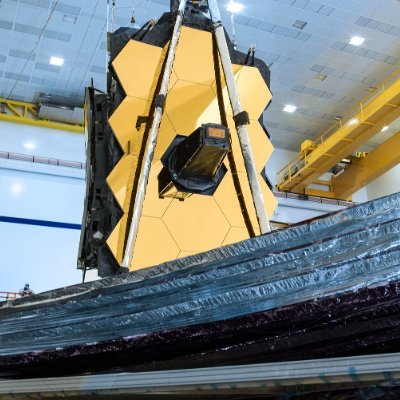
ALT The Webb telescope's primary mirror is inside a facility laying on its side, with engineers in white protective suits. The mirror's two wings that give it its honeycomb shape are not deployed in this image. Its secondary mirror, held by a long boom, is deployed in front of the primary mirror. The primary mirror is made up of multiple hexagonal mirrors assembled into one shape, and are covered in gold.


