

Product & process. Creator of Shape Up. Prev: 37signals. [email protected]
Lisbon
Joined November 2007
- Tweets1.8K
- Following41
- Followers52.8K
- Likes2.7K




"Interface" is such a powerful word because you can use it talking about software or you can use it talking about a value chain. And the meaning doesn't change.
Another word for "simplicity" is "leverage."
How much of the same thing can I get out of fewer elements.
"Product" means working backward from an interface.
The interface -- human, API, CLI -- is where the value happens.


This was so cool to see. Every time my Stratechery invoice arrives, I cheer a little.

Love the wide inner margins.


And now you can preorder the NOMAD LETTERS (out December 1!): press.stripe.com/nomad-lette…
For years these letters have circulated (at first, unofficially) among investors, acquiring a devoted readership. We wanted to give them a permanent home in print.
Nick and his partner Qais Zakaria’s record is extraordinary. The letters are the account of how they got there, featuring everything from studying Amazon and Costco (Nomad’s defining investments)—to visiting cement plants in Zimbabwe, and beyond.
They’re candid about their mistakes and curious about the forces that shape investors’ behavior: incentives, psychology, and the wisdom (or foolishness!) of the crowd.
Since closing the fund, they’ve devoted their time to philanthropy, a journey Nick recounts in the lovely foreword he wrote for this edition.
I’m thrilled to continue adding to the investing corner of our catalogue, and I can’t think of a better work to follow Poor Charlie’s Almanack. ❣️


It presented a few options of how to explain the new logic... (not shown here) ... and then it revised the breadboard with the change for me to inspect.
Next is updating the prose...

Since I prefer to use the breadboard as the bottom-most truth, I always update the prose afterward. I think of it like the commentary on or the detailing of the breadboard.
Claude Code never gets 100% there, but Opus 5.5 is reliable at getting me 90% of the way there. It makes a diff like this:

You're seeing a Notion doc there massively zoomed out. The agent created a private "diff" copy of the original shaping doc, with yellow and green highlights for changes and additions. I make corrections directly to the Notion doc, letting the highlights draw my attention. Then once I'm satisfied, I tell it to merge. And boom. Everyone has a new human and agent-readable source of truth that reflects the new decision. ■
The issue requires loading a lot of context into my brain and drawing out new flows to make it clear what the behaviors are.
Instead of scratching my head figuring out where to start, I opened up Claude Code and told it to read the shaping doc.
Then I dictated a stream of consciousness description of the problem and my idea for how to solve it.
It knew which part of the concept needed to change...

I have some conventions for this, and Claude Code gets me 80% there in the first draft. I'll give some back and forth, and then publish the doc for the team. (For one client it's Notion, for another it's markdown in GitLab).

What you're seeing there is some framing for the project, the breadboards (two here) embedded as zoomable vector graphics, and a prose explanation of what's in the breadboards.
My rule of thumb is that the structure of the prose follows the structure of the breadboard.
So far all of this has been a story of more quickly producing a shaping doc from the human shaping session + recording of the guided tour.
Here's where it gets interesting. And where the CAD part comes in. Much to my surprise, what worked well for humans works REALLY well for agents. So now I can run workflows on top of this.
When an issue or a question comes up, I have a quick path to ask the agent for suggestions and evaluate alternatives. Or I can drop a demo video in from the team to check for misses. Or auto-update the source of truth after a decision is made, etc.
For example, the other day we had a review, and I realized there was some logic we missed during shaping ...
How did I generate that? I take the first rough whiteboard and record myself giving a guided tour, just explaining the whole thing. Then I drop a screenshot of that original whiteboard together with the recording to Claude Code so it knows the idea. Then it has what it needs to produce a better clean-line version.
The next step is turning the stream-of-consciousness dictation from the recording into well-structured prose.
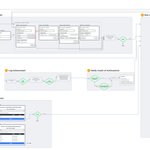
First is the agent-generated hard-line breadboard. I prefer the breadboard as the "bottom-most" truth for a shaping doc because it synthesizes all the parts and their relationships in one picture.
I originally started making breadboards like this because I found them most effective for aligning humans. It helps to have one "circuit" that shows you the "bill of materials" you need to put together and how they work as a whole.
But it turns out this is also a really good source of truth for agents.

I've been talking a bit about CAD for product design. Here's an example of what I'm talking about. This is from a client project. First we worked on a whiteboard to get to a concept for the project. It's a mix of wireframes and pasted screenshots ...

At this point it's all in our heads. Now I wanted to create a durable and editable source of truth that captures all the thinking behind what we drew.
In the past, I would spend many hours painstakingly creating a shaping doc. Now, I take a screenshot of the whiteboard and paste it to Claude. Then I dictate myself talking through the whiteboard as if I was explaining the concept to somebody top-to-bottom.
From that, the agent can draft two artifacts for me to review and adjust. A little back and forth got us to this ...