

VP, Human-AI Operations, Dataminr. Human In The Loop and AI enthusiast. Former journalist.
London
Joined June 2008
- Tweets28.2K
- Following4.4K
- Followers1.9K
- Likes1.5K







Agree with 1
Five theories about AI and work in 2027:
1. AI writing will get good enough we won't read before publishing
2. Anthropic/OpenAI quotes per task, not per token
3. Freelancers will compete for the same tasks as AIs and AI + human teams
4. Junior jobs will be fully in a simulation before they're allowed to make real world changes
5. We have half as much work and twice as many meetings
Come back December 31st 2028 and tell me I'm wrong.
1
47


I just had to ask Claude to get accurate info about a Gemini product. A long way to go there it seems.
111
Wow

Norway now has more than 2,000 underwater AI laser robots shooting lice off its salmon
they're made by a company called Stingray, and they already guard more than 50 million salmon and trout 24/7
the reason is sea lice, tiny parasites that latch onto salmon and feed on them
as few as 11 can kill a small fish, and one pen can hold 150,000 salmon
the usual fix is pumping the fish out and blasting them with warm water or water jets to knock the lice off
but the handling is so rough that Norway's fish health report ranks it the top cause of death in full-grown farmed salmon
so instead, Stingray puts a robot inside the pen that hunts lice one at a time, all day:
> two cameras watch every salmon that swims past
> AI checks two frames to make sure it's really a louse
> then a green laser fires from up to 2 meters away
> the salmon's scales reflect the beam, so the fish swims off fine and the louse is dead
we now live in a world where AI lasers do pest control on your dinner lmao
59
This is like Robocop

Meet Ring Drone Cam 🚀
Unlock a new way to take command of your home. Fly room to room for unobstructed aerial views. Use Live View to check in on different rooms or create custom patrol routes unique to your space, right from the Ring app.
Learn more: to.ring.com/DroneCamX
61
This is my experience too.
I think there is way too much concern expressed about verification of AI output in everyday work due to a risk of factual errors.
It used to be true, but data on more recent models suggest they beat human experts, including PhD specialists, in finding facts and checking claims.


84
Do Androids Dream of Electric Sheep

Memory is what allows Claude to learn from experience. In a new Engineering Blog post, we share how “dreaming” helps Claude organize what it’s learned, correct its mistakes, and find what it needs more easily the next time. anthropic.com/research/compo…

52
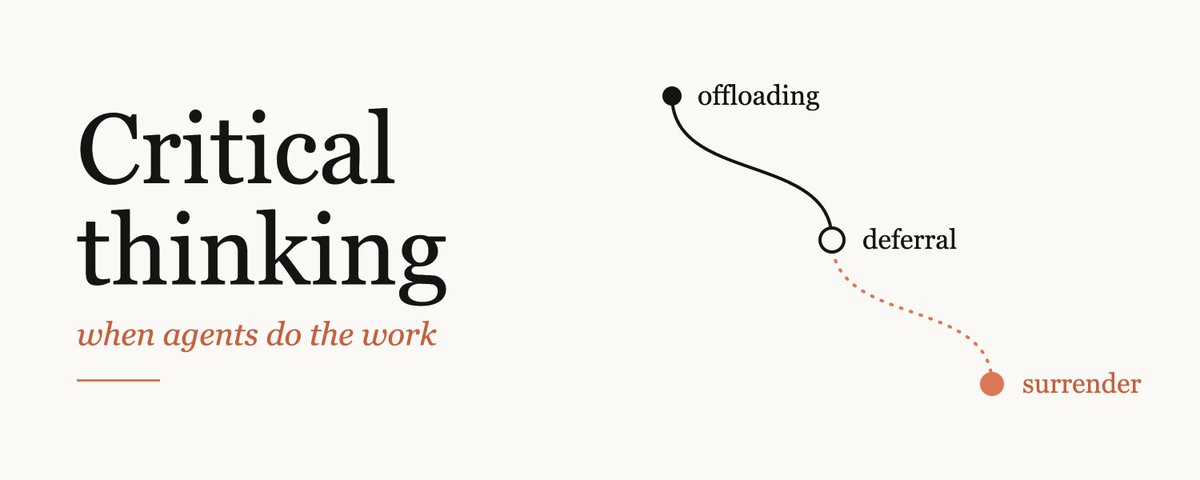
This is a good post. I agree with the principle. I'm less sure about where to deploy the thinking. More at the start now than rechecking the output at the end. And we maybe assume that work produced by humans was thought through rigorously every time.

49
Great to see that I - a non technical person - am using a very similar process and model selection to an AI expert.

btw @karpathy uses medium on opus 5.5 on his latest project (Hackertube launched today).
overall i think having strong opinions on effort levels is like the tabs vs spaces of our time. just tweak to taste. altho mine is definitely superior to yours.


1
54
Write for your primary audience - humans - not for yourself.

What would the writing of superintelligent AI sound like? You might expect it to have the characteristics of good human writing — figurative language, high information density, coining new terms, and punchiness — but dialed up to 11. Well, that’s what Claude did, until Anthropic dialed it back recently because of user complaints. It didn’t sound superintelligent to most of us. Instead, the neuralese writing style sounds like a “stupid person’s idea of a smart person”.
Our response to information density and metaphor-laden writing looks something like the cartoon graph I've drawn. Beyond a point, it completely backfires. The reason human writers don’t overdo it isn’t because they aren’t capable, but because they are aware of the reader’s cognitive burden. One of the hardest skills to learn as a writer is to simulate the reader’s experience.
It’s easy to train AI to mimic mediocre human writing. But optimizing it to be (perceived as) good is really hard, and made much harder by the fact that when everyone uses the same few AI models we get tired of their tics very quickly. Most Claudeisms are individually pretty good. I hate that I can’t use “load bearing” in my writing any more. If it weren’t for AI overuse it would be a neat metaphor.
A broader question is whether most tasks in the economy are like chess, where there is a clear performance metric that can be optimized, or whether they’re like writing, where quality is a multidimensional balancing act without clear training signals beyond human mimicry.

43
Agree with this. Actually being able to challenge plausible sounding AI that is only wrong a fraction of the time is going to be a sought-after future skill.

New Anthropic research: How AI agents shape experts' judgment calls
When experts delegate work to an agent, do they still make the key decisions? We tested this in a randomized trial with 50 professional data analysts.
61

Thought > text > code. I agree.

I disagree with @mattpocockuk that the code should be the source of truth when building with AI.
- The intent in our minds is the true source
- How we capture that in English is 2nd
- Code is an implementation, and it's actually 3rd
Writing is closer to thought than code.
danielmiessler.com/blog/writ…

52