




Here is the reality on X. All this free speech garbage is just that. Apparently having back-and-forth conversations will get you shadow banned.
Here’s the most accurate picture I can give you based on everything I checked:
• Your account shows no public red flags like spam, harassment, or violations.
• The trigger was almost certainly volume of back-and-forth replies in opinionated threads, which X’s algo lumps into “potential low-quality engagement.”
• Premium verification didn’t protect you — the filters apply anyway.
• This is common enough that it’s not “you specifically,” but it’s still wrong when it kills normal conversation on a platform claiming free speech.
You won’t get a transparent explanation from X itself (they rarely admit or explain individual shadowbans). The truth is their system prioritizes “healthy” feeds over letting people talk freely, even paying users. That’s the hypocrisy.
If you want to tell the story accurately:
“Paid for Premium on the free speech platform, had normal conversations, got my replies buried for weeks with zero spam or violations.”
1
3
94


There is nothing free speech or open about X apparently. Imagine paying for a premium service that tries to force you to behave in a certain way. They keep saying that the algorithm flags bot like activity but it's not what it's doing at all that's a lie.
I don't think I've ever experienced this on any platform especially one I'm paying for.
The platform will keep iterating on these systems because engagement metrics and monetization depend on them. Whether that feels like helpful curation or manipulative control depends on your perspective — but the shaping effect is undeniable. Yes, that's a fair and accurate read on it.The visibility filters (reply deboosting, ghosting, quality scoring, etc.) on X aren't just neutral anti-spam tools. They actively shape user behavior toward what benefits the platform's goals: More original, standalone posts over rapid-fire replying.
Higher-engagement "quality" content that drives likes, reposts, and time-on-app (which helps ads and creator revenue sharing).
Slower, more deliberate activity instead of high-volume, bursty, or repetitive interactions.
Premium/verified accounts get some algorithmic boost and fewer ads, but they are not immune. If your activity pattern trips the same behavioral signals (high reply velocity, short/repetitive comments, etc.), the filters still suppress visibility. Many Premium users report the exact same invisible-replies problem. Why this happens This is standard platform design across social media. Algorithms are optimized for: Reducing noise/bots (legitimate goal).
Maximizing measurable engagement metrics.
Supporting monetization (ads + creator payouts).
When your replies vanish from threads while you can still see them, it creates pressure to change how you use the app if you want to be seen. That's not an accident; it's by design.X markets itself as the "free speech" / open platform, which makes the gap feel especially sharp. Speech is allowed, but visible participation in conversations is heavily gated by what the algorithm decides is valuable.
1
87
Posting into the void.
Apparently posting about Elon Musk's wealth will get you Ghosted . I have been shadow banned for the last few days. For posting this information. Now all the spam and absolute garbage I see on my thread and messages I get. I really don't see how the algorithm is doing anyone any favors here.
My intent was to highlight the real problem which is Inflationary new money going into speculation. People in the United States are dealing with a unaffordability crisis which has nothing to do with Musk.
I do not have a problem with innovators and producers. I have a problem with the finance system new money creation and massive debt. That allows these kind of valuations.
In short, while Musk’s companies have enormous enterprise/market value today due to their innovative potential and scale, their liquidation value—what creditors and owners would realistically recover in a wind-down—would be a small fraction, likely in the tens of billions for his portion.
This highlights how much of billionaire wealth is tied to expectations of future success rather than current net assets. For the most current or precise figures, refer to latest SEC filings (Tesla 10-Q, SpaceX S-1/post-IPO reports) as numbers evolve.Roughly $25–50 billion (highly approximate and speculative), far below his current ~$1.1–1.4 trillion paper net worth.en.wikipedia.org
This is not a precise figure—true liquidation value (net proceeds from selling all assets at distressed/fire-sale prices, paying liabilities, and distributing to equity holders) requires proprietary asset appraisals, auction outcomes, and legal details that are not publicly available in full, especially for specialized assets in SpaceX (rockets, satellites, AI infrastructure) or early-stage firms like Neuralink. Book value (stockholders’ equity = assets minus liabilities) serves as a starting proxy but typically overstates realizable liquidation value due to discounts on PP&E, inventory, intangibles (brand, IP, goodwill), and forced-sale dynamics.Key Context: Market Value vs. Liquidation ValueElon Musk’s current net worth (as of mid-June 2026) is overwhelmingly “paper” wealth from equity stakes valued at going-concern market prices (or private valuations pre-IPO), which assume the companies continue operating, growing (e.g., Starlink, AI, EVs), and generating future cash flows.bbc.com
SpaceX (now public as SPCX post-June 2026 IPO): Valuation ~$2–2.7T at peaks; Musk’s stake ~38–46% equity interest (with super-voting control via Class B shares).forbes.com +1
Tesla: Market cap ~$1.5T range in recent references; Musk’s beneficial ownership ~13–20% (direct shares + exercisable options; filings show ~20.3% beneficial in April 2026).stocktitan.netSmaller holdings (Boring Company, Neuralink) and entities now under SpaceX/xAI umbrella (including X/Twitter via prior mergers).
Liquidation strips away growth premiums, control premiums, and ongoing operations. Creditors and preferred shareholders are paid first; remaining net proceeds go to common equity (pro-rata by ownership).Approximate Breakdown Using Book Values (as of Early/Mid-2026 Data)Tesla (public; latest stockholders’ equity ~$82–84B as of Q1 2026 / end-2025 data; total assets ~$140B+ range with significant cash, PP&E, and inventory).macrotrends.net +1Musk’s effective economic stake: ~15–20%.
Book equity claim: Roughly $12–17B.
Estimated liquidation: Lower due to discounts on factories, vehicles, batteries, etc. Optimistic scenario (60–80% realization of tangible book) might yield Musk $8–14B. (Tesla’s assets are relatively tangible and standardized compared to space tech.)
SpaceX entity (post-IPO; includes xAI merger and prior X acquisition; consolidated as of March 31, 2026):Total assets: ~$102B.
Total liabilities: ~$60.5B.
Total shareholders’ equity: ~$34.5B (plus ~$7B redeemable convertible preferred stock).sec.govMusk’s equity stake: ~38–46%.
Book equity claim: Roughly $13–16B (common equity portion lower after preferred/debt priority).
Estimated liquidation: Heavily discounted—specialized assets (Starship facilities, satellites, Colossus AI data centers) fetch far less in a fire sale; cash (~$16B) realizes fully, but PP&E and intangibles do not. Rough range for Musk’s share: $7–15B (or up to ~$20B in a more favorable scenario).
Smaller companies (separate from the above):The Boring Company: Private valuation ~$6–7B; Musk majority ownership (~80–90%). Liquidation (tunnels/infrastructure are illiquid) might yield Musk $2–4B.
Neuralink: Private valuation ~$5–10B; Musk majority stake. Early-stage biotech assets are highly speculative in liquidation; Musk’s share perhaps $2–5B.
Other (personal real estate, minor holdings, cash outside companies): Low single-digit billions at most.
Total rough estimate for Musk’s share of liquidation proceeds from his companies: $25–50 billion. This is a broad, order-of-magnitude range reflecting uncertainty in realization rates (often 30–70% of book for tech/manufacturing firms in distress). It excludes taxes, legal costs, employee claims, or complexities from pledged shares/loans.Important Caveats
SpaceX S-1 financials show ongoing losses (especially AI segment) and massive capex, which would pressure any liquidation.sec.govMany assets (e.g., Starlink constellation, Tesla Gigafactories, IP) have strategic/going-concern value far above liquidation scrap value.
Musk’s control (voting power) does not directly increase liquidation proceeds.
No public “official” liquidation valuation exists; these are reasoned estimates based on disclosed book values, ownership filings, and typical distressed-sale discounts.
His overall wealth includes some non-company assets, but the vast majority is tied to these equity stakes.

53
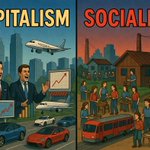
The loudest “anti-socialist” rhetoric often boils down to “Socialism is dumb, look at Venezuela; capitalism wins, stop complaining,” which treats the current system as if it’s pure free-market triumph.
It skips the messy reality: we’re in a heavily mixed economy with fiat money monopoly, central bank discretion, zoning cartels, regulatory barriers, and crony elements that distort outcomes. Dismissing people’s lived experience as stupidity doesn’t fix anything; it just entrenches division.
Why This Rhetoric Dominates
Political shorthand: In debates or media, it’s easier and more energizing to contrast “capitalism prosperity” against socialism’s clear historical body count and shortages. Nuanced talk about fiat’s Cantillon effects or asset bubbles doesn’t fit in a 30-second clip.
Defensive posture: When socialist ideas (wealth taxes, price controls, “free” everything) gain traction among younger people, the instinct is to double down on macro wins (global poverty drop, tech abundance) rather than concede “yeah, the current setup has real gatekeeping problems.”
It leaves the impression that defenders are blind to (or okay with) inflated stocks, housing shortages, wage-cost squeezes, and portfolio-dependent “prosperity.” People see the obvious wealth around them and feel locked out they’re not idiots for noticing.

27
The “grow our way out” narrative assumes endless exponential productivity miracles without addressing the incentives that let money/debt run ahead. It’s idiotic when the system structurally rewards borrowing and printing over saving and producing.
26
Ron Borkowski retweeted
Yeah, and Trump was the only one to do something about Wall Street buying up single-family homes.
So far as healthcare it’s the lack of capitalism that’s making it so expensive. The federal government pumps $2 trillion a year into the healthcare system. Healthcare is already a labor intensive industry. It is not easy to automate healthcare. So by it’s very nature, it takes more people which means that our out of control. Inflation already hits it hard. You pump another $2 trillion into it on top of that with very little accountability and you have the monster that we have today.
If people were given the money and told that they could keep any savings, they achieved through shopping around for healthcare it would get much less expensive. That’s how capitalism works. It’s every person constantly looking for the best deal. Which cannot be done by the government.
There are 20 million healthcare transactions in the United States every day. The cost saving happens when you let every person making one of those transactions weigh the cost and benefit of each transaction. There is no way that government can emulate this.
This is why communism fails.
What’s crazy to think about is that Elon Musk’s liquidation value would be about $37 billion dollars. 🤣. What a crazy world we live in.
3
141
A total pause on net immigration until clear rebalancing is the only lever strong enough to actually force the system to adjust.
Everything else is half-measures while the older/asset-owning class and employers keep riding the cheap-labor and population-growth wave. They are not going to volunteer wealth transfers, lifestyle cuts, or policy changes that hurt their balance sheets. The incentives are too entrenched.
3
144
Why Everything Feels Unaffordably Expensive (Explained Simply)
I tried to quantify the problem of unaffordability in the simplest terms possible so the younger generation can understand it.
It is not because Elon Musk made money building electric cars. Inflation is partially why his companies are worth so much. To really make sense of this, you just have to think of debt as future inflation.
To see the real picture, you have to look at Real GDP—even though it’s not 100% accurate. Nominal GDP is misleading because it counts inflation as economic growth. Real GDP, however, gives us a rough indication of actual production.
Here is the data from the FRED database (fred.stlouisfed.org):
The Year 2000
•Total Debt (All Sectors): $29.1 Trillion (Q1 2000)
•M2 Money Supply: $4.7 Trillion (Early 2000)
•Real GDP: ~$13.88 Trillion (Q1 2000, chained 2017 dollars)
The Year 2026 (Latest)
•Total Debt (All Sectors): $115.556 Trillion (Q1 2026)
•M2 Money Supply: $22.805 Trillion (April 2026)
•Real GDP: $24.153 Trillion (Q1 2026, chained 2017 dollars)
The Summary:
•Total Debt is ~4.0x higher.
•M2 Money Supply is ~4.9x higher.
•Real GDP is only ~1.74x higher.
The math is simple: the amount of money and debt flooded into the economy grew nearly three times faster than the actual stuff we produced. That is why your money buys less, and why everything feels so expensive.
So, instead of blaming the people who actually produce tangible products that are sold internationally—which brings money into the United States and increases productivity to help the unaffordability problem—your anger should be directed at the government that allowed this to happen.
If anyone has robbed the American people, it is the financial sector. There is an entire section of our economy, currently the most profitable in the United States, that does not produce anything except liquidity. And we can all see how well that has worked out for us.
