

You are here, I am not. Founder at Kuvera. Wealth at CRED.
Joined March 2019
- Tweets9.3K
- Following299
- Followers4.6K
- Likes2.8K





Pinned Tweet
Millions of young Indian investors skip mutual funds (MF) entirely, believing they can generate massive, consistent outperformance by day-trading weekly options (F&O) on the Nifty or Bank Nifty.
SEBI’s data is stark and unyielding: over 90% of individual traders in the F&O segment lose money, with the average loss running into lakhs. Retail traders are bringing human emotion and basic charts to a highly leveraged game dominated by institutional algorithmic setups and high-frequency trading desks.
They treat trading like a lottery. A few early wins create an illusion of skill, causing them to scale up their capital. When a single volatile market gap-up or gap-down wipes out their entire trading account, they realize too late that they didn't just fail to beat the index—they lost the core principal required to invest in it.
In contrast, the average investors MF portfolio on @Kuvera_In is at ~11% XIRR, almost 4-5% more than FDs post-tax. Long term compounding and punting have very different outcomes. Choose wisely.

Gaurav Rastogi retweeted

In my ongoing quest to find the limits of Opus 5.5, I directed it to audit my old scientific field, theoretical astrophysics. We indexed about 150,000 papers, audited 50,000 for issues, and did progressively more thorough checks on thousands more. We found nearly 1000 major errors that got cited many times, most are still uncorrected. This survey enabled me to estimate the efficacy of peer review for correcting errors (not very good) and to identify dozens of open questions that anyone with spare Claude Max tokens could answer today (.md context files included).
Bottom line: AI can speed up quantitative science by >1000x with no further model improvement required. But I'm seeing no evidence of this being pushed within universities, only academics complaining about labs dropping math proofs.
Among my fellow reformed academic high agency founders, however, several are speed running entire disciplines.
This survey has implications for how science will be run in the very near future. Hint: Academic publishing is dead. It was already a very stupid way to record and promulgate knowledge, and had been so for decades, even before all that publicly funded knowledge was locked behind paywall cartels. Now AIs can generate thousands of novel, correct papers per day, it is no longer meaningful for humans to consider a research paper a "unit of science" or to even bother much with the 99.9% of science which, up to this point, was necessary drudgery. Time to discover something like General Relativity or Evolution every week. LFG!!
Enjoy: science.caseyhandmer.com/phy…


The first shoe is falling.
Semi Analysis Capex Estimates
2027: $770B → $627B (-19%)
2028: $1.054T → $758B (-28%)
2029: $1.352T → $796B (-41%)
2030: $1.531T to $923B (-40%)

British railway shares roughly tripled between 1830 and 1845, then lost most of those gains in five years. Railways transformed the economy anyway. The chart tracks share prices, excluding dividends.
Today, the biggest AI spenders have committed to payments worth 4.6 times their annual operating cash flow. A technology can deliver while investors pay too much for it.
Are we speedrunning the same chart again?
More thoughts here: gauravrastogi1.substack.com/…

4
387
British railway shares roughly tripled between 1830 and 1845, then lost most of those gains in five years. Railways transformed the economy anyway. The chart tracks share prices, excluding dividends.
Today, the biggest AI spenders have committed to payments worth 4.6 times their annual operating cash flow. A technology can deliver while investors pay too much for it.
Are we speedrunning the same chart again?
More thoughts here: gauravrastogi1.substack.com/…


Gaurav Rastogi retweeted

US vs. China 10-year yields.
Probably the most important macro divergence between two superpowers engaged in wartime-scale spending on an AI arms race.
substack.com/@tavicosta/note…

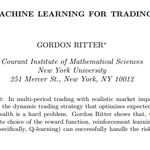
A trading machine learns what you reward, so rewarding profit while penalising wild swings can teach it to take less risk.
Ritter tested this in a simulated market where a stock kept drifting back towards $50, and the machine learned to buy low and sell high without being told that pattern.
Across 5,000 fresh simulated runs, the machine trained to care about risk earned better returns for the risk taken than one trained to maximise profit alone.
The maths behind the reward can accommodate some patterns with more extreme gains and losses than a bell curve allows.
The catch is that a machine can master an imaginary market, so the price model used to create its training world still needs to resemble the market where it will trade.
gordonritter.com/papers/ritt…

4
439
The AMFI Mutual Fund data for October is out. Flows look healthy on top; underneath, retail de-risks through SIP churn while lumpsum buying dies.
1/ Retail investors hold 65% of small-cap fund assets, while HNIs hold 71% of balanced advantage funds. Small accounts carry the most volatility with the least protection against falls.
2/ October saw 59 lakh SIPs stop or mature against 51 lakh new ones, the highest ratio since April 2025. Fewer new accounts today mean slower SIP growth next year.
3/ Since June 2024, when the Sensex first crossed 79,000, ₹19.3 lakh cr entered equity funds, 43.8% of assets. At about 73,000 in October, much of it probably sits below cost.
4/ Net equity flow beat SIP debits by ₹834 cr, while estimated SIP withdrawals rose to 53% of debits. SIP households supply most of the buying and more of the selling.
5/ Retail holds 26% of index funds and 3% of other ETFs, while EPFO supplied 52% of equity ETF inflows in FY23. Small investors pay active fund fees almost everywhere.


No one is criticising the humble SIP. Wait for a downturn or flat markets for that to restart again.
For a country trying to build a long term equity culture, ~ 8% Indians have equity exposure, the Net SIP inflow as % of market cap is still really low. Starting from a lower base, it hasn't moved much.
We have a long runway.
When you hear a criticism of SIP try and separate the commentators view of expensive market valuation from a simple cashflow matching and rupee averaging investment framework.
Lots of commentators conflate their view of expensive market valuation as a judgment on retail being naive to continue to SIP.
The real signal, however, is this. None suggest a better alternative 🙏

Portfolio entropy measures how evenly money is spread across holdings. Entropy-based methods can pull noisy forecasts back toward diversified weights. That helps returns when forecasts disappoint. Higher entropy alone guarantees nothing about returns.
ideas.repec.org/a/taf/emetrv…

1
2
376
The important lesson is that knowing today's valuation differs from the past is easier than knowing which past is the right comparison.
A market's dividend yield can look useful for predicting returns in one period and fail in another because what counts as a normal yield has changed.
This paper finds shifts around 1954 and 1994, so comparing yields across the whole history can mistake a lasting change for a temporary bargain or an overpriced market.
Once the researchers account for those shifts using hindsight, the relationship between yields and later returns becomes much more consistent.
But investors making the adjustment with only information available at the time still did worse than simply predicting the historical average return, because they couldn't estimate the new normal accurately enough.
nber.org/papers/w12109

3
464
Clean divergence: institutions are passing the baton, with FIIs absorbing what DIIs distribute.
FII net bought Rs 52,265 cr over the last 10 sessions (Oct 26 to Nov 6), with the final week bringing most of it: Nov 5 and Nov 6 alone added Rs 28,700 cr. DII sold Rs 21,087 cr cumulative, deepening every day last week.

1
4
739
Gaurav Rastogi retweeted

Some useful qualifications. Nifty +8.6% on the week, India VIX ~15.3→17.7 (+15%).
Parallax telemetry: the average India basket rose only 4.6%, led by the year's laggards.
2026's best theme, Grid & Transmission (+68% YTD), fell 5.2%. Narrow relief bounce. Gta b cautious.

A week where India VIX jumps 10%+ AND Nifty 50 also gains 5%+ is rare. The market is charging in while fear keeps climbing. I pulled every such week since 2008 to see what came next.
The rally usually continues for a month, then it's a coin flip with a fat left tail.
1 month later: Nifty median +4.0%, 55% of episodes positive (any random week: +1.0% median, 60% positive). The bounce extends.
3 months later: median -1.1%, only 45% positive (baseline: +3.1%, 64% positive). Below average and much wider.
The split: 4 of the 12 episodes sit in 2008. Those delivered -16%, -11%, -44% and -7% over 3 months. Ex-2008, the other seven went +19%, +27%, -1%, +3%, -3%, +15%, +6% (median +5.6%, 5 of 7 positive).
The mechanics make sense. A violent rally on a rising VIX usually means a sharp relief bounce off a fear spike, or a momentum surge priced with event risk still on the board. If the fear was real (2008, 2011), the rally fails within a quarter. If it was a mispricing (2009, 2014), you get a moonshot.
2
30
8,921
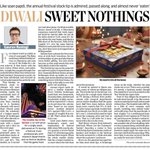
Diwali stock picks have a lot in common with soan papdi. They arrive every year, get passed around with gusto, and are probably best left untouched 😉
My playful take in @EconomicTimes
Happy Diwali 🪔

3
406
On Dhanteras, people pray to Kuber, the god of wealth. Also known as Kubera or Kuvera.
You can see why I like this festival.
Happy Dhanteras!
And here is a little something extra special from @CRED_club
app.cred.club/k63y/8pern43r

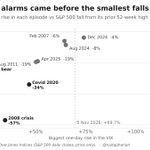
The VIX just saw its 3rd largest daily jump since 1990. History says the market bounces back 13.2% on average after shocks like this.
But there is a massive catch built into the data. The wolf, when it comes, rarely sets the alarm off first. Read more:
gauravrastogi1.substack.com/…


