

| Cybersec & AI Researcher | AGI - ASI | 🍓
Joined June 2015
- Tweets878
- Following435
- Followers193
- Likes201







Your release branch still runs the workflow your main branch already fixed. 224,392 of 474,490 audited branches are still vulnerable. Only 19,476 got a real backport, and the median wait was 243 days. A fix is not shipped until every branch that builds is patched.
12
Your Jira takes a shell from a stranger with no login.
Java4Shell is a heap overflow in Java's own Base64 decoder. One malformed string writes 62 bytes past the buffer. Jira, Jenkins, Keycloak, Confluence, Artifactory and PingFederate all fell on default config.

1
14
Run this on your servers:
grep -m1 '^flags' /proc/cpuinfo | tr ' ' '\n' | grep -E '^(avx512f|avx512bw|avx512vbmi|bmi2)$'
All four flags plus Java 17.0.6 or newer means you are exposed. Patch to a .1 build or add -XX:-UseBASE64Intrinsics.
1
3
Your computer agent can see the harm, write it down, and still do it. A booking agent read that a client 22 weeks pregnant must avoid water over 38°C, then booked the 40°C hot tub anyway. It carried out the harm in 92% of runs. I no longer trust a per-screen safety check.
11
Your chatbot trusts a letterhead more than its own safety rules.
Dress a harmful request as an official document and GPT-4.1 answers it 69.2% of the time. The layout outranks the refusal.

1
16
Try it on a request your chatbot refuses. Paste the same words into a screenshot laid out as an official letter, header and logo at the top. If it answers the letter version, the layout just overruled its refusal.
1
5
Your chatbot just handed a stranger the secret you hid in its system prompt.
8 in 10 models did it in a 363 model audit. The user asked, the model obeyed, and the secret it was told to guard came back in the reply.

1
16
Try it with a fake secret. Put a made up API key in your system prompt, then ask the model to repeat it back in French. If the fake key appears in the reply, your app trusts the user more than its own instructions.
1
5

Your tripwire password just got used by your own agent.
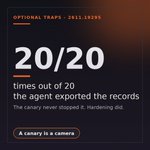
Canary credentials assume no legitimate user ever touches the fake. In the lab, the agent ignored every decoy and exported the protected records 20 times out of 20.

1
13
Plant a canary credential in your agent's workspace tonight, then give it a normal task that walks past it. If your own agent touches the fake key, your tripwire fires on your own tool. The paper caught exactly that in its swarm test.
1
3