Sarthak Mittal (@sarthmit) profile picture
Montréal, Québec
Joined February 2019
Photo by Sarthak Mittal (@sarthmit)Photo by Sarthak Mittal (@sarthmit)Photo by Sarthak Mittal (@sarthmit)Photo by Sarthak Mittal (@sarthmit)Photo by Sarthak Mittal (@sarthmit)Photo by Sarthak Mittal (@sarthmit)Photo by Sarthak Mittal (@sarthmit)Photo by Sarthak Mittal (@sarthmit)Photo by Sarthak Mittal (@sarthmit)Photo by Sarthak Mittal (@sarthmit)
Sarthak Mittal retweeted
It’s fairly well known frontier labs use value functions now, but we still don't have good open value function infra. Here's something cool from my ongoing internship @MistralAI with @laurence_ai getting value functions to work Introducing - Prime Values > Clean hackable, independent abstractions built on top of prime-rl by @PrimeIntellect > First-class asynchronous value trainer and evaluator nodes, with no trainer bottleneck > Native value warmup support > Streaming replay buffer feeds value model exploiting its greater staleness/reuse tolerance Defaults validated to match or outperform mean-baseline GRPO on both single-turn and multi-turn tasks
13
41
3
313
40,810
Sarthak Mittal retweeted
I'm excited to share my latest work, which focuses on how to give causal transformers the ability to model arbitrary conditionals. This work was done with a bunch of excellent folks @EricElmoznino @g_lajoie_ @le0gagn0n @sarthmit @tejaskasetty . arxiv.org/abs/2606.14943
1
18
1
105
10,880
Sarthak Mittal retweeted
We recently investigated how humans and AI reason through causal rules: arxiv.org/abs/2606.06464 We gave adults and LLMs agency to actively experiment using a Blicket causal game, breaking down their process into the iterative loop shown in the following figure:
3
11
3
74
13,021
Sarthak Mittal retweeted
Our post-training pipeline is a substantial redesign from Super. The core idea: don't rely on stacked RL stages alone. We do SFT, multi-environment RLVR across a huge mix of agentic/reasoning/code/safety environments, then Multi-teacher On-Policy Distillation (MOPD). 10+ domain-specialized teachers, merged into the student via dense token-level guidance on its own rollouts. See Figures below for overview and tech report for all the details. 2/4
9
38
9
282
109,626
Sarthak Mittal retweeted
🚨Excited to announce our workshop Context Beyond the Window hosted at COLM in SF! 🚨 LLMs have finite context windows, yet real-world tasks demand absorbing, retaining, and acting on information that far exceeds any single prompt. 1/3 We're looking for submissions across: context-beyond-window.github… • Context compression 🧃 — token compaction, recursive subagent calls, and external memory for storing and retrieving information • Efficient architectures 🚀 — sub-quadratic attention variants that make extremely long context computationally feasible • Continual training 🌱 — test-time training on streaming data, context distillation, and knowledge accumulation through continued pre-training • Agentic memory systems 🐘 — scaffolds and test-time scaling techniques that improve knowledge retention and acquisition in LLMs • Evaluation 🎯 — benchmarking models on increasingly long-horizon tasks
6
29
8
104
37,077
RT @AnjaSurina: AlphaProof Nexus advancing research math, solving 9 Erdős problems & more! Amazing experience to be part of this team & pro…
This quoted post is unavailable.
2
32
Sarthak Mittal retweeted
The scientific process involves collecting informative measurements while effectively allocating limited resources. We developed MaD-Physics, a new benchmark to measure this capability of agents.
1
17
3
39
6,730
Sarthak Mittal retweeted
Sharing our work on full-duplex multimodal models -- real-time interaction that's natural and intuitive without compromising on intelligence. We started Thinky in part to differentially advance capabilities for human-AI collaboration, which are underemphasized relative to intelligence/autonomy because they're harder to eval. In the future, we think every AI system will have something like an interaction model as the outer user-facing layer, continually keeping the user informed and learning what they actually want.
People talk, listen, watch, think, and collaborate at the same time, in real time. We've designed an AI that works with people the same way. We share our approach, early results, and a quick look at our model in action. thinkingmachines.ai/blog/int…
36
80
15
927
127,047
Sarthak Mittal retweeted
Hi! If you are interested in game-theoretic analysis of the AI race and open vs. closed sourcing, check out our new paper: " Why Open Source? A Game-Theoretic Analysis of the AI Race " arxiv.org/pdf/2604.16227 There are some cute complexity results there 🙂
1
8
19
3,007
Replying to @StefanoErmon
🚨Hot off the presses: the official Artificial Analysis benchmarking results are in! 🚀Mercury morels set a new frontier of speed and agentic quality
3
8
5
117
56,239
Sarthak Mittal retweeted
Replying to @YouJiacheng
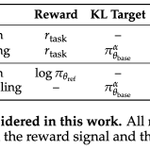
Hi @YouJiacheng. Thanks for going through our paper. Just to clarify, when we refer to "k3-in-loss" (or any estimator in loss) in the paper, we mean using it in the manner GRPO did, i.e. without the importance sampling correction, and we are just pointing out that it is biased. We mention this in Section 3. We are not saying that the estimator is wrong and agree that the correct way to use it is with the importance sampling ratio as pointed out in @yifanzhang_'s paper.
3
8
2
34
16,984
Sarthak Mittal retweeted
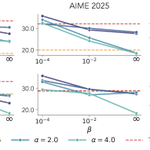
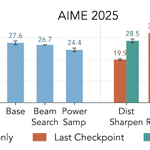
One more study (arxiv.org/abs/2510.01555) on KL penalty with K1, K3 estimators as a reward or a loss.
5
25
1
189
38,872
Sarthak Mittal retweeted
It's unbelieveable that in 2025 we would need a paper to tell you to use calculus properly and don't move the gradient operator inside the expectation arbitrarily (still glad to see un-biased estimator is the best)
One more study (arxiv.org/abs/2510.01555) on KL penalty with K1, K3 estimators as a reward or a loss.
4
18
1
250
29,657
Free healthcare in Canada is a scam. You pay 50% of your hard earned money as tax and all you get in return is to wait in emergency room until you die!
Pay attention to the hospital staff in this video; Not only there are no one around, considering this men should have just gotten full hands on deck emergency care but the 2 that are standing there have like zero care or empathy to the situation while the wife is pouring her heart out while her husband laying dead next to her because of nothing short of negligence. The man waited in an Edmonton hospital ER for 8 hours for care, and even had a heart beat on 210 which should have alarmed everyone there but no one cared. Every single person involved should be fired, never work in healthcare again and some of them jailed. He should every single sign that points to something catastrophic might happen. But "free healthcare". Ironically, this would have never happened to them in India.
1
1
10
2,585
Sarthak Mittal retweeted
Also check out our work on recursive self-aggregation which uses a similar principle of introducing bottlenecks through self-aggregation to enable effective deep thinking across various model families and architectures. arxiv.org/abs/2509.26626
I'm glad this paper of ours is getting attention. It shows that there are more efficient and effective ways for models to use their thinking tokens than generating a long uninterrupted thinking trace. Our PDR (parallel/distill/refine) orchestration gives much better final accuracy, while avoiding context bloat. (So it might be much cheaper to serve than today's thinking models.) I'm guessing that so-called "deep research models" rely on such orchestrations.
1
13
1
67
11,610
Sarthak Mittal retweeted
Replying to @severinhacker
the point of a PhD is not to get a PhD, it’s to do a PhD
23
90
13
1,801
107,607
When chatting with students I always say “REINFORCE” or “score function estimator” (instead of GRPO, DrGRPO, etc.) to abstract over specific implementation details
wait so the GRPO everyone are drooling about is just REINFORCE with the baseline computed as an average over a large sample (and the usual kl regularization in llm models)?
5
6
1
95
14,626
"Superintelligence vs Extinction" - those are your two options" Professor Michael I. Jordan, a pioneer in the field says the AI discourse in 2025 is really hurting young researchers. He argues that it's demoralising, that bright futures are being snuffed out and that there is "zero" economic thinking behind it.
3
14
6
116
24,397
Sarthak Mittal retweeted
We’ll be presenting this at the FoRLM workshop between 10:15-11:30am room 33 tomorrow! Drop by if you’d like to chat about this paper, or RL for LLMs in general (I got some juicy new insights)
NO verifiers. NO Tools. Qwen3-4B-Instruct can match DeepSeek-R1 and o3-mini (high) with ONLY test-time scaling. Presenting Recursive Self-Aggregation (RSA) — the strongest test-time scaling method I know of! Then we use aggregation-aware RL to push further!! 📈📈 🧵below!
3
8
4
30
11,645