

We provide information for resource managers to address the impacts of climate variability and change in OK, TX, NM, & LA. Follows/RTs are not endorsements.
Norman, OK
Joined June 2015
- Tweets4.5K
- Following601
- Followers778
- Likes11.6K
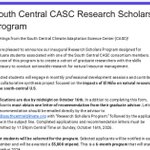


We are looking for graduate students to join our six-month Research Scholars Program to work on a synthesis topic related to the impacts of El Niño on natural resources in the south-central U.S.
docs.google.com/forms/d/e/1F…

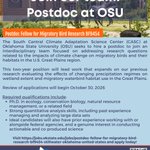
Our consortium partner, OSU, is hiring a postdoc for migratory bird research!
Review of applications will begin on October 30, 2026
Learn more about the position and apply today at:
jobs.okstate.edu/jobs/postdo…
The link is also posted on our website.

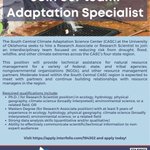
We're hiring!
We're looking for a full-time Adaptation Specialist to join our University of Oklahoma office. This is a research position open to Ph.D. and Masters Degree holders.
Learn more at apply.interfolio.com/194302 and apply today!


NOAA and other scientific agencies are forecasting the current El Niño to become very strong over the next 2–9 months, raising important questions for resource management across the country.

Explore the link to learn more and read about the more specific regional impacts
usgs.gov/programs/climate-ad…
An Update from the South Central CASC:
As we embark on 2026, we wanted to provide an update on our current status. At this time, the South Central CASC is still at minimal operations while we wait for the approval of our base funding. We appreciate the support we have received

from you, and we will continue to do as much as possible in our region to support the ongoing National CASC mission.
Some activities will continue as planned for this year, thanks to collaborations and partnerships with other organizations and institutions.
"Lost funding for Climate Adaptation Science Centers put the brakes on science that supports local communities."
Read this article discussing projects in the 3 CASC regions where funding has been blocked & see why resource managers are speaking up!
theconversation.com/from-inv…

South Central CASC retweeted

US Drought Monitor 10-2-25
For the 50 states and Puerto Rico, the US Drought Monitor shows 36.03% in moderate drought or worse, compared to 36.39% last week.
#droughtmonitor #drought #drought2025

ALT US Drought Monitor showing conditions for 10-2-25.
South Central CASC retweeted

SEP2025 @CLIMAS_UA SW Climate Outlook: Precipitation and Temperature
Drought
Monsoon
Water Supply
ENSO Tracker
Seasonal Forecasts
E&S Fellow Blogs
Southwest Climate Podcast, #SWclimate #AZWx #NMWx : arcg.is/1SqzDX1

South Central CASC retweeted
This Week: NOAA Fire Research from Conditions to Impacts: Improving wildfire risk tools - featuring @CLIMAS_UA Burn Period Tracker. Wednesday 10/1/25 from 2-3 pm ET. Register Here: attendee.gotowebinar.com/reg… Learn More: climas.arizona.edu/fire/sout…

South Central CASC retweeted

🐝 Upcoming Seminar: Assessing Bee Vulnerability in the Southeast & US Caribbean
📅 Wednesday, October 15 at 1:00pm ET
🎙️ Speaker: Dr. Hailey Shanovich, USGS
🌐 Format: Virtual webinar via Zoom
🔗 Learn more and register: loom.ly/v8Xb_-s

South Central CASC retweeted
The NOAA Southeast and Caribbean Regional Collaboration Team (SECART) is pleased to announce the release of the updated “Disaster Guide”.
You can access the updated Guide (in both English and Spanish!) here: noaa.gov/regions/noaa-disast…

Beginning October 1, 2025, the South Central CASC will fully transition to minimal operations until such time when the U.S. Department of the Interior (DOI) approves our FY25 funding. Learn more on our website southcentralclimate.org
South Central CASC retweeted

Hotter & drier conditions are making wildfires more intense & destructive. Science from the USGS Ecosystems Land Change Science Program informs reduction of wildfire hazards to protect ecosystems and communities. 👉ow.ly/Q67w50WXEN9
#NationalHazardPreparednessMonth

ALT Low-intensity wildfire burning dry grass and fallen branches in a pine forest with smoke rising among the trees. Credit: Public Domain
South Central CASC retweeted
ICYMI New Paper Alert! "Changing Climate, Changing Fire: Understanding Ecosystem-Specific Fire–Climate Dynamics in Arizona and New Mexico" - Read the latest CLIMAS blog to learn more about this recent publication: climas.arizona.edu/news/clim…

South Central CASC retweeted
Check out this @NW_CASC deep dive on the ecological impacts of extreme heat in the Northwest👉 ow.ly/IfaP50WZvAi

ALT Wide view of rolling hills with patches of green and dead, drought-stricken trees under a partly cloudy sky. Credit: US Forest Service
South Central CASC retweeted
Forests in the eastern U.S are shifting from drought tolerant trees to species that need more water. As droughts become more common & severe due to climate change, this change may make the forests less resilient and less productive. @mw_casc
Learn more: ow.ly/Ekbo50WYg8Y

ALT Sunlight filters through dense green foliage along a narrow forest trail surrounded by tall trees. Credit: Public Domain, Emma Shedd. Copyright dedication agreement on file.