

Assistant Research Scientist at @UofMaryland/@NASAGoddard working on the Roman Space Telescope.
- Tweets899
- Following171
- Followers192
- Likes515


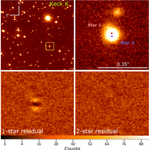





ALT A field of stars that are a mix of blue, white, and orange. A small region between the center and the right is outlined with a square box. Above it is a pullout of the outlined region, labeled “OGLE-2013-BLG-0341.” The pullout shows two fuzzy red orbs that are very close together, each of which are stars. One of the stars is labeled “lens,” while the other is labeled “background star.”

ALT An observation (labeled \u201CVISTA V V V Survey, Near-infrared) of the Milky Way\u2019s center pointing toward its supermassive black hole, which is labeled Sagittarius A*. At 7 o\u2019clock from center is a small region, outlined with 5 fields of view from the Nancy Grace Roman Space Telescope that are stacked together in a horizontal rectangle. This region is about a third of the image in length and a fifth of the image in width. Within that same region are diagonal lines that alternate between orange and blue. A legend at the bottom left shows two Hubble instruments. One of them, marked with an orange diamond, is labeled \u201CW F C 3 / U V I S.\u201D The other, marked with a blue diamond, is labeled \u201CA C S / W F C.\u201D The background is a field of stars, gas, and dust that appear gray, except the center third that runs from the left to the right of the frame, which is composed of brown filaments of dust and gas. The tiny region surrounding Sagittarius A star appears orange.


ALT Dr. Nancy Grace Roman, NASA's first Chief of Astronomy, at NASA's Goddard Space Flight Center


ALT The upper half of a person in a white jumpsuit with hood and surgical mask stands in front of out-of-focus metal columns and a black disk.




ALT A view into a room with two flat pieces of black space hardware flanking the left and right sides of the room. Each is encased in a black frame-like structure that holds them upright. The left and right walls and the ceiling are covered in white cones that jut into the room like spikes. A worker in a head-to-toe white suit and blue gloves inspects a panel.