

CS Prof. Security and applied cryptography. Some highlights: Zerocash (zcash, et al. ), Zexe (Aleo, Aztec, etc ), zk-creds/zk-promises(...)
Washington DC/ UMD
Joined April 2012
- Tweets9.4K
- Following915
- Followers12.7K
- Likes1.6K





People’s predictions for our AI future aren't creative enough. It’s Skynet or Star Trek. What if we get Iain M. Banks’ Culture series? A post-scarcity civilization which does two things: 1) throws weird orgies 2) interferes with less advanced societies.
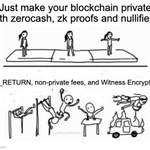
The post-Watergate dream of private electronic cash is still alive. We have both private cryptocurrencies like Zcash and (mostly) private stablecoins. Funnily enough, usable wallets are one of the harder problems here.

The best new private stablecoin wallet right now is @alcove_wallet. Nothing else is close.
- insanely fast (seconds, even for a cross-chain transfer)
- comically cheap (I'm seeing $0.38 on a $10k deposit)
- easy mobile UI, anybody can use
I think it's the next gen leader.
The AI cyber doom and gloom just isn't creative enough. Imagine a worm that updates all PHP websites, adding user-demanded features, but then makes the sites brutalist. Or there are competing swarm ideologies and you're like: the DMV website hasn't been the same since the anarcho-syndicalist hive mind patched it.
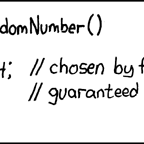
Relevant XKCD strikes again, this time for real. A certificate authority actually generated private keys where 4 was part of the key.


"Computers now constitute or will soon constitute adangerous threat to individual privacy "
Some of the first notions of cryptography, privacy , and computers came from someone at .... fucking IBM.
Yes, this the Feistel of Feistel network fame. These guys were not just in it for the math.
(from Steven Levy's Crypto, written in january 2001 when Crypto meant Cryptography)


Dissent is essential to democracy. And when it's needed most, you need either courage or anonymity.
We've repackaged anonymity as privacy, dressing it up in friendly clothes. But no one thinks they have privacy today, and it's hard to articulate why that matters.
Anonymity and privacy aren't the same thing. Even if they know everything about you, you can use AI to disguise your writing style, use Tor or Apple Private Relay, make a burner account, and still post anonymously.
For now.
Bitcoin isn't private, but against hostile intelligence services (whether that's the CIA or the SVR), the traditional financial system isn't private either. We need better. We finally have the cryptography for the 1980s dream of both encrypted money and encrypted messaging.

(this comment is exaggerated for comedic effect but it’s not wrong)

fun fact: satoshi refused to use the NIST seeds probably because he was somewhat of a bunker mode retard himself, instead used the more obscure secp256k1, and most other cryptocurrencies followed
this is why we can’t directly use industry standards like passkeys in blockchains, and instead we ship people purpose-built hardware wallets made by fucking amateurs, leading to routine 9 figure hacks
anthropic’s discovery reveals that in retrospect his panic wasn’t necessary and we could’ve just used the standards
thanks bunker mode retards!
(this comment is exaggerated for comedic effect but it’s not wrong)
Why buy a quantum computer if AI keeps improving classical computing?
If we can build a big enough quantum computer, we get asymptotically faster algorithms for chemistry, optimization, and finance. But the funny thing is, classical computing keeps catching up on the commercially interesting problems. So again, if classical algorithms or their AI-optimized variants are good enough for the commercially viable instances, why buy a computer to run quantum algorithms? Why invest in building one?
A number of “hard” problems in theoretical computer science aren’t hard for the average commercial version of the problem. For example, checking for a low-cost route that visits all n cities is the traveling salesman problem, which is NP-hard, meaning the worst-case version is very, very hard. But real-world versions of the problem aren’t, and in fact you can solve many of them with some clever algorithms and a smartphone.
A few caveats. For optimization and finance, it’s not even clear you need AI improvements, since the quantum advantage there was smaller to begin with. There's an argument for quantum in scientific computing, specifically simulating quantum physics, but that’s science, not much of a business. And AI may well improve quantum computing itself, e.g. with better error correction, but that helps the supply side, not demand.
Student: the demo characters in our anonymous group chat are Alice, Bob, Master Yoda and Darth Vader.
Me, if you are going to do Star Wars references for real world cryptography , you really ought to do:
• Cassian Andor
• Luthen Rael
• Kleya Marki
* Lonni Jung
Zeroday malware delivered by targeted labs. Interesting to get confirmation of this and evidence of just how targeted ads can be.

NEW @citizenlab report We uncovered an Israeli firm using online ads to run vast spy operation
This is the first-ever public confirmation of zero-click mercenary spyware delivered via targeted ads.
45 devices at @AJEnglish confirmed infected
citizenlab.ca/research/how-d…

Your cyberpunk future was never going to be a utopia, Snow Crash edition. Atlanta apartments now have robot dog guards.

🚨#BREAKING: Absolutely WILD footage has emerged from Atlanta where an apartment complex now uses "robot security dogs" to patrol the area at night.
The robot dogs also seem to speak in Indian accents to the residents.
I've never seen anything like this before... insane!!!

I've long wanted to build a secure wallet as software.
Repurpose an old iphone in lockdown mode, put it in a faraday bag, and only communicate via QR codes on the front facing camera.
Originally the point was something more accessible than a Ledger which was both secure and made folks feel safe. Would basically eliminate the hardware supply chain risk, though increase the TCB and of course depend on Apple's software security.
(The QR code part of this already exists in a few wallets and standards)