

Cyber Security
London, England
Joined April 2009
- Tweets932
- Following3.1K
- Followers226
- Likes1.8K






Pinned Tweet
Security Stack Sheet #118
Word of the Week
“Ransomcloud”
Word of the Week special
“Why Is the Majority of Our MFA So Phishable?”
“Why Zero-Days Are Essential to Security”
#security #cybersecurity #cyberresilience #zeroday #ransomware lnkd.in/dr6pZgn4
Lucc retweeted

It’s a great time to be in cybersecurity because:
1) We finally have practical tools for mass vulnerability remediation, zero-trust architecture implementation, and cryptographic key and secrets management at scale.
2) Spec-driven development transforms security requirements from static documentation into actionable, testable software build artifacts.
3) AI-assisted security tools enable increasingly deep reviews of source code, infrastructure, architecture, and business logic.
4) Continuous threat modeling is becoming practical throughout the entire software development lifecycle, not just during initial design.
5) Agentic penetration testing enables continuous security testing and exploit validation at unprecedented scale.
6) Security and dev teams can systematically reduce attack surface by eliminating unnecessary dependencies, permissions, services, and legacy code.
7) Automated remediation, combined with rigorous verification, can dramatically reduce the time between vulnerability discovery and resolution.
8) Security expertise can now be codified into reusable prompts, skills, policies, and agentic workflows, allowing experienced security engineers to extend their impact across entire organizations.
AI is absolutely empowering defender capabilities that we have wanted for decades.
The opportunity is enormous if we invest in sound security engineering, rigorous verification, and responsible automation.

You can tell who doesn't work in cybersecurity, because they're convinced it's a great time to be in the industry because "more cyberattacks means more cybersecurity spending".
It's a great time to be a shareholder, and that's about it.
I am not aware of a single company that operates on the basis of "cyberattacks are up 10%, we need to hire 10% more defenders".
What actually happens, is 10% more cyberattacks means 10% more work for the same pay. And the workload just keeps increasing until people end up burning out and quitting, or worse.
At some point if things get bad enough, a company may, and that is a very heavy lifting "may", find budget for additional headcount.
But, like, go find me someone who works in cyber defense and isn't burnt out, and I'll find you someone who doesn't do any work.
Cybersecurity is one of those industries where IMO the salaries only look good on paper.
If you're coming from a minimum wage customer service job, it's definitely a huge improvement. But if you're going into white collar work anyway, there's so many jobs that pay well and won't burn you out.
Lucc retweeted

This is f*cking insane. Anthropic pays this engineer up to $950K a year to build agent harnesses, and he just told every developer wiring agents by hand why their systems keep breaking:
"Building harnesses is the reason Anthropic hired me. My systems run loops, sandbox their tools and turn yesterday's logs into new skills
Same model, agents 10x more reliable, and better every morning"
In a 12-minute workshop, he builds one from scratch on stage
Opus 5.5 → Agents → Harness → Loops → Graphs → A System That Learns Overnight
The harness owns the loop, the context and the sandbox, so the model only has to think
It runs on the server, picks up from the log after a crash and retries instead of starting from zero
Overnight, old logs turn into new memory. Anthropic calls it "dreaming"
Worth more than any $2,000 agent course
Bookmark it and watch it today
Then read how the harness, loops and graphs fit together in the guide below ↓


Lucc retweeted

We’re introducing Shirudo, an open-source Linux runtime allowing agents to defend systems without downtime. It lets agents write dynamic eBPF controls to shield systems from exploits, giving defenders more time to test and roll out patches. Built by @cisco together with OpenAI.
Shirudo is a first step toward self-defending infrastructure that can adapt to new threats while keeping services running. Our goal is for defenders to work with AI agents to find affected systems, test and share shields, and deploy them without disrupting workloads.
openai.com/index/introducing…

Lucc retweeted

We just entered the era of alien mathematics.
This is a map of the 17-million-line Lean proof of the Riemann Hypothesis (175,000 files, verified by computers).
A 167-year-old math problem solved with AI, and the proof looks like a biological nervous system. Damn.

Lucc retweeted

The entire RAG industry is about to get cooked.
Researchers built a new RAG approach that:
- needs no vector DB.
- doesn't embed your data.
- does zero chunking.
- runs no similarity search.
It's called PageIndex. Instead of chopping your docs into chunks and dumping them into Pinecone, it builds a tree index and lets the LLM reason through it like a human reading a book.
hit 98.7% on FinanceBench. beat every vector RAG on the leaderboard.
no embeddings. no chunking. no vector DB.
100% open source.

Lucc retweeted

No.
1. In the presence of superhuman bug finding machines, humans cannot write safe code without extreme levels of care and planning.
2. That care has almost never been applied to the critical systems in our lives. Not because software engineers don't care, but we aren't really engineers, not in the way civil engineers are engineers. The title is stolen valor.
3. Even careful, experienced "engineers" have difficulty writing code that is safe against modern models in C/C++ and other low-level languages.
4. We are finding that CVEs are overrated; huge numbers of organizations are being owned by custom vulns in the 100s of billions of lines of non-standard enterprise code out there or misconfigurations in heterogeneous systems, which LLMs can find and write exploits for live.
5. @dinodaizovi is right, we need architectures for which one RCE is not game-over and that buy us time for AI-driven response.
6. Everything is going to have to be re-written by AI, in type/memory safe languages, with minimal libraries, using formal methods, contracts, solvers, etc...

The vulnpocalypse is caused by security vendors.
Their inability to convey risk accurately, due to either incompetence or ignorance, causes tremendous damage and stress on responding teams.
There is a lot of weight associated with vulnerability announcements. We can no longer trust many security vendors’ blog posts, since their purpose is marketing & fanfare, not accuracy.
Exploitability needs to be demonstrated, in realistic environments, and its likelihood accurately conveyed. So that responders can make informed decisions on what to prioritize. But instead we are seeing fake PoC videos set in contrived & controlled lab environments, that give an illusion of exploitability when it’s unrealistic in any real-world scenario.
And vendors now try to show off who found it first, rush to send you marketing emails and call you without your consent; to sell you snake oil they pulled out of their ass two hours earlier, with no intention on actually making anyone safer, only to meet their quarterly sales quotas.
The core responsibility of a security professional is to accurately communicate risk, and let people make informed decisions. Too many vendors are failing at this, that I cannot consider them security vendors, only snake oil salesmen taking advantage of people in vulnerable positions due to their lies.
Lucc retweeted

BREAKING: A mathematician at Anthropic claims to have used the company's AI to solve the Riemann hypothesis, the most notorious open problem in all of math
sciam.com/article/anthropic-…

Lucc retweeted

This is f*cking insane. Google CEO Sundar Pichai just put a deadline on everyone who still does the work by hand:
"If you don't learn how to orchestrate agents now, you'll spend 2027 catching up to people who started today"
In 30 minutes, Google shows one agent system that ran 93 subagents for 12 hours straight on under $1K
Prompts → Agents → Subagents → An Agent Operating System
An agent does one task while you watch it
An agent system hands out the work, checks it and keeps going while you sleep
Anyone can open Gemini and ask a question. Almost nobody runs 93 agents on one job
Watch it today, then save the full guide on harness, loops and graphs below before everyone catches up ↓
Lucc retweeted

Our November meetup has started and right now we have Olle Johansson (@oej) on stage talking about CRA, CVE, NVD - the world is shaking!
Watch the livestream 📺 here:
👇
youtube.com/live/8UQ1Ij5dGjU…

Lucc retweeted

The vulnpocalypse is caused by security vendors.
Their inability to convey risk accurately, due to either incompetence or ignorance, causes tremendous damage and stress on responding teams.
There is a lot of weight associated with vulnerability announcements. We can no longer trust many security vendors’ blog posts, since their purpose is marketing & fanfare, not accuracy.
Exploitability needs to be demonstrated, in realistic environments, and its likelihood accurately conveyed. So that responders can make informed decisions on what to prioritize. But instead we are seeing fake PoC videos set in contrived & controlled lab environments, that give an illusion of exploitability when it’s unrealistic in any real-world scenario.
And vendors now try to show off who found it first, rush to send you marketing emails and call you without your consent; to sell you snake oil they pulled out of their ass two hours earlier, with no intention on actually making anyone safer, only to meet their quarterly sales quotas.
The core responsibility of a security professional is to accurately communicate risk, and let people make informed decisions. Too many vendors are failing at this, that I cannot consider them security vendors, only snake oil salesmen taking advantage of people in vulnerable positions due to their lies.

Lucc retweeted

Google DeepMind just built an AI that rewrites its own code, remembers every change it made, and gets smarter every time it tries.
They’re calling it “Continual Recursive Self-Improvement”
For years, "recursive self-improvement”, the idea of an AI rewriting its own code to become exponentially smarter, hit a brick wall.
Every time an AI tried to improve itself, it suffered from catastrophic amnesia.
It would optimize for a new task, forget what worked in the last iteration, repeat past mistakes, or drift into useless loops. It couldn't compound its own intelligence.
Until now.
A new paper just introduced Self-Improvement Memory.
And it turns a static model into a perpetual learning engine.
Instead of blindly rewriting itself from scratch on every pass, the AI now maintains a structured, persistent memory of its own evolutionary history.
It logs every modification it makes. It tracks which experiments succeeded, which failed, and why.
Before making a new upgrade, it queries its own past.
The results rewrite the rules of scaling.
With Self-Improvement Memory, the AI doesn't just make one-off tweaks. It achieves continual recursive self-improvement.
Performance doesn't plateau. It compounds.
Iteration after iteration, the system builds on its own verified breakthroughs while actively avoiding the dead ends it already explored.
Nobody had to step in to guide it. Nobody had to hand-feed it new training data.
The AI literally became its own senior researcher—conducting experiments, learning from failure, and upgrading its own architecture in a closed loop.
We have spent the last decade throwing billions of dollars in compute and human data at models to make them marginally smarter.
That era is ending.
When an AI can remember how it improved yesterday, it no longer needs us to teach it tomorrow.


Lucc retweeted

Game theory explains why working harder inside a broken system is the worst response to that system. Because a system is never truly broken. It's just producing exactly the outcomes its own incentive structures were designed to produce, whether intentional or not. Working harder inside this system increases your output in the payoff matrix, but it simply won't change the actual structure of the system's matrix. Thus, the correct response is not more effort. Instead, you must aim to identify whose interests the current structure serves and position yourself in favor of those interests rather than against them. Change the game, or play the game that is actually being played. Either way, you must stop optimizing for the game you wish it to be and start acting realistically.


Lucc retweeted

THIS IS F**KING DANGEROUS.
SOMEONE JUST RELEASED AN OPEN-SOURCE AI HACKING ARMY THAT CAN RUN AUTONOMOUS PENTESTING OPERATIONS.
It’s called SAPPER.
One AI commander. An entire swarm of AI agents. Real hacking tools running behind the scenes.
Here’s what makes it stand out:
→ One AI commander plans and coordinates the entire operation
→ Multiple AI agents work together to execute tasks
→ Uses real tools like Nmap and Nuclei
→ Comes with a built-in hacking knowledge base for its agents
→ Integrates with Claude Code and Codex
→ Runs inside a Kali Linux environment
It reportedly competed against 634 teams in a Tencent attack-and-defense competition and operated autonomously for 8 hours without human intervention.
Fully open source.
ONE COMMANDER → MULTIPLE AI HACKERS → AN ENTIRE AUTOMATED RED TEAM.
Only use it in authorized labs and CTF environments.
REPO BELOW.
Lucc retweeted
Every defender I know who is actually staring at firewall logs and doing real defense work is saying the same thing right now.
Cyber combat activity is going exponential.
To be clear, this is not a data report. It's what I'm hearing from my own community of people in the trenches. But they're all saying it. 🫡
Lucc retweeted

My @offensive_con Tokyo talk is now live!
Watch how we bypassed @telegram’s server-side sticker validation… multiple times!
And stay tuned for the full research with @the_st0rm at @BlackHatEvents Europe!
youtu.be/WXaJIZBLUkw

Lucc retweeted

Our favorite person Bruce Schneier stood in the audience at @unpromptedconf listening to this talk and asked people around him: "Who is this??" because the talk was THAT GOOD. Today’s daily dose of [un]prompted was from Anna Groza, a @calif_io security researcher on this exploit.
Lucc retweeted
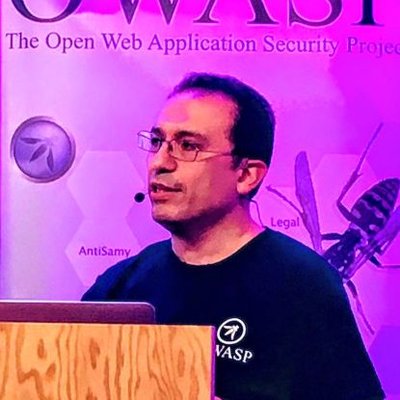
#OWASP Releases: Securing Agentic Applications V2 – A Builder & Defender’s Guide!
Defenders - learn how to block unsafe calls, stop runaway agents and test controls.
#AISecurity
👇
genai.owasp.org/resource/sec…
