





senasgr retweeted

LuxxPool just hit 423 mining devices online! ⛏️
21 accounts pushing 35.83 TH/s, and we're growing every day.
Get ALL your earnings at LuxxPool: litecoin:native + dogecoin:native + soqucoin:native plus 7 more chains, all from one pool.
Come mine with us: LuxxPool.ca
$LUXX.CN 🇨🇦 $LUXFF 🇺🇸

senasgr retweeted

Financial privacy is often misunderstood as a tool for illegal activity.
It isn’t.
It’s about protecting yourself in a transparent digital world.
Public companies disclose financial information at specific times, not every second of every day.
They have some control over when and how that information becomes public.
Individuals should have the same control over their financial information in crypto, too.
Optional privacy isn’t the way forward.
Some privacy coins allow users to opt into privacy while leaving others with transparent transactions.
This can weaken privacy overall because anonymity often depends on the number of users sharing a common anonymity set.
When privacy requires additional steps, many users won’t take them.
Meanwhile, blockchain analysis firms have become increasingly powerful.
They can link wallet addresses to real identities through exchange data and transaction patterns.
Privacy doesn’t just help protect you from phishing attacks and targeted scams.
It can also help protect you from price discrimination based on your transaction history.
Next-generation blockchains need privacy built into their core.
Not an add-on or optional setting, but the foundation.
We built JunoCash this way.
Every transaction is shielded by default.
juno.cash

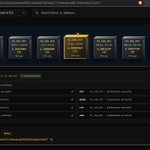
8 chains. One Litecoin parent.
LTC #3,169,150 → 8-chain PSob sibling group:
DINGO · PEP · SHIC · TRMP · B1T · LKY · JKC · CRC
One shared Merkle root. Raw AuxPoW verified.
dedoo.xyz/research
#AuxPoW #Scrypt #Litecoin
Largest group in the current indexer window.
2
78


senasgr retweeted

JUNO — Junocash
Community-funded listing
Markets: JUNO/USDT
nonkyc.io/listing/campaign/J…
@JunoCash_on_X

Cross-Chain Verification Without Oracles or Multisigs: How Shared Litecoin AuxPoW Merkle Roots Connect 8+ Blockchains 🧵👇
Over the past few months, we’ve been researching merge-mining consensus dynamics across the Scrypt ecosystem.
Today, we’re releasing our open research paper, interactive live block explorer, and open-source SDK. We’d love to get feedback and constructive critique from the Litecoin, Dogecoin, and Scrypt mining/dev communities.
---
🔹 1. The Core Observation
When major Scrypt mining pools (like ViaBTC, Mining-Dutch, F2Pool, etc.) merge-mine multiple auxiliary blockchains simultaneously, they don't mine each chain in isolation.
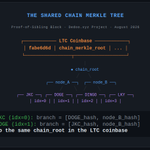
Instead, they construct a unified chain Merkle tree (up to 256 leaves) containing block hashes from independent auxiliary chains (Junkcoin, Dingocoin, Luckycoin, Shibacoin, Craftcoin, B1tcore, TrumPOW, Lebowskis, etc.) and commit this single root into the parent Litecoin coinbase transaction (via the 0xfabe6d6d magic bytes).
---
🔹 2. The Invariant: "Sibling Blocks" (Proof-of-Sibling / PSob)
We sampled 400+ consecutive live blocks across 8 active Scrypt networks and empirically verified:
1️⃣ Proof 1 (Parent Linkage): The Litecoin coinbase TXID folds up the parent Merkle branch directly into the parent header's Merkle root.
2️⃣ Proof 2 (Aux Linkage): Each aux block hash folds deterministically to the shared root in the parent coinbase.
3️⃣ Anti-Grind Consensus: Slot assignments are strictly governed by a 32-bit Linear Congruential Generator (LCG) to prevent nonce grinding.
Whenever two or more chains are mined under the same parent share/candidate template, they are cryptographically locked under the exact same root and coinbase TXID.
---
🔹 3. Why This Matters for Cross-Chain Swaps
Traditional cross-chain bridges require trusted relayer multisigs or expensive centralized oracles.
With Proof-of-Sibling (PSob):
• Verification is self-contained within the 882-byte raw CAuxPow header.
• Smart contracts (on EVM covenants, Bitcoin Computer, or ZK verifiers) can mathematically prove cross-chain inclusion trustlessly without trusting off-chain actors.
• Reorgs on the parent propagate to siblings together, eliminating cross-chain state divergence.
---
🔹 4. Limitations & Real-World Realities (We Need Your Feedback!)
Our paper also addresses nuances where we'd love input from pool operators and devs:
• Aux-Target vs Dual-Target: Most co-mined sibling blocks meet the aux difficulty target but not Litecoin's higher difficulty (valid pool shares on the canonical LTC tip).
• Single-Aux Stratum vs Multi-Chain: Pools configured for single-chain merge-mining produce depth-0 trees without siblings.
---
📖 Open Resources:
📄 Full Technical Paper (PDF): dedoo.xyz/auxpow-sibling-pap…
🌐 Live Interactive Explorer: dedoo.xyz/research
🦀 Rust Multi-Chain Indexer: github.com/dedooxyz/psob-ind…
📦 TypeScript / JS SDK (@dedoo/psob-sdk): github.com/dedooxyz/psob-sdk
We're sharing this in the spirit of open research and would be deeply grateful for any thoughts, feedback, or edge cases from core developers, miners, and pool operators across all Scrypt chains! 🙏
#Litecoin #AuxPoW #MergeMining #Scrypt #CryptoResearch #CrossChain #OpenSource


9/11 — THE TIMING
Junkcoin is about to activate full opcodes: Taproot, SegWit, CSV, CTV.
And MimbleWimble for private transactions.
Bellcoin already has OP_CAT.
This means AuxPoW chains are becoming programmable. They'll verify ZK proofs ON-CHAIN. Peg-out becomes trustless—no signers needed.
And LitVM just launched. Litecoin's own EVM L2. The settlement layer is ALREADY being built.
PSob is the missing piece. The verification layer that connects:
LTC PoW (security)
→ LitVM (programmability)
→ AuxPoW chains (the assets)
→ PSob (the proof)
All four layers exist or are imminent. This is not a whitepaper dream.
1
3
99
11/11 — ONE LAST THING
For ten years, a dozen chains in the Litecoin family have been sharing the same miners, the same hashrate, the same parent blocks.
Billions in market cap. Zero interop.
The reason they couldn't talk was in the LTC coinbase the whole time. Four magic bytes: fa be 6d 6d. A shared Merkle root that connects every aux chain block to every other.
PSob is the recognition that these chains are ALREADY one system. LitVM gives them a place to meet. ZK proofs make it trustless.
One circuit. One L2. One verification layer.
The Litecoin ecosystem. Unified.
Paper + scripts + data → Dedoo.xyz Project
Built by @senasgr
Build on it. Critique it. Improve it.
That's how we move forward. 🧵
5/11 — THE BIG PICTURE (HERE'S WHERE IT GETS WILD)
Litecoin just launched LitVM. That's an EVM Layer 2. On Litecoin.
Read that again. The parent chain now has its own programmable layer.
Combine this with PSob:
DOGE block → PSob proof → verified on LitVM
JKC block → PSob proof → verified on LitVM
DINGO block → PSob proof → verified on LitVM
All wrapped tokens live on LitVM. Same chain. Composability.
One contract. One circuit. One imageId.
All aux chains. Trustless. On Litecoin's own L2.
This is not "bridge to Base." This is the Litecoin family becoming a unified ecosystem with its own programmable settlement layer—secured by LTC PoW, connected by PSob proofs.
The parent chain provides security. The L2 provides programmability. PSob provides the trustless verification link between them all.
1
3
120
8/11 — WHAT COULD GO WRONG?
No sugar-coating:
① Dishonest miner puts fake hash in the chain tree
→ Aux block's own difficulty check prevents this
② Someone uses a non-canonical LTC block
→ Require LTC confirmations (LitVM makes this easy)
③ Miner excludes a chain from the tree
→ Liveness issue only. Wait for next LTC block.
④ Two LTC blocks share same chain root
→ Aux blocks have unique hashes. Can't replay.
⑤ Miner grinds coinbase to control slot
→ Costs one full LTC block. ~87M difficulty. Not happening.
All mitigable. No showstoppers.
1
3
85
7/11 — WAIT, IS THIS NEW?
I searched.
"Proof of sibling block" → zero results
"Chain merkle branch" + "cross-chain" → zero results
"One circuit bridges all AuxPoW chains" → zero results
The chain Merkle tree has existed since Namecoin, 2011. Every AuxPoW chain's codebase has it. It verifies their own blocks. Has for years.
But nobody asked: "what if we use this BETWEEN chains?"
It's like having a universal translator that works for every language, and only ever using it to check your own spelling.
The mechanism was there. The cross-chain use case was missed.
This paper names it. Formalizes it. Proves it on mainnet.7/11 — WAIT, IS THIS NEW?
I searched.
"Proof of sibling block" → zero results
"Chain merkle branch" + "cross-chain" → zero results
"One circuit bridges all AuxPoW chains" → zero results
The chain Merkle tree has existed since Namecoin, 2011. Every AuxPoW chain's codebase has it. It verifies their own blocks. Has for years.
But nobody asked: "what if we use this BETWEEN chains?"
It's like having a universal translator that works for every language, and only ever using it to check your own spelling.
The mechanism was there. The cross-chain use case was missed.
This paper names it. Formalizes it. Proves it on mainnet.
1
3
70
6/11 — BUT CAN THEY TALK TO EACH OTHER TOO?
Yes. This is the part that got me excited.
Atomic swap DOGE ↔ JKC without HTLC:
Alice sends JKC tx. Bob sends DOGE tx.
Both blocks share the same LTC parent.
One ZK proof proves BOTH inclusions.
Both sides settle. No preimage. No timelocks.
Neither DOGE nor JKC needs smart contracts for this. They just need OP_RETURN. That's it. Legacy UTXO chains. Working TODAY.
Cross-chain oracle:
Event X on Dogecoin. Event Y on Junkcoin.
PSob proves both happened in the same LTC block.
LTC timestamp = universal clock for the whole family.
This isn't "every chain bridges to EVM." This is "every chain can verify every other chain." The EVM (LitVM) is just where the DeFi composability lives.
1
3
72
🧵 THREAD
I found something hiding in the Litecoin blockchain since 2011.
It was there the whole time. In the coinbase. Nobody used it.
What it unlocks: every chain in the Litecoin family—Dogecoin, Junkcoin, Dingocoin, Luckycoin, and others—can trustlessly talk to each other. No bridges. No signers. No new consensus.
And Litecoin just launched LitVM, its own EVM Layer 2.
The pieces are falling into place. Let me explain. 👇
4/11 — WHY THIS MATTERS (THE REAL REASON)
Right now, all these chains live in separate universes.
DOGE holder wants to do something with JKC? Centralized exchange.
DINGO holder wants to use DeFi? Custodial bridge. Trusted signers.
Despite sharing the SAME miners, the SAME LTC hashrate, the SAME parent blocks—these chains cannot interact. At all.
This has been the case since 2014. Ten years of isolation.
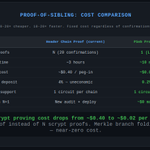
But it gets worse. Even bridging ONE of these chains to an EVM using zk proof is expensive. You have to prove N block headers (one per confirmation). Each header = proving scrypt in ZK. Scrypt in ZK is SLOW.
20 confirmations → ~3 hours → ~$0.40 per proof
For small transfers, the proving fee eats everything.
PSob fixes this from both angles:
1. CHEAPER: 1 scrypt proof (LTC parent) instead of N. ~10 min. ~$0.02. Fixed.
2. MULTI-CHAIN: One ZK circuit verifies ANY aux chain. Just different branch.

1
3
82
3/11 — DOES IT ACTUALLY WORK?
I didn't want to theorize. I wanted to prove it.
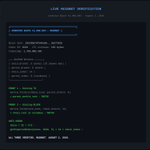
August 2, 2026. Fetched real CAuxPow data from the Junkcoin Electrs API. Raw block headers. Live mainnet.
JKC block #1,069,993:
chain_merkle_branch: 5 levels
parent_merkle_branch: 6 levels
chain_index: 14
Proof 1 — Coinbase is real ✓
Proof 2 — JKC block is in the shared tree ✓
Anti-grind — Position is correct ✓
All three passed. Mainnet. Real data.
Then I checked timing across 7 chains. All within 135 seconds—same LTC parent window. DOGE, JKC, DINGO, LKY, PEP, SHIC, TRMP. Same root. Same proof structure.
It works. Empirically. Reproducible.

1
3
78