
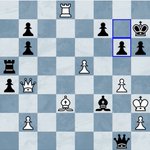


The finish is not a unique win here (and starting a move in, after 1 Bd3+ g6, to avoid transpositions), but it's still pretty and we do have some unique moves first.
Forintos-Tomovic (1957)
White to move

ALT Chess position after 1...g6
This one seems quite elegant. (Couldn't confirm the players or year.)
Sokolov-Mikhailov (1973)
White to move

ALT Chess position
My intended answer here might surprise you, and doesn't come from the book. (Providing the best guess for black's name with Latin letters, and the year may be uncertain as well.)
White just played 1 Bc8. Is this brilliant, a blunder, or neither?
Niedermann-"Czücs" (1895)

ALT Chess position after 1 Bc8
This one makes for a challenging (or at least multi-stage) puzzle, as you'd have to anticipate white's best defense try. (Can't confirm white's name, so the year may be uncertain as well.)
"Redeli"-Barati (1961)
Black to move

ALT Chess position
This was a correspondence game, it seems. Quite a nice finish.
Nettheim-Hamilton (1958)
White to move

ALT Chess position
I could definitely mess this up solving as a puzzle, after a particular 2nd move for black, since black does have two queens on the board.
Vladimirov-Donchev (1975)
White to move

ALT Chess position
Couldn't verify the players in this game, though it has two last names that existed in former Soviet countries. Might also be a challenge figuring out what was played/is the main line here.
"Bankov-Lusmägi (1975)"
Black to move

ALT Chess position
Skipping forward a move here to present as a puzzle (1 Bxh6 Rd1 was played). (Can't confirm who black was or the year.)
Littlewood-Powell (1960)
White to move

ALT Chess position after 1...Rd1
This one might be subjective.
White just took a pawn with 1 Rxg7+. Is this brilliant, a blunder, or neither?
Blackburne-Lipschütz (1889)

ALT Chess position
This one can't really make it as a puzzle, but still shareable, perhaps.
Black just took a pawn on d4 with 1...Bxd4+. Is this move brilliant, a blunder, or neither?
Mayet-Hirschfeld (1861)

ALT Chess position
Another quite nice one. (The year in the book is likely wrong, perhaps by 4 decades, given the players, but I don't have an alternative guess for it.)
Heemsoth-Heissenbüttel "(1924)"
White to move

ALT Chess position

Pretty sure I've seen this one shared too, or at least something similar. (Can't confirm the year, players seem right.)
White played 1 Nf6+. Is it brilliant, a blunder, or neither?
Shvedchikov-Estrin (1977)

ALT Chess position after 1 Nf6+
Did not recall seeing this one in the book, but definitely have seen it somewhat recently. The point is that the whole uniquely winning main line (up to repetition) is actually seven (white) moves here.
Ravinsky-Ilivitsky (1952)
White to move

ALT Chess position
Here is a 3-for-1, including something not in the book.
a) What is white's best move?
b) White played 1 e5. What was black's best reply?
c) How did white win after 1...Rxc1?
(The year is probably wrong. Names might be right.)
Spiller-Matchett (1956)

ALT Chess position
This one is a nice one-two punch (I think that expression fits, anyway). Couldn't confirm the names or year, though.
Arkhipkin-Prodanov (1977)
White to move

ALT Chess position
Skipped like two pages due to ambiguity, etc. In this one, it can be resolved by looking at the position after the first move.
Zhuravlev-Kapanadze (1977)
Black to move

ALT Chess position
This is a neat study. Feels like I've seen some similar ideas involving rook pawns on here.
Grigoriev (1925)
White to move

ALT Chess composition
I've seen some simpler versions of this being shared, but not the whole composition. Khenkin thought the mate in 8 was also a unique win (up to repetition), but it's not quite true. In any case, a useful pattern.
Limbach (1953)
White to move

ALT Chess composition
