

Time-series foundation model research and deployment.
New York, NY, USA
Joined May 2025
- Tweets47
- Following0
- Followers28
- Likes6

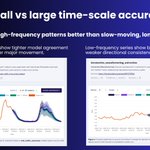

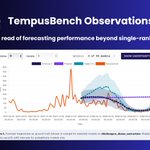

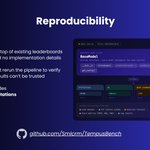

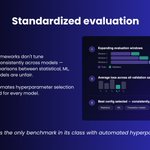


Follow-up to last week: this time we focus on concrete TempusBench runs and what they show when you hold setup constant and compare tasks directly.
benchmark.smlcrm.com

Different metrics can point to different “best” models on the same task/window. That is why selecting a model should start with the metric tied to your use case.

TempusBench keeps this comparable with shared protocol, multiple task types, and open code.
Benchmark: benchmark.smlcrm.com
Github: github.com/Smlcrm/TempusBenc…
Back shortly with more future.
Introducing TempusBench (appeared at NeurIPS’25 BERT2S) — an open-source evaluation framework for time-series forecasting.
Interactive version: benchmark.smlcrm.com
The paper: arxiv.org/abs/2604.11529
Code and datasets: github.com/Smlcrm/TempusBenc…

No data leakage:
M3 and M4 are in the pretraining corpora of most TSFMs. Benchmarking on them inflates zero-shot scores. TempusBench uses new datasets no existing open-source TSFM has trained on. A strong score here is real.

Live now:
TempusBench is live. Run your model against new datasets, standardized tuning, and leakage-free evaluation.
📄 arxiv.org/abs/2604.11529
💻 github.com/Smlcrm/TempusBenc…
🔗 benchmark.smlcrm.com
Back shortly with more future.

Forecasting benchmarks can create false confidence.
When the benchmark setup changes between runs—time split changes, data rules change, or key steps aren’t repeatable—rankings can flip.


That’s why “best model” from a benchmark often doesn’t carry over.
A small score gap can be real… or just a setup difference.


Fast inference doesn't mean a fast forecasting system.
The real bottleneck is retraining — and while your pipeline catches up, your model is already stale.


Real-world time-series data raises tough questions: how to handle missing dates and data recorded on different schedules. Most forecasting models force you to preprocess and fill gaps before use.


