

multimodal AI for bio & health @TempusAI; ex faculty @DanaFarber & group leader @Harvard; phd cs @eth; views & tweets mine
Boston 🇺🇸 & Zurich🇨🇭
Joined January 2016
- Tweets4.7K
- Following468
- Followers9.5K
- Likes6.2K






Pinned Tweet
scRNAseq cell type annotation is notoriously messy. Despite so many algorithms, most researchers still rely on manual annotations using marker genes
In a new preprint accepted at ICML GenAI Bio Workshop, we ask if reasoning LLMs (DeepSeek-R1) can help with cell type annotation🧵

Simona Cristea retweeted

Very excited to share the most important discovery of my career yet: your brain switches between a conscious and an unconscious mode ~15 times every second. Consciousness may depend not on where in the brain activity occurs but when.
Find out more below.
bit.ly/3WvA6di


1/ We discovered something totally unexpected about the neural structure of consciousness that overturns decades of thinking on its biological basis and brings us significantly closer to the recipe for generating conscious awareness.
New preprint: biorxiv.org/content/10.64898… (led by @HesseJanis, with @FrankLanfranchi, @_conor_mcgrory, @Yuelin_Shi, and @EngelTatiana)
“passes a stage 3 trial” is what gets every single drug into use.
absolutely nobody fully, mathematically understands the mode of action for any drug.
TT must know that drugs get approved via trials, and not by having expert X map out all the biochemical reactions of the drug.


heard similar stuff from maths friends, nobody understands these, nobody can read them, the only way to navigate it is with AI.. and nobody knows what to do
probably parsing out AI proofs into human understandable language is valuable.. but even that seems not possible


this is good advice. reminder:
positive control = something I know always to be true. I’m gonna test it to see if I see it as true. if yes, it shows me that my approach is able to discover things that are true. if not, it clearly means that my experiment has limitations in showing as true what is actually true.
negative control = something I know to be false. if I see it as false, it means my approach is able to not highlight things which are not true. if I see it as true, it means that not everything my experiment shows to be true is actually true.
choosing the right controls is a wonderful scientific task and a true testimony to understanding the problem you are trying to solve.

On the cover in @CellCellPress : cell-free DNA fragmentome in patients with liver cancer.
The red hexagons are cancerous liver cells. The red pieces of DNA are cancerous DNA from the cancer cells and released into the bloodstream upon cell death.


happy to see this paper finally peer-reviewed & out.
it raises & formalizes a profound point: are we actually using informative benchmarks to assess & understand Foundation Models on gene expression data?
anybody who has ever pre-trained or benchmarked a bio FM from scratch understands that this is hard.
for example, one of the most intuitive ways in which a gene expression model can be assessed is the arithmetic mean: by simply averaging the gene expression signal in the training cells, do we get a smaller error to the true expression for the cells in test than the model’s predictions on test?
but this mean is often taken over really many genes, most of which don’t matter at all for the phenotype we want to measure. so why do people still look at so many genes then?
the answer is that, oftentimes, we don’t have a real measurement of the phenotype we are truly interested in. we are not really interested in “will this gene go up or down”. we are interested in the effect of that perturbation on an (alive) organism, and even more simplified, we are interested if it can help cure a certain disease.
but such an endpoint is so far off that we do not (and could not) measure it in a controlled setting that could causally link it to the perturbation.
long story short, we often don’t know what else to measure, so we average across everything readily available.
another approach is to look at key marker genes, or pathways. but then we have the inverse problem: the task becomes overly specific and well biology is noisy. also false negatives are super popular in biology… so we end up without much actual information.
this paper proposes a new metric to help us better answer such benchmarking questions. this is a very important contribution in the direction of more profoundly evaluating FMs in bio. I am looking fwd for more progress in this area.
one last thought is that this matches the conceptual trajectory we’ve seen in LLMs in the past 2 years: from over-indexing on the metrics, to benchmaxxing, to understanding that what we care about is a specific usecase hard to measure and that a list of metrics is hardly meaningful for the models’ true potential.
bio FMs still have a long way to go to rise to their full potential, but i am really excited about the immense rate of progress.
nature.com/articles/s41587-0…

text here, paper is very short and super readable
nature.com/articles/s41587-0…

This @Nature paper on sugar & the gut microbiome is pretty crazy:
It is known that the gut microbiome (the bacteria living in the gut) has a powerful effect on health & disease, especially via immune modulation.
But one reason why this field has remained in a “hypothesis” state for so long is that, for all practical purposes, it’s almost impossible to rigorously connect the composition of the food a person eats with the composition of their gut microbiome and further to outcomes.
This is because nobody actually checks everything a person eats, and people are notoriously bad at self-reporting the food they consume.
This paper actually did this! It looked at 9,419 food items consumed by 173 hospital patients undergoing allogeneic haematopoietic cell transplantation during a course of antibiotics. In this therapy, donor-derived blood-forming stem cells are used to rebuild a recipient’s blood and immune system to treat blood cancers. Then they linked this to gut microbiome composition derived from repeated stool measurements.
Antibiotics are known to disrupt the gut microbiome, which can also facilitate resistance. So the links between all these (allo-HCT, antibiotics, gut microbiome, diet) are probably quite complex.
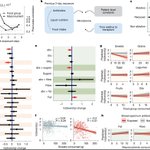
The paper is overall quite interesting, but essentially what it found was that, on antibiotics, the gut microbiome diversity was reduced if sugar was consumed vs no sugar. Outside antibiotic treatment, there was no change.
These are of course correlations and not causality, but it’s nevertheless impressive the rigor and level of depth with which this study was done.


People who underwent stem-cell transplantation and ate sugar-rich food had disrupted communities of gut microorganisms during antibiotic treatment.
go.nature.com/4jwALof

it’s never too irrelevant to apologize about AI Slop & mathematicians are the most clear communicators


wtf is this way to handle mathematicians work and scientific communication
TLDR: Leven and Tristan worked over several months on one of the Millenium Prize Problems with various AIs to reach final interesting results. OpenAI apparently heard about it in the last days and prompted their latest models to work on the direction Leven and Tristan found fruitful. They then tried to push for controlling communication of the result and dropping Leven from authorship with some very bad taste social pressure.
Hope this is not a glimpse of the future we’ll get in science research with these dominating players playing marketing games hurtful for the real scientific community.

Simona Cristea retweeted

wow so much drama about navier stokes. had no idea things could blow up so infinitely in such a finite time.
funny comments here, most researchers going like “not surprising to me…”





there aren't many times in oncology when nobody cares about statistics, but today is one of them. there has never been such a successful trial in pancreatic cancer & these survival curves are the result of 40 years of persistence.
KRAS inhibitors will forever transform oncology

🌟This is history
⭐️The most awaited abstract
👏 Standing ovation at Hall B1
💊 Daraxonrasib becomes the new standard of care for patients with previously treated metastatic #pancreatic #cancer
#ASCO26


alphaevolve has the highest potential to transform science as a whole, across fields: bio, materials, psychology etc

Algorithms are part of nearly every aspect of life, from the physics of the natural world to planning shipping routes.
Our Gemini-powered coding agent AlphaEvolve has been accelerating progress over the last year - from quantum and biotechnology to logistics and @Google’s AI infrastructure. ↓ goo.gle/4uzfe0C