
Founder | Builder
India
Joined October 2009
- Tweets1.3K
- Following1.5K
- Followers440
- Likes2.5K





Ajay Singh retweeted

AI can write smart contracts fast, but it can't be the last line of defence.
At @EFDevcon Mumbai, I representing @QuillAudits_AI shared with @develpgmbh on how teams should ship code in the Age of AI.
My PoV: Attackers might have the upper hand right now, but defensive AI is catching up fast too.
Full Interview Below 👇
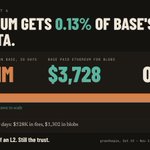
In the last 30 days, Base users paid $2.81M in fees.
Base paid Ethereum $3,728 for data availability.
That's 0.13%.
Before 2024, data was the biggest cost of running a rollup. Here's what changed, and why it still matters.

1
34
Which leaves the obvious question: if Ethereum gets 0.13% for data, who keeps the rest? That's Part 5.
This is Part 4 of reading L2s.
If Ethereum DA is this cheap, should any rollup still use a DA committee?
1
2
Data: growthepie, Oct 19 – Nov 17, 2026 (fees paid, blob costs, total L1 costs). Margin figures from Galaxy Research on rollup economics after Dencun. growthepie.com

3
Two ZK rollups. Two optimistic rollups.
Only the optimistic ones are Stage 1.
I scored Arbitrum, Base, Taiko and Linea on the two jobs every rollup does, using ETHBEAT (formerly L2BEAT) data. The proof type wasn't what separated them.

2
3
78
One caveat: stages measure who you have to trust, not whether a chain is safe. All four still have a no-delay upgrade path through a council or multisig.
When you look at an L2, do you check the proof type first, or who's allowed to use it?
1
28
Data: ETHBEAT (formerly L2BEAT), project pages for Arbitrum One, Base, Taiko Alethia and Linea, read Nov 16, 2026. ethbeat.org/layer2s/summary

1
32
1/
Four places an L2 can hurt you.
When a chain says "decentralized", the useful question is: which layer?
A rollup is four jobs you trust someone with, and each has a different worst case. Ranked by what they can do to your balance:

1
36
7/
The sequencer gets the headlines. Your money sits in layer four.
Part 1 covered the two jobs every rollup does. This is what that model leaves out: the keys that can overrule both.
Which layer do you check first?
1
7
link to part 1 - xitter.gq/singhajaysingh/status/…

Every rollup is two jobs.
Verification: how does Ethereum know the state is valid? Sequencing: who decides the order of transactions?
Pick one answer for each and you can read any L2's trade-offs straight off.
Here is the model.

4