
Dammit, Jim, I'm a Doctor, not a Provider. As with my Medical Opinion, my Tweets are my own. I do not speak for anyone other than myself.
Joined October 2009
- Tweets125K
- Following3.2K
- Followers3.6K
- Likes27.2K





Art Fougner PGY50 retweeted
Government needs to have total control of the satellites that it uses for military and national security purposes. These are core functions of government. No private citizen should ever have a personal veto over how we conduct wars or gather intelligence.


Art Fougner PGY50 retweeted

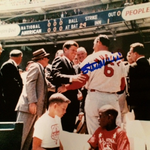
"An Unexpected Guest at Shea Stadium"
Mets fan Michael Sergio drops into Game 6 of the 1986 World Series by parachute during the top of the first inning.
October 25, 1986
Art Fougner PGY50 retweeted

NEW: Robert Reich calls for the "defunding" of Elon Musk, calls for Democrats to go after Musk's companies.
"Democrats ought to [start] laying the groundwork for nationalizing Starlink & SpaceX... It should be a public corporation."
Does he want Musk to drop another $50M on the midterms?

Metastasis

Time for #HCR Part Deux


Art Fougner PGY50 retweeted

NYC City Council are a bunch of communist slobs who've never built anything, never met a payroll, and never made a dime they didn't take from someone else.
Last night they passed COPA, and they did it quietly, because cowards always do.
Here's their scheme. Own a building and want to sell it? You now have to beg City Hall for permission first. Then you wait while their hand-picked cronies get first crack at your property. Only after that do these clowns let you sell your own building.
Don't buy the "nonprofit" label either. These buyers are certified by the city, chosen by the city, and bankrolled by the city. When the government picks the buyer and writes the check, the government is the buyer. It's a land grab dressed up as charity.
My family fled Cuba on a fishing boat when I was seven. I know these people. They always start with "helping tenants," and they always end up owning everything while the buildings crumble.
These freeloaders are strangling small landlords, chasing off investors, and wrecking the city they claim to love.
As Comptroller, I'll audit every dollar of this racket. New York was built by free markets, not by Council Members who couldn't run a lemonade stand.

NYC Council quietly passes bill that forces owners to give nonprofits first dibs on buying their properties for 90 days trib.al/6gNEct0

Art Fougner PGY50 retweeted

Oct 24, 1821. Burlington, New Jersey. Elias Boudinot dies at 81. He was president of Congress when the war ended, he gave a young Alexander Hamilton a home, and he spent his own money keeping American prisoners alive.
Boudinot was a successful New Jersey lawyer, from a family of French Protestant refugees. In 1773, a teenage immigrant from the Caribbean arrived in New Jersey to go to school. He stayed for a while with the Boudinot family at their home in Elizabethtown. His name was Alexander Hamilton.
When the war came, Washington asked Boudinot to take one of the worst jobs in the army: commissary general of prisoners. He was responsible for American soldiers held by the British. Thousands of them were dying in terrible conditions in New York, in overcrowded jails, churches, sugar warehouses, and the rotting prison ships in the harbor.
Congress had almost no money. So Boudinot borrowed and spent his own, reportedly tens of thousands of dollars, to buy food, clothing, and blankets for the prisoners. He went into British-held New York himself to inspect the conditions and negotiate. It took years for him to get repaid.
In November 1782 he was elected president of the Confederation Congress. He held that office as the war ended. He signed the proclamation announcing the end of hostilities. And in June 1783, when unpaid Continental soldiers surrounded the building where Congress met in Philadelphia demanding their pay, Boudinot moved Congress to Princeton, New Jersey.
He kept serving the new country after the war. He was elected to the first U.S. Congress. Washington then made him director of the United States Mint, a job he held for about a decade.
In his later years he turned to religion and charity. He helped found the American Bible Society in 1816 and became its first president. He also paid for the education of a young Cherokee student, who was so grateful he took Boudinot's name. That student, Elias Boudinot, became the editor of the Cherokee Phoenix, the first Native American newspaper.
Hamilton's first friend in America. The man who fed the prisoners. The president of Congress when the war was won. And almost no one remembers him.

Art Fougner PGY50 retweeted

In 1941, a Spaniard walked into the British embassy in Madrid and offered to spy on the Nazis.
The British turned him down.
So he went to the Germans instead, pretended to be a loyal fascist, and got hired as a German spy. His plan was to lie to them for the rest of the war.
It worked better than anyone could have imagined.
His name was Juan Pujol García. Before the war he had tried his hand at running a chicken farm and a movie theater. He had no spy training. What he had was a deep hatred of both fascism and communism after the Spanish Civil War, and an incredible imagination.
The Germans gave him a codename, invisible ink, money, and orders to go to Britain and recruit spies.
He didn't go to Britain.
He went to Lisbon, Portugal, and made everything up.
Using a tourist guidebook, maps, magazines, newsreels, and a British railway timetable from the library, he wrote long, detailed reports about life in England. Military movements. Morale. Ports.
He'd never been there. He made mistakes. He didn't understand British money. He once reported that dockworkers in Glasgow would do anything for a liter of wine.
The Germans loved him anyway.
Then British codebreakers reading German messages noticed something strange. The Germans were hunting for a convoy that didn't exist, based on a report from some agent in Britain they'd never heard of.
The British went looking for this mystery spy. They found Pujol. In 1942 they finally took him on and brought him to London.
Now he had real help. MI5 gave him the codename Garbo, after the actress, because they thought he was the greatest actor in the world.
Together with his British handler, Pujol built a fake spy network for the Germans. It eventually had 27 imaginary agents. Each had a name, a personality, a job, and a backstory. A Welsh nationalist. A Venezuelan student. A Greek sailor. Some of them recruited their own imaginary sub-agents.
When they needed to explain why one agent had gone quiet, they killed him off. They even put a fake obituary in a Liverpool newspaper. The Germans reportedly paid a pension to his widow.
Who also didn't exist.
Then came D-Day.
Hours before the landings, the British let Pujol send a message warning the Germans that the invasion was coming in Normandy. It was timed so it would arrive too late to matter, but it made him look brilliant.
Three days later he sent the most important message of his career. Normandy was a trick, he said. The real invasion was still coming, at Calais, led by a huge army under General Patton.
That army was fake too. But the Germans believed him.
German forces that could have been rushed to Normandy were held back near Calais for weeks, waiting for an attack that never came.
The Germans were so grateful they awarded him the Iron Cross.
A few months later, King George VI made him a Member of the Order of the British Empire.
He's one of the only people known to have been decorated by both sides of the war.
After the war, afraid of revenge from surviving Nazis, he faked his own death from malaria in Africa and disappeared to Venezuela, where he lived quietly running a shop.
For decades the world thought he was dead.
In 1984, a British writer tracked him down. Pujol came back to Normandy for the 40th anniversary of D-Day and met veterans who had landed on the beaches.
Some of them thanked him.


Art Fougner PGY50 retweeted
Grampa Yogi retired as a player in 1964 after 18 seasons with the #Yankees. As he would say, "These records will stand until they're broken." But I suspect that might be never! #WorldSeries #RepBX 🙏⚾️❤️
🤖 Made with AI

Art Fougner PGY50 retweeted

Cue up the lawsuits.
The government has no business regulating who you can and can't sell your property to.
NYC Council quietly passes bill that forces owners to give nonprofits first dibs on buying their properties for 90 days trib.al/6gNEct0


Art Fougner PGY50 retweeted

You love presenting half truths and expecting everyone to accept the conclusion.
QPA is not interchangeable with actual in-network reimbursement. A published study using Elevance’s own data found QPAs approximately 30% below the corresponding in-network medians—roughly 70% of that benchmark. So “3.5 times QPA” does not establish “3.5 times in-network rates,” much less prove overpayment. Your denominator matters.
The Fifth Circuit explicitly addressed this in August, finding that including non-negotiated ghost rates produced artificially low QPAs. That is a court finding you cannot wave away because the resulting arbitration awards look expensive relative to that benchmark.
Insurers have multiple opportunities to resolve these claims without an arbitration award. They can make a reasonable initial payment, negotiate during the mandatory 30-business-day period, and reach a settlement even after arbitration begins. Arbitration is avoidable through agreement. Insurers have choices throughout this process.
And there is evidence that those opportunities are being squandered. In AFHC’s survey covering 2023, respondents reported insurers failed to reply during open negotiation 37% of the time and made no counteroffer another 34%. That is provider-reported evidence, but it deserves examination instead of being ignored.
The ASA, ACEP and ACR analysis of 2025 federal data found insurers lost by default on 24.5% of line items and submitted offers of $1 or less on 8.2%. Insurer nonparticipation and nominal offers belong in any honest discussion of physician win rates.
Your claim that higher offers barely affect win rates also proves considerably less than you suggest. Successful settlements never enter those arbitration win-rate comparisons. Looking only at cases that remain disputed cannot establish that reasonable offers and meaningful negotiation would fail to prevent arbitration. That is a basic limitation of your analysis.
CMS has also documented actual compliance failures: its Aetna Texas air-ambulance audit found incorrect QPA calculations and failures to provide required disclosures. These problems are documented, not hypothetical.
If insurers want fewer arbitrations, they can negotiate reasonable contracts, make defensible offers, participate in the process and pay what they owe.
Blaming physicians for using the remedy Congress created, while minimizing insurer conduct that contributes to these disputes, is selective storytelling.
