

UO Doctoral Candidate - Economics Health Economist Professional Home Cook WI Sports Enthusiast
Joined September 2015
- Tweets2.4K
- Following559
- Followers326
- Likes11.6K





Yes, lots of work using the timing of the OxyContin reformulation. Evans Lieber & Power is a solid example. Huge literature on triplicates and PDMPs which make it a lot harder to prescribe.
1
20
Matthew Fienup was a rock climbing instructor at some point if I’m not mistaken! [email protected]
286
David M. Hall retweeted

My new book Causal Inference: the Remix comes out in two weeks (Aug 25). It’s with Yale University Press like the mixtape had been. And it’s basically the 2nd edition too, but it has a different title — go figure. The online version is now up!
mixtape.scunning.com

RT @benconomics: I actually agree with statement our recent study does not lay to rest the debate. Debate is health. We still have more t…
This quoted post is unavailable.
Good question, two answers:
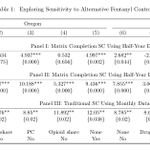
1. That’s what the synthetic control matched on. The states chosen are all late-breaking fentanyl states when we run structural break tests.
2. We do run a western US only comparison and it’s robust to that.
1
16
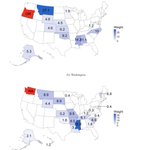
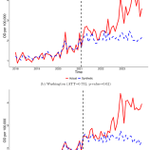
Robust to many different synthetic controls but these are the main weights.
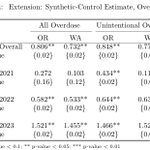
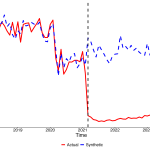
The results are pretty comparable (29 and 23.8% of OD 2021-2023 are attributed to regime change). And while both OR and WA decriminalized, they did so in very different ways.

1
17
We use a synthetic control, so the comparison is much broader than another bordering west state.
In terms of effect size difference, it’s a similar estimate. 30-40% of deaths from 2021-2023 are due to the regime change. The outcome is a per capita which ensures comparability.
19
Yes, nationally it was the case that overdoses peak in 2023. But I disagree it is impossible to disentangle other effects: in fact, a national shock would be the easiest to “remove” using fixed effects. Any other macro effects you’re thinking of? Feedback is genuinely welcome!
2
22
Whether the results fit your priors or not, I hope we've given you a transparent look into how hard a question like this is to assess. We continued to try to challenge these results with robustness checks, but they continued to hold up.
A few final notes:
1. We study the net effect of broad decriminalization regimes in Oregon and Washington, not any single mechanism.
2. The appendix reconciles prior studies.
3. A full GitHub replication package will be available soon.
1
4
104
12/ Bottom line: across Oregon and Washington, and across many robustness checks, decriminalization was followed by sustained increases in overdose mortality relative to matched counterfactuals.
Future work will look more directly at mechanisms, deflection, and related outcomes.

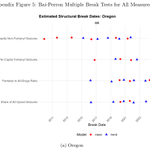
11/ Across these measures, the structural-break evidence is similar when allowing for one break. We also show results allowing for multiple breaks.
And importantly, the SCM often places weight on late-fentanyl-arrival states anyway (weights in blue rings).


10/ We examine some alternative measures, including:
a. Fentanyl reports per-capita
b. Fentanyl share of all opioid seizures
The second measure is useful because it may better capture the transition from heroin to fentanyl.


