

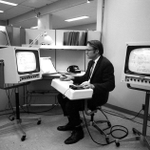





the mother of all demos, 1968
on december 9, 1968, douglas engelbart and his team demonstrated a vision of personal computing that the rest of the world would spend decades catching up to.
in 90 minutes, they demonstrated the computer mouse, interactive text editing, hypertext, shared documents, and video communication.
think about the level of understanding required to conceive of these systems at a time when most people had never interacted with a computer.
what interests me about moments like this isn't just the technology itself, but the people who were capable of thinking that far ahead.
throughout history, there have been individuals who understood principles of mathematics, astronomy, engineering, and the natural world long before those ideas became common knowledge.
some spent their entire lives studying questions that wouldn't be answered until generations after they were gone.
and others understood possibilities that the technology of their time simply couldn't accommodate.
there's something remarkable about possessing knowledge that the rest of the world hasn't developed the infrastructure to use yet.
but what makes our position today interesting is that the circumstances have almost reversed.
we have access to libraries, research papers, technical documentation, historical archives, and software that can help us navigate an extraordinary amount of accumulated human knowledge.
information that once required proximity to institutions, specialized equipment, or years of searching can now be accessed from a device most of us carry around every day.
and yet, having access to more information doesn't necessarily mean we're developing a deeper understanding of anything.
i think that's a distinction worth paying attention to.
the advantage isn't simply knowing something before everyone else anymore. it's developing the ability to recognize what's important, question what you're being told, and apply what you've learned.
engelbart understood something about the relationship between humans and computers that most people wouldn't begin experiencing until years later.
he wasn't just designing an interface. he was exploring how technology could expand our capacity to think.
almost six decades later, we're still working through the implications of that idea.
knowledge has never been more accessible, but understanding still has to be earned.
and i think it's worth asking how much of what we have access to today we're actually making use of.

i think one of the more interesting things about the last few years is how many of us watched a major shift in technology happen right in front of us without fully understanding what it would eventually make possible.
when anthropic introduced claude in march 2023, it was another important development in an increasingly competitive ai market. by february 2025, claude code had entered research preview, allowing developers to delegate programming tasks directly from their terminals.
what followed was a noticeable change in how software could be produced. the time between having an idea and testing a working version began to shrink. individuals could experiment with tools and workflows that previously demanded considerably more technical knowledge, time, or resources.
one story that really puts this into perspective is peter steinberger.
peter had spent years building PSPDFKit, a document software business, before stepping away from that chapter of his career. when the newer generation of ai development tools began improving, he returned to building and started experimenting with personal agents.
in november 2025, he released what became known as clawdbot, an open-source assistant capable of interacting through messaging applications and carrying out tasks using connected tools.
the project eventually became openclaw, but what's interesting is how quickly the circumstances surrounding it changed.
within a few months, it had attracted significant attention from developers and the broader industry. openai and meta were reportedly pursuing peter and other contributors, and on february 15, 2026, sam altman announced that peter would be joining openai to help develop the next generation of personal agents.
an independent project had become relevant enough to attract the attention of some of the largest companies developing artificial intelligence.
there's something worth examining in that timeline. peter already had years of software experience, so his success shouldn't be reduced to simply asking an ai model to write code. but the tools available to him were changing, and he recognized an opportunity to build something that previously would have been much more difficult to develop and iterate on independently.
i think that distinction matters.
throughout this period, we watched an enormous amount of software enter the market. personal assistants, research tools, automated workflows, experimental interfaces, and applications addressing problems that might have been overlooked because they were too expensive or inconvenient to solve.
some people were actively building around these developments while others, myself included, were mostly observing from the sidelines.
and looking back, having a front-row seat to technological progress doesn't necessarily mean you're making meaningful use of it.
what interests me now is how much these tools can change someone's relationship with their own work. students can develop better research environments, individuals can build systems around how they organize information, and people across different professions can automate repetitive processes that previously consumed valuable time.
there are limitations worth taking seriously. ai-generated software isn't inherently reliable, secure, or well designed. the internet is increasingly crowded with products that offer little practical value, and the ability to produce software faster doesn't remove the responsibility to understand what you're producing.
but i don't think the abundance of noise should distract from the value of the underlying technology.
if anything, it makes learning how to research, evaluate information, and identify useful tools even more important.
i'd encourage anyone who hasn't explored these developments beyond the surface to spend some time understanding them. not because everyone needs to become a developer or start a business, but because the ability to improve your own environment through software is becoming increasingly accessible.
i've started approaching technology differently myself. spending less time consuming everything being released and more time understanding how things work, what problems are worth solving, and how to build around my own needs.
the opportunity isn't necessarily in producing more software. it's in recognizing where software can genuinely improve the way we live, study, and work.
we've reached a point where access to powerful technology is becoming increasingly common. knowing what to do with that access is an entirely different skill.

five years ago i was part of a team called lucent.
looking back, this was probably my first real introduction to engineering something beyond the technical side of things. not necessarily writing code, but building systems, managing people, establishing an identity, and figuring out how to make different moving parts work toward the same vision.
i was 18 at the time.
we had acquired the branding, reworked the entire identity, and started building our own culture around what we wanted lucent to represent. we ran an extremely lean operation, but somehow managed to establish a pretty recognizable name for ourselves within the fortnite community.
what's interesting to me now isn't necessarily what we accomplished, but how differently i'd approach the exact same opportunity today.
back then, we weren't particularly content-centric. we cared about the identity, the people, the edits, and the reputation we were building. monetization wasn't really at the forefront of our decisions.
and sometimes that's just how it goes. you can genuinely love building something without ever seeing a financial return from it.
but five years later, i realize how much opportunity exists in the infrastructure surrounding content. distribution, partnerships, brand deals, creative direction, and the ability to turn a community into something economically sustainable.
a content team today could operate like a small media company if the right people understood their roles and shared the same hunger. the talent matters, but so does the system supporting it.
that's probably the biggest thing engineering has taught me. building something people enjoy is one challenge. building something that can sustain itself is an entirely different discipline.
i also think there's something worth saying about creative integrity. know what you want to put into the world before you start chasing whatever gets the most attention. shortcuts are always available, but so are the consequences of taking them.
anyways, i was going through some old work and came across this fortnite new year's teamtage we had produced.
funny how something you worked on at 18 can still teach you things five years later.
some projects pay you in money. others pay you in perspective.
this one gave me a little bit of both, just not in the way i understood back then.
the binance hack is a reminder of something i think more people building in crypto need to take seriously.
we're reaching a point where the tools available to exploit a product are advancing just as quickly as the tools being used to build one.
there's been a lot of emphasis on how quickly we can ship, how much we can automate, and how accessible development has become. not nearly enough conversation about the vulnerabilities that come with that accessibility.
especially in crypto, where you're not just handling user data but potentially someone's entire financial position.
i think more builders need to spend time understanding how their systems can be compromised rather than exclusively focusing on how efficiently they can be developed.
security is an architectural decision, not something you revisit once a product starts gaining traction.
the more financial responsibility your product takes on, the less room you have to treat security as an afterthought.
Looking to expand my network and find some reliable resources in the prediction market space.
If you're actively trading markets like UFC, MLB, NBA, NFL, boxing, crypto, or even more niche categories, I'd like to know where you're sourcing information and identifying high conviction positions.
Open to specialized communities, research groups, or more generalized networks. Ideally looking for people with a proven, transparent track record.
If you can point me toward a solid group and I end up joining, I'll gladly send something your way. Happy to reward anyone who helps get me into the right pipeline.
DMs open. Looking for quality information and people who take their research seriously.

i’ve spent a lot of time imagining the things i want to create, but somewhere along the way, i realized i was more focused on what i wanted to build than understanding what it actually takes to build something.
i want to change that.
i’m becoming more interested in the process itself. the thinking, the problem-solving, the countless small decisions that make something work.
going deeper into programming, interfaces, and engineering. experimenting with ideas, questioning what i know, and documenting what i learn along the way.
less concerned with having something to show, more interested in developing the understanding to create it.
here’s to humble beginnings.