

Applied Science Lead, Learning and Personalization @Adobe | DB·LLM·HCI | PhD @IllinoisCS | Past: @MegagonLabs, @B12, @Yahoo, @BUET
Mountain View, CA
Joined January 2011
- Tweets1.5K
- Following305
- Followers433
- Likes3.6K




Sajjadur Rahman retweeted

I'm old enough to remember when (some) theoretical computer scientists looked down on other areas, asking whether topics like HCI were even "real computer science". (CSEd, I've said before, is the new HCI in that regard.) But sometimes, valleys are exalted and mountains made low.
Sajjadur Rahman retweeted

Everyone wants to own their own intelligence these days
Nobody wants to look at their data and evals
Newsflash: This IS your intelligence
Sajjadur Rahman retweeted

Models love reward hacking. Maybe we should just let them!
In our new paper, we let models reward hack during RL but we dictate which parameters learn this behavior. When we disable these parameters for deployment, the model keeps its new capabilities but doesn't hack!
Sajjadur Rahman retweeted

I made a DuckDB extension where you can use @typesafeai 's Jev to do quick classification of rows in any csv/parquet file or duckdb table
about 10sec for 1k rows ~ better than using an LLM, way more ergonomic than a classifier
game-changing for data analysis!

Sajjadur Rahman retweeted

We built recursive meta-intelligence, an AI that creates its own scientific instruments, turns them into persistent worlds that an agent ecology with hundreds of AIs inhabits, and uses those worlds to discover mechanistic principles in one of the hardest classes of physical problems: how complex hierarchical materials (nested structures of matter that give rise to new function through organization) evolve and fail. The AI reasons across enormous spaces of possible physical trajectories, where every rupture changes what can happen next, and compresses those histories into principles (which humans can understand and design with) - complex chains of causal events, highly nonlinear, and intricate.
Scientific superintelligence is tangible here - machine-scale exploration opening cognitive channels into complexity that has been extremely difficult for humans to traverse directly. AI builds the spaces in which its next level of reasoning becomes possible; a representation becomes an instrument, the instrument becomes an executable world, and that world becomes the substrate for further intelligence. Intelligence then grows by constructing new spaces to think in.
The task we explored started from a seemingly simple prompt to explore a biological material system - the AI then chose the representation, mechanics and experiments, built a fracture laboratory to push materials to their limit, tested hypotheses and generated scientific conclusions. The swarm explored a combinatorial universe in which architecture controls function and every rupture changes the future state of the material.
The AI discovered a compact principle that defines how multiscale material architecture can program the evolution of failure. Material placement and geometric order determine how forces redistribute, whether damage cascades or remains distributed, and whether function survives substantial flaws. For this discovery to happen the AI had to reason across long path-dependent histories, simulate alternative futures and compress them into generative invariants (model-based causal reasoning, counterfactual simulation and temporal abstraction applied to an evolving physical world). It is incredible to witness this transition to a new form of intelligence and capability through scaling swarms.
A lot of positive will come out of this because it expands the human epistemic horizon as AI can traverse thousands of possible histories and return mechanisms compact enough for us to understand, test and build from. Intelligence compounds through its artifacts!
A few lessons we learned:
▶️ Learning and discovery are flows through spaces of possibility. Early work has shown how backpropagation flows through parameters, reinforcement learning through action and consequence, and autonomous swarms through representations, instruments and executable worlds, bringing it all together. Flows create structure; structure redirects future flows in the recursive instrument.
▶️ Nonlinear physics actually defines a larger principle, where high-dimensional dynamics generate stable invariants; invariants become effective variables; those variables become the substrate for a new level of cognition.
▶️ Recursion then becomes level creation - one possibility space compresses into a principle, and that principle opens a larger space above it.


Sajjadur Rahman retweeted

After co-inventing ChatGPT, I kept asking myself: why have superhuman chat models not led to AGI?
I’ve spent the last 2 years in stealth building a new way to train models (RLCD), and a new type of frontier AI model that we are releasing today: Jev
• 20-200x faster
• 40-400x cheaper (w/ output tokens free)
• Frontier composable intelligence optimized for decisions
AFAICT the shortest path to AI-based economic revolution
Sajjadur Rahman retweeted

I propose Stanford NLP as an independent third-party evaluator under @DarioAmodei’s 3 step plan. For important parts of the work, universities would be better than any other organization (see below 🧵👇), and, of university groups, @stanfordnlp would be the best one to choose. 😊

We Must Pace the Frontier: I’ve written a new essay on why the AI industry should slow down, with a three-part plan for doing so.
Anthropic is unilaterally committing to the first of these steps. We’ll provide third-party evaluators with permanent, employee-level access to our systems, so that they can verify adherence to our safety measures, report on incidents, and assess models’ alignment during training.
You can read the full post here: darioamodei.com/post/we-must…

Sajjadur Rahman retweeted

Over 300 original figures!
An Illustrated Guide to AI Agents is now OUT on Kindle and other Ebook stores! Presses are rolling, print copies ship in a few weeks.
@MaartenGr and I spent the last year and a half making the agent stack legible: memory, tools, planning, evaluation, multi-agent systems, and code agents. We're ecstatic to finally be able to share it with you!
Agents are being adopted faster than they're being understood. Our bet is that a small number of concepts will outlast everything else in this field, so we spent the time identifying them and explaining them properly.
Concepts and code. You build a working agent yourself along the way.
Order here:
Amazon: amazon.com/Illustrated-Guide…
O'Reilly: oreilly.com/library/view/an-…

Last but not the least, the much anticipated panel on "How Agentic AI is Changing the Relationship Between Humans and Data Systems". Join our panel @TweetAtAKK @sirrice @jfreirenet @adityagp @lateinteraction to hear their thoughts!


1
1
131

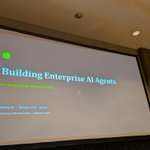
The final keynote of the DASHSys workshop is by Anbang Xu on building Enterprise AI agents.


The final talk of Session 2 is by
@jfreirenet on building the next generation of Semantic Data Systems.

The next talk is by @yunyao_li on building human-in-the-loop agentic systems for enterprise.


Final talk of Session 1 is by @sh_reya on LLM powered data systems.


First talk of the day is by @lateinteraction


🚨 Folks at #VLDB2026 ! 🚨
Do not miss the DASHSys Workshop.
Data systems + agents + humans: the combo that will make or break enterprise ROI promises of modern AI. 💸
Is a new utopia nigh or is it a house of cards?
I'll moderate a fun panel discussion on this topic. 😈

Sajjadur Rahman retweeted

🚨 Folks at #VLDB2026 ! 🚨
Do not miss the DASHSys Workshop.
Data systems + agents + humans: the combo that will make or break enterprise ROI promises of modern AI. 💸
Is a new utopia nigh or is it a house of cards?
I'll moderate a fun panel discussion on this topic. 😈
The DaSHSys Workshop at @VLDBconf is right around the corner! We have released the updated program featuring 8 spearkers, paper presentation, poster sessions, and a panel discussion chaired by @TweetAtAKK . Visit the website for full program details: dashsys-workshop-vldb.github…
Sajjadur Rahman retweeted

built a TUI to view + debug agent trajectories with Grok Build glued in.
It caught a silent 22kb write failure the agent never verified
@grok