

Strategy @OpenRouter. Previously #VC, @MARA, @Krakenfx, @BCG. All opinions are my own, good and bad.
Joined January 2012
- Tweets303
- Following629
- Followers1.7K
- Likes310




Adam Swick retweeted

The biggest lie in AI is that the future belongs to one winner.
Every technology wave starts with one company promising that one walled garden is all you'll ever need. And every time, market forces and creativity break the walls down.
I cofounded OpenSea and now OpenRouter around the opposite bet: humanity will refuse to be locked in.
Intelligence was never meant to belong to one lab, one model, or one gatekeeper.
The future of AI is open, plural, and yours to choose.
So you’re saying there’s still some TAM left…

98% of US households aren't paying for AI yet
More charts in State of Markets II: a16z.news/p/state-of-markets…

AI infrastructure is increasingly about utilization, not just capability. A theoretically incredible chip that spends half its time waiting for data isn’t an incredible economic asset.
AI inference is becoming a logistics problem.
It’s not just how much compute you own. It’s whether you can get the right data to the right compute at the right time without wasting expensive hardware.
Agents change the shape of inference.
Chat was mostly prefill → decode → done.
Agents look more like context → decode → tool → more context → decode → tool, potentially for hours.
KV cache and orchestration become much more important.
A useful mental model for inference economics:
Data sitting idle in expensive memory is cost.
Data moving through memory to generate tokens is revenue.
Makes memory bandwidth vs. memory capacity a much more interesting tradeoff.
open.substack.com/pub/semian…

The US now spends more on data centers and compute than housing.
$752B vs. $748B.
And hyperscaler capex is projected to go from $470B in 2025 → $870B in 2026 → $1.3T+ in 2027.
Kind of insane how quickly the physical buildout for AI is scaling.
fortune.com/2026/09/20/us-ec…

The AI market increasingly has two races happening simultaneously:
How quickly can frontier labs create a new capability?
How quickly can everyone else reproduce it?
Both clocks are speeding up.
AI may end up being a strange software market where the underlying technology gets materially better every few months AND the identity of the best supplier keeps changing.
That creates a lot of value in maintaining optionality.
One consequence of models getting better this quickly: committing your product too tightly to today’s best model looks increasingly risky.
The model you build around today may not be the model you want six months from now.
There’s a big difference between having a technology lead and having a durable technology lead.
If open models can replicate a new capability within months, the frontier labs need to turn those few months into distribution, product adoption and the next technical lead.
Model competition is increasingly going to be fought on price/performance, not just absolute intelligence.
A model doesn’t need to be the best model in the world to be economically disruptive. It just needs to be good enough at a dramatically lower price.
The AI model market is getting harder to describe with a single leaderboard.
Best coding model. Best reasoning model. Best latency. Best price. Best context. Best tool use.
As models proliferate, “best model” increasingly depends on what you’re actually trying to do.
Open models catching up doesn’t necessarily mean frontier labs lose. But it does mean they have to keep inventing the next thing.
If a capability advantage can be replicated in <5 months, standing still gets expensive very quickly.
SemiAnalysis has Kimi ahead of Anthropic on parts of its benchmark composite, but still prefers Claude for actual work.
That’s a useful reminder of how incomplete model benchmarks are becoming.
The model matters. So does everything around it.
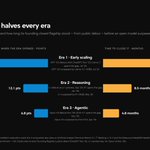
Open models took ~20 months to close the early scaling gap, 8.5 months for reasoning, and under 5 months for agentic models.
That’s a pretty remarkable rate of compression. Makes you wonder where the durable advantage ultimately sits.

One of the more striking charts I’ve seen on how quickly the AI market is moving.
A major new open model every ~10 days.
Hard to imagine this pace slowing down anytime soon.

DeepSeek’s pricing isn’t interesting because it’s cheap.
It’s interesting because it forces everyone else to answer whether inference is actually a commodity.
If the answer is yes, the value shifts away from the model itself and toward everything built around it.
AI adoption and AI efficiency are not opposing goals.
The winning companies will use far more intelligence while becoming increasingly selective about where that intelligence comes from and what they pay for it.
More useful computation. Less indiscriminate computation.