
student of intelligent systems @ pitt. my dream is to collaborate with people from everywhere in the world. please feel welcomed to dm for discussions!
Joined July 2025
- Tweets140
- Following48
- Followers10
- Likes637






ben panny retweeted

A reminder that proteins are highly dynamic molecules.
◼️We have made much progress in measuring & predicting static protein structures, but the dynamics that animate life remain challenging to measure & model.
ben panny retweeted

Quantum states split under magnetic fields (Zeeman effect)—the same physics fusion relies on to control charged particles. Here, color shows wave phase, brightness its strength. Microscopic rules, macroscopic power.
ben panny retweeted

UnsolvedMath - a curated list of 1000+ open math problems for AI to solve.
We've just uploaded to Hugging Face a curated set of unsolved math problems, including 600+ Erdos problems, in a machine-friendly way.
The goal is to have a proper benchmark for Reasoning Models, which can't be incorporated through training.
Any new insights are a good benchmark. Currently GPT 5.2 with Extended Thinking is the leading model by a lot. Tests and whitepaper incoming! Link below.


not awesome:
"Seasonal flu causes a total of 700,000 deaths from respiratory diseases and cardiovascular diseases each year on average."
awesome:
"However, the burden is far lower than in the past due to improvements in sanitation, healthcare, and vaccination."
not awesome:
"The flu also remains a large burden around the world for two major reasons. One is that many people around the world still lack access to healthcare and have low rates of influenza vaccination, which increases the risk of death. Another reason is that the populations of many countries have been aging rapidly. In lower-income countries, the flu could become a larger burden as they face aging populations in the future."
awesome:
"To tackle this risk, the world can take lessons from how the burden has been reduced in the past. One way is to increase the rates of influenza vaccination, as well as other routine vaccinations, which also reduce the risk of severe flu. Another is to improve sanitation and access to healthcare around the world.
We've already seen a huge decline in the burden of the flu over many decades, and with greater efforts, we could see that burden decline even further."
-Saloni Dattani and Fiona Spooner
what's so important to understand about collaboration is that it is explicit when we work directly with people but there is virtually uncountable implicit collaborations we are in every single day
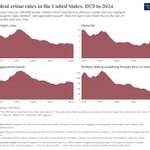
this is fuckin' great, everyone has a lower chance of being a violent crime victim. However, there are still approximately just as many violent crimes (raw total) now as in 1979 when considering the near 50% increase in US population since 1979 till now.

ben panny retweeted

I've been editing this article about "brain mapping" and connectomics, and I'm just stunned by how quickly the cost estimates to map, say, a mouse brain have plummeted in just the last couple years.
It actually seems feasible that we could map the entire human brain -- all 86 billion neurons, and their connections -- in this lifetime.
In the 1970s, Sydney Brenner started mapping all the connections between neurons in C. elegans. His team sliced the worm into thin pieces, took photos using an electron microscope, and manually traced and reconstructed each synapse for 302 neurons total. This project took more than a decade of work, and it cost about $16,500 to reconstruct each neuron. Scaling this up to a human brain boggles the mind.
Electron microscopy remained the norm in connectomics for decades, because it was the only option available to see synapses at a resolution high enough to be able to trace their paths. Each electron microscope costs several hundreds of thousands of dollars, though, and you need lots of them to map even a mouse brain in a reasonable timeframe.
In 2023, the Wellcome Trust released a report estimating how long, and how expensive, it would be to map the mouse connectome (~70M neurons). They estimated that imaging alone would cost $200-300M, and that proofreading (or ensuring that traces between neurons are correct) would cost $7-21 BILLION. (A human can only manually trace about 1 mm of neuron per hour.) Also, the images would occupy about 500 petabytes of data, and getting those data would require 20 electron microscopes running in parallel for about 5 years, continuously. They estimated the whole project would take about 17 years of work.
This is, understandably, insane. But now it seems like there's an actual path toward mapping the full mouse brain in about five years for ~$100M dollars.
There have been three major breakthroughs in the last year or so:
1/ Expansion microscopy, first developed in 2015, showed that it's possible to "enlarge" the brain by about 5x using a swellable polymer. But an improved method increases this number to >20x expansion, meaning we can now expand brains and image neurons much more easily using cheap light microscopes, rather than expensive electron ones.
2/ E11 Bio (a nonprofit research org) developed protein barcodes that get delivered into brain tissue; each neuron gets a unique combination of barcodes. These cells are then stained with colorful antibodies, which stick to a matching protein barcode, causing each neuron to light up in a distinct color. This makes tracing neurons so much easier.
3/ Google Research released PATHFINDER this May, an AI-based neuron tracing tool that can proofread about 67,200 cubic microns of brain tissue per hour, with very high accuracy. It works on electron micrographs, but something similar could be presumably be developed for the E11 / colorful tag approach.
This is an extremely exciting time for neuroscience. (C. elegans connectome below.)
i can't wait for scientific literature and presentations to contain more beautiful figures and diagrams thanks to nano banana