






Berlin, let’s put open models to work!
I’ll be at the @nebiusai booth at @nvidia GTC Berlin, demonstrating how we turn open models into specialized warehouse agents through the Intelligent Warehouse Fine-Tuning Flywheel.
See how warehouse experience becomes training data, how fine-tuning builds domain expertise, and how evaluation and guardrails guide continuous improvement—from inventory and labor planning to responding to operational disruptions.
Powered by NVIDIA AI technology and Nebius infrastructure, the demo connects model customization with a practical goal: agents that understand warehouse workflows, use tools effectively, and operate within business constraints.
Building agents for retail, CPG, manufacturing, or supply chains? Come see the flywheel in action and let’s compare ideas.
Meet me at the Nebius booth. Let’s build the intelligent warehouse of the future!
2
5
6,027
Today, I had the privilege of joining @SanjayBrahmawar on stage as QAD | Redzone introduced Manufacturing Intelligence—a new approach to helping manufacturers make better decisions when reality breaks the plan.
A supplier is late. A production line goes down. Inventory becomes constrained. The information needed to respond usually exists—but it is fragmented across ERP, planning, procurement, the shop floor, and the experience of the people running the operation.
Manufacturing Intelligence brings that context together to understand the disruption, evaluate the trade-offs, recommend the best course of action, and keep people in control of the final decision.
This is also where the AI flywheel becomes powerful:
Operational event → context → reasoning → simulation and optimization → human approval → execution → measured outcome → continuous learning
My interaction with QAD key developers and engineers was powerful and exciting around a specific topic: the next bottleneck is not simply model intelligence—it is coordination intelligence.
By combining QAD | Redzone’s deep manufacturing knowledge and presence across more than 6,000 plants with NVIDIA accelerated computing, AI models, simulation, and optimization, we can help manufacturers turn decades of hard-earned operational knowledge—their ALPHA—into a governed and continuously improving decision capability.
The goal is not to replace manufacturing people. It is to give every planner, buyer, operator, and plant manager the intelligence to see problems earlier, understand their economic impact, and act with confidence.
Keep the ALPHA private. Federate the capabilities. Democratize industrial intelligence.
This is how AI can help power the next era of manufacturing.
1
3
6,104

Just came off stage at ALL IN 2026 in Montréal.
Great panel with Mila, IVADO Labs, Kinaxis & Jamieson Wellness on AI in logistics — speed, resilience, cost.
Autonomous operations aren’t coming. They’re here. The question is who builds the stack first.
Proud to represent NVIDIA. Montréal delivered.


1
4,334
Looking forward to this conversation at Stanford OpenLab with @karenhsumar , BASES and the Stanford OpenLab community.
The next generation of physical AI will not be defined simply by putting more intelligence into robots or connecting LLMs to machines. The real opportunity is to build closed-loop decision systems that can understand the current state of the physical world, predict how that world may evolve, and decide what should happen next within explicit safety, policy, and operational boundaries.
In the work I have been developing around intelligent warehouses, this distinction has become central: the digital twin helps us understand what is happening now, the world model helps us reason about physically plausible futures, and the decision layer determines which future we should pursue. Agents can reason, plan, and propose—but reasoning is not authority. Trustworthy autonomy comes from combining agentic AI, physical world models, optimization, and governed execution.
Excited to discuss what this means for builders creating the next generation of agents, robots, digital twins, and autonomous systems—and why the path from AI to autonomy is ultimately a problem of decision architecture, not just model intelligence.
luma.com/5k4twswi

2
4,802
If you’re heading to #ALLIN2026 next week, I invite you to stop by the Agora stage on September 17th to catch me in a panel session, AI in Logistics and Supply Chains: Speed, Resilience, and Cost.
Looking forward to diving into how we can leverage these innovations in AI to build smarter, more resilient, and cost-effective supply chains.
I'll be joining : Manik Sharma, Emma Frejinger Andre Teixeira and Enrico D. Cremonese for what should be a great conversation on building supply chains that are faster, more resilient, and smarter.
I look forward to seeing you next Thursday, September 17, from the Agora Stage at 1:15 p.m. ET!
ALL IN | 2026 => nvidia.com/en-us/events/all-…

77

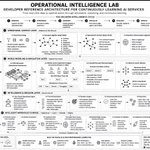
I’ve been building an Operational Intelligence Lab — a living developer environment for exploring how AI services can understand dynamic physical systems, simulate possible futures, orchestrate trusted models, act safely, and continuously learn from operational experience.
The warehouse is the first proving ground.
The work brings together:
Dynamic Agentic Graphs → DES + Monte Carlo → World Models → Agents + Optimization → Operational Experience → SFT/RL → Continuous Learning
This isn’t about proposing another WMS or one monolithic architecture. The goal is to build and eventually open-source a developer blueprint: tools, patterns, experiments and reference implementations for the next generation of operational AI.
I’m documenting the journey openly through a series of articles on Operational Intelligence Lab.
Here is my latest notes: open.substack.com/pub/tarikh…
More experiments, architecture, code—and eventually the open-source blueprint—coming.
The next frontier of AI isn’t only answering questions. It’s understanding the world, exploring what could happen, making better decisions, and learning from what actually happened.

6
10,862
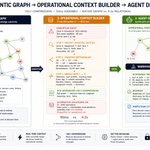
Assembling operational context from a relational database takes 4.2 seconds. From a native graph structure, it takes 50 milliseconds.
That is not a performance optimization. It is the difference between a system that can and cannot operate at the speed warehouse decisions are actually made.
The Agentic Graph — G=(E,R,T,L,D) — is the representation layer that makes real-time operational AI possible. Five components: entities carrying live state, active relationships between them, real-time telemetry attached to both, a four-hour event trace, and a history of decisions made in comparable situations along with their outcomes. Not a knowledge graph that was built once and periodically refreshed. A continuously updated model of what is operationally true right now.
What the agent reasons over is not the full graph — it is a dynamically assembled subgraph called the Operational Context Graph, extracted at 100:1 compression by the Operational Context Builder in under 50ms. The OCB identifies the entities causally connected to the current disruption, traverses their dependency chain, enriches the subgraph with telemetry and event history, and delivers a decision-ready context. The agent never sees the whole facility — only the part that matters for this decision.
One architectural detail worth adding: the graph is hybrid. Entities, relationships, and telemetry are structured graph data — precise, queryable, inspectable. The event log and decision history are embedding-indexed — because finding comparable past situations is a semantic similarity problem, not a structural query. The graph handles now. The vector index handles memory.
An AI agent with the right context makes better decisions. That is the entire argument. Full post here: lnkd.in/g5jRW76E
#SupplyChain #AIEngineering #GraphML #WarehouseAI #EnterpriseAI #OperationsResearch
🤖 Made with AI

2
2
115
One of the biggest bottlenecks in advancing Agentic AI isn’t the reinforcement learning algorithm itself.
It’s the engineering complexity.
Every time researchers introduce a new reward function, estimator, rollout strategy, or training pipeline, they often end up modifying thousands of lines of distributed infrastructure instead of focusing on the science.
This is why I found NVIDIA’s new Molt framework particularly interesting.
Instead of treating RL infrastructure as a massive software engineering problem, Molt takes a different approach:
1- Pure PyTorch-native architecture
2- Compact enough to understand end-to-end
3- Asynchronous training for multimodal and MoE agents
4- Strict policy consistency (never trains on tokens it didn’t generate)
5- Comparable performance to significantly more complex distributed training stacks
To me, this represents something bigger than another RL framework.
It reflects a broader shift in AI:
The future belongs to frameworks that optimize researcher iteration speed, not just GPU throughput.
This resonates strongly with the work I’ve been building around continuous learning flywheels for operational systems.
Whether we’re training warehouse agents, manufacturing copilots, or enterprise decision systems, success won’t come from a one-time fine-tuning pipeline.
It will come from rapid experimentation:
• Generate synthetic experiences
• Fine-tune efficiently
• Evaluate continuously
• Reinforce successful behaviors
• Deploy updated policies
• Repeat…
The faster we can complete this loop, the faster AI systems evolve.
The infrastructure itself becomes a competitive advantage.
Excited to see research moving in this direction. Simplicity is often the catalyst for innovation.
Paper from NVIDIA Research: Molt: A Scalable PyTorch-Native Training Framework for Agentic Reinforcement Learning (arXiv): arxiv.org/pdf/2607.21653
#AI #AgenticAI #ReinforcementLearning #PyTorch #LLM #NVIDIA #OperationalIntelligence #MachineLearning #OpenSource #ContinuousLearning

2
103
Welcome to the Operational Intelligence Lab
For the past year, I’ve been exploring a simple question:
What if AI systems never stopped learning?
Most enterprise AI is trained, deployed, and eventually retrained. But warehouses, factories, and supply chains don’t stand still—they evolve every minute.
Over the coming weeks, I’ll be publishing a series of articles documenting the architecture behind what I call the Operational Intelligence Flywheel—a continuously learning AI Factory that combines operational context, simulation, Agentic AI, reinforcement learning, digital twins, and world models to improve decision-making over time.
This isn’t just theory. It’s based on real engineering work, prototypes, customer engagements, and lessons learned while working with industry developers building AI systems for industrial operations.
Along the way, I’ll share:
Architectural deep dives
Original diagrams and reference architectures
Research on Operational Intelligence and Physical AI
AI Factory design patterns
Agentic Graphs and World Models
Practical engineering lessons
The evolution toward continuously learning industrial systems
My goal is simple: make these ideas accessible to architects, engineers, researchers, and technology leaders—and help establish a common blueprint for the future of industrial AI.
As the work matures, I also plan to release an open-source reference implementation of the architecture, providing developers with a practical starting point for building continuously learning operational AI systems.
If you’re interested in the future of AI beyond chatbots—where systems understand, simulate, predict, and continuously improve in the physical world—I hope you’ll join me on this journey.
Welcome to the Operational Intelligence Lab. The next generation of AI is built through operational experience:
open.substack.com/pub/tarikh…. #OperationalIntelligence #PhysicalAI #AgenticAI #AIFactories #IndustrialAI #SupplyChainAI #DigitalTwins #WorldModels #ReinforcementLearning #WarehouseAutomation #EnterpriseAI #NVIDIAAI
Supply chain is the only enterprise AI domain that simultaneously demands high decision frequency, high consequence per error, high operational variability, and high interdependency. Each of those properties individually makes AI harder to build and deploy. Together, they constitute an operating environment that breaks the assumptions underlying most enterprise AI architectures. #logistics #operationalintelligence #Agenticsystems open.substack.com/pub/thdev/… – at Kalaoa, HI

85
The future of AI isn't bigger models. It's systems that continuously learn from operational experience.
Today I'm launching Operational Intelligence Lab—a place to explore AI Factories, Physical AI, Digital Twins, World Models, and the future of industrial AI.
This is the journey toward continuously learning operational intelligence. AI That Forgot the Warehouse open.substack.com/pub/thdev/…
#OperationalIntelligence #PhysicalAI #AgenticAI #AIFactories #IndustrialAI #WorldModels #NVIDIAThe
64
The first wave was about language models—systems that can read, write, and reason over text. The next wave is about world models and action models—AI systems that learn how the physical world works, predict future states, and determine the optimal sequence of actions before taking them.
This is a fundamental shift from predicting the next token to predicting the next state of the world.
NVIDIA’s Cosmos 3 is an important milestone in this direction. By combining reasoning, world simulation, and action generation into an open multimodal foundation model, it enables developers to build robots, autonomous vehicles, industrial agents, and warehouse systems that can perceive, simulate, plan, and act in physically grounded environments. developer.nvidia.com/blog/de…
What’s particularly exciting is that this isn’t happening in isolation. Across the industry, we’re seeing convergence:
• Yann LeCun’s vision around JEPA and latent world models argues that intelligence comes from learning predictive representations of the world—not simply generating text. Recent investments around this thesis demonstrate how seriously the industry is taking this direction.
• Google DeepMind continues advancing interactive world simulation with Genie.
• Fei-Fei Li’s World Labs is focused on spatial intelligence and 3D world understanding.
• NVIDIA is pushing an open ecosystem around Physical AI with Cosmos, enabling World Action Models (WAMs) that bridge perception, reasoning, simulation, and control. nvidia-cosmos.github.io/cosm…
For enterprise AI, this has profound implications.
In supply chains, manufacturing, and robotics, the future won’t simply be AI assistants answering questions. It will be AI systems that maintain an internal model of the operational world—a living representation of assets, constraints, workflows, and physics—allowing them to reason, simulate, optimize, and execute before acting.
This is where digital twins, graph-based representations, reinforcement learning, and world models begin to converge into a new generation of Physical AI.
The next decade of AI won’t just understand language.
It will understand—and interact with—the world.
#AI #PhysicalAI #WorldModels #ActionModels #EmbodiedAI #Robotics #SupplyChain #Manufacturing #DigitalTwins #NVIDIA #JEPA #AgenticAI

Stanford should have a world class compute infrastructure with Tokens to bootstrap creativity for each student at Stanford, that’s the only way we keep our nation R&D competitive advantage. Cut a billion $ right away …
76
Honored to participate in the annual innovation event hosted by @Prologis in the beautiful town of Charleston.
What stood out most was the energy in the room — leaders, operators, technologists, and innovators deeply focused on the future of industrial infrastructure, logistics, energy, and supply chain transformation. The conversations were not just about warehouses or facilities; they were about building the intelligent foundation powering the modern economy.
One of the most powerful realizations from the event is this: Real estate is no longer just physical space. When connected with AI, data, automation, robotics, and energy intelligence, it becomes a strategic platform that maps value across the entire supply chain ecosystem — from manufacturing and fulfillment to transportation, inventory flow, and ultimately customer experience.
The convergence of industrial real estate, digital infrastructure, and AI-driven operations will define the next era of global competitiveness. The opportunity ahead is massive.
A big thank you to the entire Prologis team for the outstanding hospitality, the world-class organization, and for bringing together such an exceptional group of leaders and innovators. Truly inspiring. @ToriDeems @wbodonnell @WalterKemmsies @richardteachout @avihou @FreightAlley #innovation #supplychain #AI #automation #physicalai #prologis #nvidia


Most people watch platform shifts from the outside.
I’m watching this one get built.
Working in Developer Relations at NVIDIA means you don’t just hear about the technology — you sit inside the decisions about how it reaches the world.
And what I keep coming back to isn’t the scale. It’s the architecture of the conviction.
Long before AI was loud, NVIDIA was making bets that looked strange:
→ GPUs for general compute, not just graphics
→ CUDA as a developer platform, not just a toolkit
→ Simulation and physical AI as a foundation, not a feature
None of those were obvious. All of them compounded.
What we’re building now — AI factories, accelerated inference, agentic systems that close the loop between decision and execution — that isn’t a product cycle.
It’s the payoff on decades of disciplined platform thinking.
The developers writing on top of NIM today are standing on 20 years of that infrastructure.
I’ll be honest about something:
Working inside a shift this large forces a question you can’t ignore.
Am I operating at the level this moment requires?
Not in terms of output. In terms of depth. Curiosity. Willingness to stay uncomfortable.
But here’s what I’ve come to believe:
No individual carries a platform shift. These moments are collective — built by people who push the boundary consistently, quietly, over time.
The privilege isn’t being the one who built it.
It’s being in the room where it’s being built.
Grateful. Grounded. Back to work.
#AI #NVIDIA #AcceleratedComputing #DeveloperRelations #AIFactory #Leadership
67
School taught you what to think.
College taught you how to think.
AI gives you the power to think at scale.
The scarce resource isn't information anymore — it's the tokens to reason over it.
🧵👇
1
59
A PhD student with a $100 API budget can now run experiments that used to require a team of 10 and six months.
A founder in Lagos or Lahore with the same token budget has the same reasoning power as a Stanford lab.
But only if they can afford the tokens.
1
40
The next great equalizer won't be free education.
It'll be free compute.
The countries, companies, and communities that figure this out first will define the next era.
We democratized information. Now we need to democratize thinking.
#AI #GenAI #NVIDIA #FutureOfWork #AIForAll
37