

A research lab by @MBouchardCrim and his graduate students @sfucriminology. Tweeting about #networkedcriminology.
Burnaby, British Columbia
Joined January 2018
- Tweets289
- Following215
- Followers508
- Likes849






Here's "Betweenness to assess leaders in criminal networks" by R.Grassia, @FraCalderoni, M.Bianchi, & A.Torriero: sciencedirect.com/science/ar…!
Check out @cmsmith_soc's new paper in @asr_journal, "Exogenous Shocks, the Criminal Elite, and Increasing Gender Inequality in Chicago Organized Crime": journals.sagepub.com/doi/ful…

After taking a long break, we're back! Check out "Robust link prediction in criminal networks: A case study of the Sicilian Mafia" by @FraCalderoni et al.: sciencedirect.com/science/ar…
1/4
The investigation found that mafia organizations can control and reduce ordinary crime, but smaller, less structured groups cannot. The authors suggest that weakening mafia-type groups requires official authorities to improve their standing as providers of security.
This weekend, check-out this study that examines the capability of mafia-type groups to prevent ordinary crimes and provide security by @AlbertoAziani, @SerenaFavarin and @CampedelliGian of @Transcrime
doi.org/10.1177/002242781989…
This weekend, checkout by this study on police misconduct networks in Chicago by @_georgewood, @droithmayr and @AVPapachristo doi.org/10.1177/237802311987…


This weekend, take a look at @Chad_Whelan’s research on occupational culture in security networks dx.doi.org/10.1080/10439463.…
Police, intelligence, and security officers are interviewed to investigate organizational culture.
It is that time again--your weekend read this week is Group Cohesiveness, Gang Member Prestige, and Delinquency and Violence in Chicago 1959-1962 by Lorine Hughes onlinelibrary.wiley.com/doi/…
Contrary to expectations, the author found increased levels of violence
Weekend reading: Brokering between (not so) overt and (not so) covert networks in conflict zones by Patrycja Stys et al tandfonline.com/doi/full/10.….
The authors use a ego-net analysis and a multilevel exponential random graph model to
This week check out recent work done by @c_stadtfeld @aaavoros and Károly Takács: “The Emergence and Stability of Groups in Social Networks” examining the role of negative ties in group formation and persistence. 1/4
sciencedirect.com/science/ar…
@c_stadtfeld explains the results here: xitter.gq/c_stadtfeld/status/119… and so instead here we will reflect on the implications for illicit networks. Conflict ties play a major role in structuring organized crime networks through violence, intimidation, territory etc. 2/4

Structural groups in social networks are often characterized by a high proportion of negative ties between them. Could negative ties help explaining the emergence and stability of groups? Our new paper in #SocialNetworks (with @aaavoros and Károly Takács)
sciencedirect.com/science/ar…

1
1
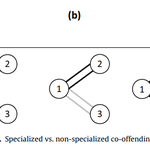
And we’re back! “This week check out Overlapping crime: Stability and specialization of co-offending relationships” by Grund & Morselli (2017). sciencedirect.com/science/ar… 1/2

This week we are at #ASCSF19, lots of great network presentations across the 4 Networks and Crime panels! @MBouchardCrim @GravelJ
This week check out Carlo Morselli’s 2001 paper: “Structuring Mr Nice: Entrepreneurial opportunities and brokerage positioning in the cannabis trade” exploring how an ego can leverage their brokerage position for criminal achievement (link.springer.com/article/10…). 1/2

This week check out Criminal Careers in Organized Crime and Social Opportunity Structure by Kleemans & de Poot (2008) looking at how social ties influence criminal opportunities and age of onset for organized criminal activity.
researchgate.net/profile/Chr…
Check out "Connected in crime: The Enduring Effect of Neighborhood Networks on the Spatial Patterning of Violence" by @AVPapachristos & @sarabastomski :journals.uchicago.edu/doi/ab…
1/3
Check out "Neighborhood isolation in Chicago: Violent crime effects on structural isolation and homophily in inter-neighborhood commuting networks" by C. Graif, A. Lungeanu, & A. M. Yetter
A 2-for-1 on bid-rigging & collusion in construction!
"Bid-rigging networks & state-corporate crime in the construction industry" by M Reeves-Latour & C Morselli: sciencedirect.com/science/ar… & "Network similarity & collusion" by C Morselli & @ML_Ouellet: sciencedirect.com/science/ar…
1/3
Check out "Link Prediction in Criminal Networks: A Tool for Criminal Intelligence Analysis" by @GBerlu, @FraCalderoni, N. Parolini, M. Verani, & C. Piccardi: journals.plos.org/plosone/ar…
1/3
📚 Link to an interesting paper recently published in Global Crime that looks at the influence of social media on the dissemination of civil violence using an agent-based model.
Have a look 👉
tandfonline.com/doi/abs/10.1…
Hey #illicitnetworks community,👉Interesting review on co-offending networks, illicit networks, gang-rivalry networks, and neighborhoods and crime
by K. Faust and G.E. Tita
Definitely worth reading 📚
annualreviews.org/doi/full/1…