

Inequality, economic history and policy. UU, SAIS, CUNY and UCONN. Also passionate fan of hopeless football/soccer team (no, not ManUtd).
Joined August 2017
- Tweets92
- Following2.5K
- Followers1.9K
- Likes298



Pinned Tweet
Social tables are a treasure trove of information - easy to fall into a Rabbit Hole. One example: Mean income of a forestry inspector was higher than for a banker in 1863 Prussia. See my new paper featuring German Social Tables: osf.io/preprints/socarxiv/2f…

Philipp Erfurth retweeted

Historical social tables: advantages, methodology, and problems
A new papee by Erfurth, Gomez Leon, Gabbuti and Milanovic
ehes.org/wp-content/uploads/…
Philipp Erfurth retweeted

📢 New III working paper:
This paper provides a methodological contribution to the study of historical income inequality by examining the construction and use of social tables for the nineteenth century.
@BrankoMilan @GGabbuti @Maria0zmg @theErforce
buff.ly/2LWqOwU

Philipp Erfurth retweeted
"Historical social tables: advantages, methodology, and problems",
a new paper by P. Erfurth, M. Gómez León, G. Gabbuti & B. Milanovic
researchonline.lse.ac.uk/id/…
Philipp Erfurth retweeted

Social tables are widely used 🌍but how comparable are they across countries and over time? 📚In a new working paper (with @theErforce @Ggabbuti @BrankoMilan) we explore social tables… methodology, advantages, and problems ehvalencia.es/wp-content/upl…
Philipp Erfurth retweeted
Just out.
New Working paper on the use social tables to study historical inequality; their advantages, problems, methodology;
by @theErforce , Maria Gomez Leon, Giacomo Gabbuti and myself.
stonecenter.gc.cuny.edu/publ…
Philipp Erfurth retweeted

How unequal was a rural society in the Roman Empire? A new WP by Philipp Erfurth @theErforce examines income inequality in rural Roman Egypt in 1st century using daily social tables that build on data from papyri.
bit.ly/4aniP7l

Publication alert🚨
Paper 2/3 of my PhD now out! How did unification in 19th century impact income inequality in DE and IT? Using new social tables for Germany, I study balance of power between core & periphery in newly unified states.
Find out more here: doi.org/10.1016/j.irle.2024.…

This was previously out as Stone Center Working Paper #46 - so many thanks to
@stone_lis as well as all colleagues providing invaluable comments and suggestions!
Philipp Erfurth retweeted
Delighted to give my first "foreign" talk on "Visions of Inequality" in Mexico City.

Fue un placer tener a @BrankoMilan presentando su nuevo libro en #SobreMéxico 🤓🤓 Pronto el video de la presentación


Philipp Erfurth retweeted
The 1848 Revolution is possibly one of the most interesting episodes for class/social analysis. It is not surprising that in the Cagé-Piketty book it gets much analyzed, incl. Tocqueville's and Marx's writings on it.
See this:
globalpolicyjournal.com/blog…


New WP alert 🚨 In new #LIS WP, I find evidence of regional inequality convergence using @lisdata disaggregated at subnational/regional level. Convergence is associated with unitary rather than federal state systems.
Check out the full paper here: lisdatacenter.org/wps/liswps…

Bracing for a summer-Twitter-feed full of: Shame on <insert airline name> for cancelling my flight to <insert destination>! Will never fly with <insert airline name> again!
Boxer at rest - Incredible ~4th century BC Bronze statue on Display at Palazzo Massimo in Rome. Visited the Massimo several times and never more than a few dozen people. When in Rome avoid the crowds at Trevi Fountain and go see the Boxer (and amazing Roman mosaics)..

Philipp Erfurth retweeted

📌Join us tomorrow at 5pm CET for a YSI #econhist discussion with @theErforce on the Income Inequality and Unification in 19th Century Italy and Germany
We are excited to welcome @GGabbuti as a chair for this session!
Registration: bit.ly/3tWiRRS
See you online!

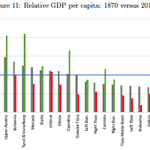
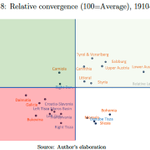
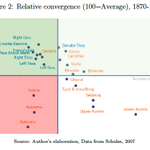
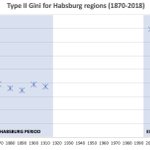
!New WP Alert! In my new Working Paper, I examine regional inequalities in Habsburg regions from 19th century until today. The findings provides a (small) glimpse at economic history of Central and Eastern Europe through lens of convergence in the past 150 years. A thread 1/n
Lastly, from 2000-2018 there is significant evidence of convergence. Yet despite convergence and EU cohesion policy, a large number of regions is still well below their relative levels of 1870 and overall inequality across regions today is still well above levels in 19th century.

Check out and download the full Working Paper here: osf.io/preprints/socarxiv/86….