

ur favorite viral video is ONE Claude prompt away ;)
Get my FREE skills
Joined August 2013
- Tweets784
- Following63
- Followers2.3K
- Likes1.4K


5.4M views on a Short about a tower squeezed between bridge ramps
make one like it with this Claude prompt ↓
<inputs>
Ask me 3 things, then wait:
1. The building: one famous building with a strange shape or an awkward site ("the Flatiron", "Sydney Opera House"). If I say "you pick", pitch 3 with the one design problem each is known for and take the first unless I choose.
2. The voice. Default: Kokoro (free, runs on my computer), a quick dry male narrator: blend am_liam and am_puck 50/50 (average the two voice style arrays), speed 1.15. Optional upgrade: ElevenLabs with a stock library voice. I keep my own key in a .env file and tell you where it is. Tell me the credit cost before you generate.
3. Music. Default: none. If I have an instrumental track, I put it in this folder as music.mp3 (the Shorts this style comes from run steady music under the voice, near 136 beats a minute).
Then tell me everything else is free and installs itself into this folder: a Python venv with Playwright + headless Chromium, kokoro-onnx (+ kokoro-v1.0.onnx and voices-v1.0.bin from the kokoro-onnx GitHub releases), faster-whisper (small.en), imageio-ffmpeg, numpy, Pillow and soundfile, plus three.js from npm (npm i three; without Node, save three.module.js and three.core.js from a CDN into the folder) and Poppins-Bold.ttf from the google/fonts GitHub repository (ofl/poppins). It needs no API key or account and never opens Blender.
</inputs>
<direction>
The look: a real city rebuilt in three.js code, low-poly but full to the horizon, filmed by a drone that never stops. One real building gets designed in front of the viewer, one decision at a time. The city behind the building counts as much as the building.
THE CITY
- Look the place up on a map first. For about 400 m around the site, model what is really there: the street pattern, the water, bridges and raised roads, parks. Add the neighbours people would know, each at its real height. A neighbour taller than the hero stays taller.
- Beyond that, fill the land to the horizon in every direction the camera looks: 2,000+ buildings on a street grid, 30 to 200 m tall, taller and tighter toward the real downtown. Open water, a far shore, hills or desert go in where the real place has them. Bare ground never reaches the horizon.
- Every building shows its floors. Build the city as a few merged meshes with wall UVs in metres (u = metres along the wall / 3, v = metres up / 4) and small repeating canvas textures, so a window is the same size on every tower: grey-blue glass #8FA3AE to #6F8794 with lighter lines, pale stone #CFC8B6 with dark window rows, a few in dark glass. Lines about 10% of a cell wide, mipmaps on and anisotropy 8, or the grid shimmers. Lighter flat roofs with one or two plant boxes. One tower in ten is round, stepped or L-shaped.
- Roads #8F9296 with white lane dashes and crossings, pavements #D8D4C6 lifted off the road, street trees (green blobs #5F9A4E, dark cones #3F6B45), parks #A8D25A, water #3F84A3 with a few boats. Bridges and raised roads stand on piers.
- Life: 300+ cars, buses and trucks driving the roads the whole time. Black peg people (a cylinder and a ball head, no faces) walk the pavements near the site.
- Light: a hemisphere light (about 1.5-2.2 in current three.js) plus one sun (about 1.5-2.3), about 40° up and off to one side, so every tower lays a shadow across a street. No tone mapping. Tune on stills until the sunlit side of a white block reads white. Sky #EAF4FB and a pale haze that fades the far city to about half by the horizon.
THE BUILDING
- The wrong version comes first: a plain cream block #F4F2EC with fine floor lines grows out of the plot in 1.5 s and is shown failing.
- Every fix is a visible change to the SAME model on the word that names it: a block lifts, splits, tilts, floors stack, parts slide in. Something on the model changes at least every 1.5 s.
- A part stays cream only until its move is settled. Then it gets its real skin at once (glass with mullions, stone, steel) and keeps it. From the middle of the video most of the building is dressed. The last third shows it finished, with its entrance, its roof and the street at its foot.
- Rules and problems are drawn as geometry: the plot outlined in sand yellow #E9C46A, a see-through red volume #E4572E for "not allowed" or "this fails", red arrows for forces, wind as white streaks across the frame, a see-through white wedge for a shadow or a protected view. Hidden structure is shown by x-ray: the shell fades to a 25% ghost with thin edge lines and the part lights up orange #F08A3C, only on the faces turned to the camera. For things under the ground, the ground over the site turns to glass the same way (cut that patch out of the road plane).
- People: when a problem lands on the people inside, push in to ONE window: a room with a few furniture boxes and a peg person, plus a white speech bubble with one drawn icon.
- Numbers: every measure or count in the script (metres, stories, tons, degrees, years, how many) appears once as a label ("22 m", "400 t", "45°"): a white pill with dark 40 px text, drawn on the 2D canvas at a point projected from the scene, with a dimension line where it measures something. Labels stay clear of the centre of the frame, where the caption sits.
THE CAMERA
- Never still: fly-ins, orbits, rises, push-ins and pull-backs, every move eased. A hard cut on the first word of each beat goes to a different height AND a different distance.
- Lens: a tall frame is narrow sideways, so use a wide one. Vertical field of view 55-65° for city and skyline shots, 40-50° on the building, 35° at the least.
- The horizon is in the frame for at least half of the video, with towers standing against the sky. In those shots the camera tilts down 15° at most.
- Use each of these shots at least once:
- fly-in (the opening): starts 800+ m out and 250+ m up with the city to the horizon, then flies down a road or over the water toward the plot
- skyline: 40-150 m up and 250-500 m from the building, the building among its neighbours, sky across the top, a road with traffic in front
- street: 2-10 m above a pavement, looking up at the building while cars and people pass close
- plan: straight down on the plot, for outlines, setbacks and areas
- x-ray: the hero angle with the shell ghosted
- window: the push-in to one room
- detail: one part fills the picture
- finale: an orbit of the finished building in its city that ends low behind a peg person looking at it, the skyline behind
- To keep the building's base in view, pick vantage points down a street, across water or over a park. Move the camera and leave the neighbours at their real height. The camera flies over streets or above roofs and stays out of buildings.
- The 7:8 band: the middle 1234 px of the frame's height (64%) is what a 7:8 crop keeps. The horizon, every label and every key action stay inside it. A shot of the whole building holds it at 35-60% of the frame's height.
CAPTIONS
- ONE word at a time, Title Case, white Poppins Bold, 58 px on the 1080 px-wide frame, a dark stroke under the white fill (canvas lineWidth 11) and a soft shadow, no box, at the exact centre of the frame. Each word replaces the last on its spoken time. Numbers are words in the captions and digits only on the labels.
Banned: photos, footage, map tiles, downloaded 3D models or textures, logos, AI images, AI video, real people on screen. Also banned: any hum, drone or pulse made in code as background sound.
</direction>
<structure>
52-59 s, 175-195 words (about 200-210 words a minute once the pauses are squeezed). The voice starts at 0.0 s. No intro and no title card.
- Second person, present tense: the viewer is the designer ("you lift", "you hide").
- Line 1: the brief and the awkward constraint in two short sentences ("Your client wants a 59-story tower on this block. One problem: a church owns the corner."). Frame 1 is already inside the fly-in with the plot lit up. The first block starts growing by second 5.
- Then 6-8 beats of 3-11 s. A beat is one problem with its fix ("But corners with nothing under them want to drop. So you hide steel V shapes inside the walls."). Problems open with "But", "Trouble is," or "One problem:". Fixes open with "So you" or "Then you". Each fix is a real design move with its real number, in plain words, with an everyday comparison where it helps.
- If the story has a famous twist (a crisis, a late fix, a walk-out), it is the last two beats.
- The last line names the building for the first time ("And that is the tower you designed: Citicorp Center, in New York."). It plays over the finale shot.
- No call to action, no "imagine", no "did you know".
Title = "How Citicorp Center was designed", with my building's name in it. The cover is the finished building in its city.
</structure>
<build>
Save every stage to disk so a crash never costs more than one stage.
- sources.md: every design fact on TWO independent sources, with both links and the date you read them. A fact with one source stays out. Where the sources disagree on a number, use the wording both support. Add the map facts you built the city from (street names, neighbours and their heights, where the water is).
- script.json: the lines grouped in beats. Each beat lists what the model does, its shot (the name from the list, camera height, distance and lens) and the labels.
- voice.py: Kokoro reads the script one beat at a time; trim each take at about -45 dB (keep 30 ms before the first sound), squeeze every silence to 0.3 s at most and join the beats with 0.28 s gaps. faster-whisper (small.en, temperature 0) times every word, one beat's take at a time with 0.4 s of silence around it (hand it a 16 kHz numpy array). Captions use the SCRIPT's words with whisper's times: align the two word lists, spread a digit token's time over the spoken number words (whisper writes "104" and "meters") and give every word at least 0.12 s on screen. Write words.json and beats.json (a beat starts on its first word). The video ends 1.3 s after the last word.
- With the ElevenLabs upgrade: ONE request for the whole script (model eleven_multilingual_v2, the stock voice I name, speed 1.05-1.15, character timestamps, 24 kHz PCM). python-dotenv loads the key from my .env inside the process; the key never goes into code, a log, a file or a command line. The timestamps say where each beat starts and ends: cut the take in the middle of the gap between two beats, then treat every beat exactly like a Kokoro take (same trim, squeeze, gaps and whisper timing). If two whisper passes agree a word is wrong, ask me before a second take. If the request fails, show me the HTTP status and message and offer the free voice.
- scene/index.html + main.js, three.js imported from the local copy by its relative path. One function builds the city and every part of the building. One function state(t) sets every part, label and the camera from the time alone: the same frame for the same t on every run (seeded random, never a clock or requestAnimationFrame). Every animation starts on a word looked up in words.json ("lift" in the beat "legs"), never on a typed-in second, so a new voice take moves everything with it. window.renderFrame(f) draws frame f at 2160x3840, scales it down onto a 1080x1920 2D canvas, draws the labels and the caption word on top and returns a PNG data URL. window.shotTable() returns, for the start, middle and end of every shot: camera height, distance to the building, tilt, lens, how many buildings are inside the view and where the horizon sits in the frame.
- render.py: serves the folder on 127.0.0.1 (ES modules do not load from file://), opens the page in headless Chromium at 1080x1920 (set PLAYWRIGHT_BROWSERS_PATH and whisper's download_root if the browser and the models should live in this folder too) and saves frames/f_00001.png onward, skipping frames already on disk. Launch Chromium with --enable-gpu --ignore-gpu-blocklist and --use-angle=d3d11 on Windows (metal on a Mac), then print the WebGL renderer string. On a graphics card a frame takes well under a second. On the software fallback it takes many seconds: there, render at 1080x1920 with antialias on and tell me.
- Stills first. Print the shot table and add the share of sky pixels in each still. Fix before going on: a fly-in or skyline shot with under 300 buildings in view or with no sky inside the 7:8 band, a horizon total under half the video, a shot from the list that is missing, two cuts in a row from the same height. Then make a contact sheet with a frame every 2 s and the 7:8 band drawn on every tile. Look at every tile and fix any where the city looks like blank boxes or empty ground. Then check the busy beats every 0.5 s. Only then run the full render.
- sound.py, numpy only, writes separate tracks and then the mix: audio/voice.wav, audio/effects.wav (a soft thud or pop when a part lands and a tick for each counted item, nothing on the cuts) and, only if I gave you music.mp3, audio/music.wav (from 0.0 s to the end with the last 1.2 s faded, 18 dB under the voice's speech level, the same level under the words and in the pauses). Effects sit at least 16 dB under the voice (compare their loudest 50 ms with the voice's speech level). Master the mix to -14 LUFS (measure with FFmpeg's ebur128).
- Encode with FFmpeg, sound as AAC at 192 kb/s: out/<slug>_9x16.mp4 (1080x1920, 30 fps, yuv420p, TV range, BT.709: scale=in_range=full:out_range=tv:out_color_matrix=bt709 plus -colorspace bt709) and out/<slug>_7x8.mp4 (the centre 1080x1234 of the frame scaled to 1008x1152, two-pass at about 1,050 kb/s to stay under 10 MB), plus out/cover.png: the finished building in its city without a caption. Measure the true peak on the encoded files (ebur128=peak=true): a lossy encode can overshoot, so lower the mix until both read -1 dBFS or less.
</build>
<gotchas>
- Facts: the famous version of a design story is often half wrong. Check every number. Write a claim that later studies dispute as what the designer's own numbers said.
- Scale: work in metres (a story is about 4 m, a person 1.8 m, a car 4.5 m, a bus 12 m). The tiny cars and people are what make the building look big.
- Windows: check on a still that the grid reads on a tower 300 m from the camera. Towers that look like blank boxes need thicker or lighter lines.
- Shadows: one directional light with a 4096 shadow map. Its box follows each shot's target and covers about 1,200 m, so the near city casts shadows too. Use THREE.PCFShadowMap (current three.js dropped the soft variant) with a small bias and normalBias, or flat roofs get stripes.
- Flicker: nothing coplanar. Lift pavements 0.3 m off the road, lane marks 0.1 m and the plot outline 0.6 m. Set the camera's near plane per shot (2 m at street level, 20 m or more in the aerials) and the far plane at 9,000 m. Give flat ground layers a polygonOffset.
- X-ray: ghost materials need transparent with depthWrite off and the orange structure a lower renderOrder than the shell. Show the structure of the two faces turned to the camera only: all four at once is a tangle.
- Wind: place the camera so the streaks cross the frame. Seen along the wind they turn into dots.
- Labels: clamp every pill inside the frame. Pin a label that would sit above the building just above the caption instead.
- Voice: if whisper hears a different word in a Kokoro take, reword the line instead of slowing down (words that sound the same count as the same word). A word that ends in d, s or t right before a similar sound gets swallowed ("designed Citicorp", "ends slide"), so put a pause between them or reword.
- Camera: never cut in the middle of a word. Keep every move slow enough to read the picture (an orbit turns 25° in a beat at most).
- Tools: imageio-ffmpeg ships without ffprobe, so read a file's streams with ffmpeg -i.
- Check: run a black-frame and one-frame-flicker check on the frames. Make a contact sheet of the finished video (a frame every 0.5 s) and a second one from the 7:8 file. Look at every tile: the city reads in the first 2 s, every fix is visible on its word, every label is whole and readable, the horizon shots show towers against the sky, the finished building with its base is inside the 7:8 frame. Fix and render again.
</gotchas>
<start>
Pitch (or take my building), then show me: the facts with their two sources, the script with the word count and the seconds per beat, then the shot list (per beat: what the model does, the shot's name, camera height, distance and lens, whether the horizon is in the frame, which labels show). Build nothing until I say go.
</start>
paste it into Claude Code in an empty folder, answer its 3 questions and say "go"
i typed "the Leadenhall Building" and picked an ElevenLabs voice (needs ur own key, the music was added after)
it took about 90 minutes on a PC with a graphics card
what it made is in the first reply
save this and pick ur building

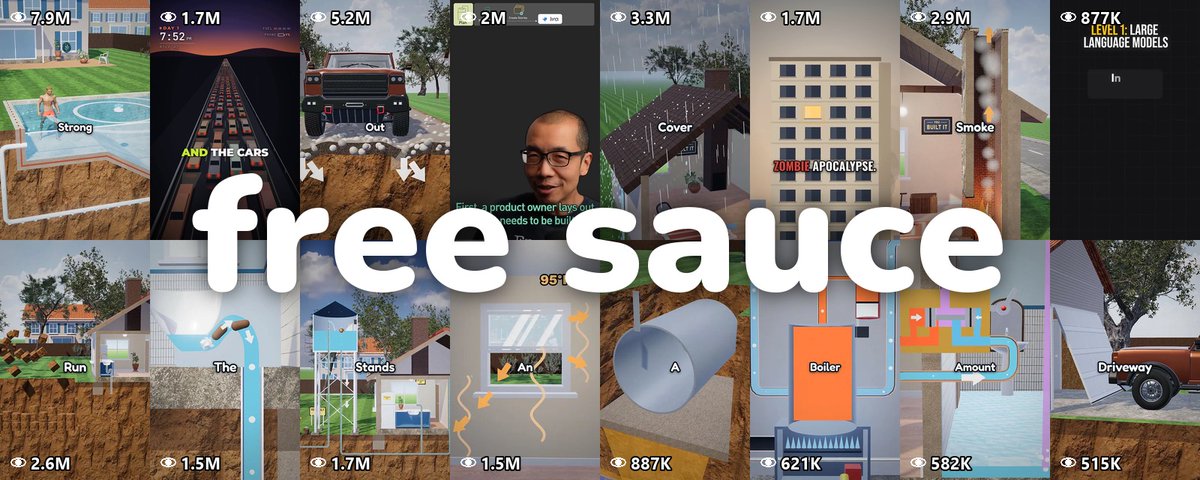
8.8M views on a backyard hole becoming a swimming pool
then Low Poly Films turned the same backyard idea into:
-> a skate bowl 4.4M
-> a bumper car arena 2.6M
(11 other versions got 29K to 237K)
make ur own with the free Claude guide in the article below

he bought an old house and found skeletons in sleeping bags
20 Zack D Films Shorts in a row each passed 2.5M views
the prompt below tells a story Zack's way: the strangest moment first, one new action per sentence, the reason LAST
save it for ur next Short
255M views on a 3D Short by Zack D. Films
i tried to rebuild his style with ONE Claude prompt, then ran it on Opus 5.5 and Fable 5.2 (they did NOT make the same Short)
the full prompt is below ↓
paste it into Claude Code in an empty folder and answer its 2 questions. it shows u the script and waits for ur go. u need Blender + its free MPFB add-on and a graphics card. give it a few hours (the prompt is minus one optional paid-voice line)
<inputs>
Ask me 2 things, then wait:
1. The story in one line: a strange TRUE event where one person did one odd physical thing ("He tied 42 weather balloons to a lawn chair."). If I say "you pick", pitch 3 with one source link each and take the first unless I choose.
2. The voice. Default: Kokoro (free, runs on my computer), a calm, warm male narrator.
Then tell me everything else is free: Blender (find my install, or tell me the one download), its free MPFB extension for human bodies (ask me before you install it) and into this folder a Python venv with FFmpeg (imageio-ffmpeg), kokoro-onnx + its model files (kokoro-v1.0.onnx and voices-v1.0.bin from the kokoro-onnx GitHub releases), faster-whisper (small.en), numpy and Pillow. It needs no API key or account and renders on my graphics card with EEVEE.
</inputs>
<direction>
The look: a clean, realistic 3D world, like a good game cutscene. Bright, saturated, a little filmic.
- People: realistic bodies with generic faces and big readable expressions (shock, a smirk, a scream). Plain clothes, no logos. Never a real person's likeness: for a real person keep the face out of close-ups (hands, back, side, distance, straight top-down).
- CALM shots only. Bodies in fast action or contact (running, jumping, fighting, falling) look stiff, so tell the story with frozen moments under a slowly moving camera, macro inserts of hands and objects, rooms, vehicles, the sky, top-down views and the aftermath.
- One new picture for every caption chunk (2-4 words, about 1-1.5 s): a new framing, a new action or a camera move. Nothing ever holds still: every shot drifts, pushes in or orbits.
- The shot kit: macro insert (extreme close-up of the key object or hands, very shallow depth of field), hero low angle (wide lens at waist height), god's-eye top-down with a slow rotate, tracked object, over the shoulder, smash zoom on the word that matters, whip pan between beats, glow highlight (the named object glows orange with a rim, then fades), a big 3D number lying in the scene, a thought bubble (a cloud ring showing what he hoped for), a TV in the scene replaying the event.
- Light: a bright warm sun, blue sky with clouds, soft shadows. Night scenes use hard lamps and a dark sky. Wide lens up close, depth of field on every shot, motion blur on every fast camera move.
- Captions: 2-4 words at a time, white bold rounded sans, about 64 px on a 1080 px-wide frame, centred, 78% down the frame, soft dark shadow, no box. Each chunk replaces the last on the same frame as its picture.
- Banned: real footage, photos, downloaded textures or 3D models, logos, AI images or AI video, downloaded music, gore.
</direction>
<structure>
38-50 s, 100-140 words, 150-180 words a minute. The voice starts at 0.0 s.
- Line 1: the most surprising physical act, in past tense, opening with "He" (or "She"). No name, date or setup. Frame 1 shows that act.
- Then a cause-and-effect chain: every sentence starts with a hinge word (Then, Suddenly, So, Because, But, Later) and is ONE visible action.
- The context arrives late, after "You see,".
- A reveal: someone looks closer and the story turns.
- The last line is the consequence. No call to action, no question.
- Names are rare: use one only when it pays off.
Title = "He ..." or "The Man Who ...". The cover is the first frame.
</structure>
<build>
Save every stage to disk so a crash never costs more than one stage.
- sources.md: every fact with its link and the date you read it. Anything you can't verify stays out.
- script.json: the lines and the caption chunks cut by hand (2-4 words, one picture each), each chunk with its shot: the set, the camera, what moves.
- voice.py: Kokoro reads the whole script in one take (speed 1.0-1.1) and pauses are squeezed to 0.35 s at most; faster-whisper times every word (pass it a 16 kHz numpy array, not a path); write chunks.json with each chunk's start and end. A picture and its caption switch together on frame round(start*30)+1.
- blender/: Python scripts run headless (blender -b -P). build.py makes one .blend with the sets, the cast, the props and every shot baked with a key on every frame. look.py sets EEVEE with ray tracing, the AgX view with the Punchy look, motion blur, depth of field and bloom in the compositor. Bodies come from MPFB or are built by you; clothes, hair, props and sets are built in code.
- Stills first: one half-size still per shot as a contact sheet. Look at every tile and fix what's off before any full render. Time one full-size frame and tell me the estimate.
- Render 1080x1920 at 30 fps to PNG frames, skipping frames already on disk.
- sound.py, numpy only: a light music bed, a sound on every action (a whoosh on each whip pan, hits, wind, room tone), ducked under the voice, mastered to -14 LUFS on the whole stereo mix.
- compose.py: burn the captions in from chunks.json. Encode out/<slug>_9x16.mp4 (1080x1920, 30 fps, TV-range yuv420p) and out/<slug>_x_7x8.mp4 (1008x1152, under 10 MB, 2-pass): a crop of the 9:16 frame that keeps the subject and the caption.
</build>
<gotchas>
- Blender paths: pass absolute output paths (a relative one lands on the drive root).
- MPFB headless: enable it with addon_utils.enable("bl_ext.user_default.mpfb"). Bake a body's shape keys before you pose it: the rig is fitted to the baked shape.
- Clothes: cut them from the body mesh and push them 7-16 mm out along the normals; keep two rings of body faces under every hem.
- Nothing coplanar: keep every resting object 1 cm off its neighbour and draw ground markings into the texture, or they flicker.
- Hair: EEVEE draws hair only from a Curves object, hair type STRIP. Use a Principled BSDF on it (the Hair BSDF renders black).
- Skin: keep subsurface weight near 0.2 (more turns faces black in EEVEE) and add a soft fill light from below under a noon sun.
- Hands: a curled hand reads as a claw from the palm side, so shoot a grip from behind the knuckles.
- Motion blur: shutter position START, a key on every frame, plus a key half a frame after each shot's last frame, so blur never reaches across a cut.
- Check: run a black-frame and one-frame-flicker check on the render. Make a contact sheet (a frame every 0.5 s) and look at every tile: the act reads in the first 2 s, faces are lit, nothing clips through anything, captions stay off faces and key objects. Then step through the first 2 s, the middle and the end frame by frame. Fix, render only the changed shots again.
</gotchas>
<start>
Pitch (or take my story), then show me the script with the word count, the caption chunks with their seconds and the shot list with what the first frame shows. Build nothing until I say go.
</start>
how the two runs went: one run each on the same PC, so it's one sample, not a ranking. both took under 3 hours on one shared 8 GB graphics card. the story for both: a man who tied 42 weather balloons to a lawn chair in 1982
where they split:
-> Opus opened wide on the balloons over the yard. Fable opened on the man kneeling at the chair with his Jeep behind him
-> Opus put 5 big 3D numbers in its scenes, Fable 2
-> Fable followed the caption spec (white text, soft shadow). Opus went ALL CAPS with a thick outline
-> Fable pulled the Smithsonian's own record and ended on the chair in the museum. Opus ended on the $1,500 fine
-> a few Opus shots are hazy and one opens on a blank grey frame
save this for ur next Short. who did it better, Opus or Fable?
the 3 guide links in this article stopped working, here are the right ones ↓
-> backyard what-if Shorts: theoardley.orderly-oak.worke…
-> stickman survival stories: theoardley.orderly-oak.worke…
-> lecture explainer reels: theoardley.orderly-oak.worke…
(paste this article's link on the page to open them)

2
267
Theo retweeted
ive generated $2M in verified leads (IN 2 MONTHS) for brands here's my story
9 months ago i didn't know how to make money online
a friend of mine got me into b2b company's whole X operation
that didn't work & eventually they let us go
the company that dropped me came back with an offer later and i said no
i started another operation with another brand & got them $2M in verified leads within two months (ran fully by me)
i'm launching my saas soon & scaling it, follow along to see my journey
animated the whole thing arcane style w/ claude
i went from "how to make money online" to solo running a B2B company's X operation that brought in $2M worth of verified leads in 2 months
i'm 18, no one knows who i really am and in June i leave for the army
this is my full story:
back in February i had no idea how to make money online. my IRL friend invited me to an X operation getting leads for a big B2B SaaS
as a clueless teenager i was excited of course, but what i didn't know back then was that X is one of the hardest platforms to grow on and i was terrible at it
i kept failing for months. i got told i was terrible and pressured to "get better", but nobody ever told me HOW
then the company dropped us. they said we hadn't found success and they had better creators
so i went on my own, grew a second account, started getting ghostwriting offers and had my first 5-figure month
after months of working on it every single day, i suddenly found myself giving the feedback, coaching 8 people on their articles and posts
the company that dropped us came back and offered me a spot. i said no (i remembered how it went the first time)
then i got a bigger offer from another B2B company, they had 15 to 20 creators, 300K views a month and almost zero leads
they let me run the whole X side alone (the hardest customers on the hardest platform)
so i gave them the one thing i never got: real feedback on every single post
first month: around 15M views and $1M worth of verified leads
second month: another $1M (their own system counted it)
i met @finnardley there. he introduced me to agentic AI systems and AI UGC and taught me a lot about ecom marketing
i became his X mentor, he's the MOST talented guy i've taught
and that's when it clicked: if i can do this for a company, i can do it for myself
2 months in i left and started this account from 0, it hit 2K followers in 3 weeks (1.4M views so far, picture below)
Finn started at the same time and he's almost at 5K
3 things that grew this account:
-> get feedback on every post before it goes out. i still do it to this day (even this one got rewritten after my friends read it)
-> put everything into one article and keep quoting it. mine got 553K views and 5,207 saves, it's 2 weeks old and still gets over 20K views a day (my quotes of it get over 4x my normal posts)
-> put a price next to free. my article quotes without a price got 2K to 10K views, the 2 that said what someone else charges got 33K and 46K
which brings me back to the clock
in June i go serve in the army for 6 to 12 months and i'll rarely have time to post or build
2 things HAVE to be live before i leave: my app (it's in review) and my SaaS (on the home stretch)
bookmark this before u start ur next account
follow along if u want to see what i ship before the clock runs out
20M views on a Short about old soda bottles
so i got Claude to make this one in the same style from ONE prompt
i picked the title and it did the rest
the full prompt is free, link in the reply ↓
"Why Old Soda Bottles Couldn't Stand Up" got 20M views
the channel is only 6 weeks old
and its titles like this one get 13x the views of its other ones
3 title formulas u can steal (each with an example):
1. the old problem
-> "Why Old Soda Bottles Couldn't Stand Up" (20M)
-> "Why Vending Machines Used to Take Washers" (15M)
-> its typical title with "Used to" or "Old" got 5.3M
-> its typical title without them got 389K
my guess: u use the thing every day and never knew it used to fail
the formula: Why + an everyday thing + "Used to" or "Old" + what went wrong
use it when ur video is about an everyday object
try: "Why Elevators Used to Need a Driver"
2. the small start, big finish
-> "How a Big Hole in the Backyard Becomes a Swimming Pool" (8M)
-> "How a Hole on a Beach Becomes a Tsunami Tower" (11M in under 4 days)
my guess: the title shows the start and the end, so u watch for the middle
the formula: How a + something plain + Becomes + something huge
use it when ur video shows something being built
try: "How a Hole in the Ground Becomes a Skyscraper"
3. the beginner mistake
-> a chess Short starting "Never Play F6 On Move 2" got 2M
(it opens up ur king)
-> the channel's other 4 Shorts from that first week ALL stayed under 120K
my guess: people click to check they aren't the one making it
the formula: Never + the mistake beginners make
use it for any skill with a classic beginner mistake, like cooking or driving
try: "Never Pour Water On a Grease Fire"
the catch: a formula won't save a weak idea
-> that chess channel used "Never" 8 more times
-> the next 2 already dropped, to 972K and 467K
-> 5 of the 6 after that stayed under 100K
-> the pool channel has 38 other "Becomes" titles
-> 25 of them got under 100K
so save the formula for ur strongest idea
bookmark this for ur next title

the prompt: theoardley.orderly-oak.worke…
and the one that writes the titles: theoardley.orderly-oak.worke…

211
"Why Old Soda Bottles Couldn't Stand Up" got 20M views
the channel is only 6 weeks old
and its titles like this one get 13x the views of its other ones
3 title formulas u can steal (each with an example):
1. the old problem
-> "Why Old Soda Bottles Couldn't Stand Up" (20M)
-> "Why Vending Machines Used to Take Washers" (15M)
-> its typical title with "Used to" or "Old" got 5.3M
-> its typical title without them got 389K
my guess: u use the thing every day and never knew it used to fail
the formula: Why + an everyday thing + "Used to" or "Old" + what went wrong
use it when ur video is about an everyday object
try: "Why Elevators Used to Need a Driver"
2. the small start, big finish
-> "How a Big Hole in the Backyard Becomes a Swimming Pool" (8M)
-> "How a Hole on a Beach Becomes a Tsunami Tower" (11M in under 4 days)
my guess: the title shows the start and the end, so u watch for the middle
the formula: How a + something plain + Becomes + something huge
use it when ur video shows something being built
try: "How a Hole in the Ground Becomes a Skyscraper"
3. the beginner mistake
-> a chess Short starting "Never Play F6 On Move 2" got 2M
(it opens up ur king)
-> the channel's other 4 Shorts from that first week ALL stayed under 120K
my guess: people click to check they aren't the one making it
the formula: Never + the mistake beginners make
use it for any skill with a classic beginner mistake, like cooking or driving
try: "Never Pour Water On a Grease Fire"
the catch: a formula won't save a weak idea
-> that chess channel used "Never" 8 more times
-> the next 2 already dropped, to 972K and 467K
-> 5 of the 6 after that stayed under 100K
-> the pool channel has 38 other "Becomes" titles
-> 25 of them got under 100K
so save the formula for ur strongest idea
bookmark this for ur next title
Theo retweeted

im about to hit 5k followers on my first 20 days on X
i would not be even close to where i am without this guy
most talented X mentor ive had, follow his story
after what he taught me, i have so many great post ideas over the course of the day to the point where i dont wanna lose them
now i always pull up my phone notes to save my ideas multiple times every single day
i went from "how to make money online" to solo running a B2B company's X operation that brought in $2M worth of verified leads in 2 months
i'm 18, no one knows who i really am and in June i leave for the army
this is my full story:
back in February i had no idea how to make money online. my IRL friend invited me to an X operation getting leads for a big B2B SaaS
as a clueless teenager i was excited of course, but what i didn't know back then was that X is one of the hardest platforms to grow on and i was terrible at it
i kept failing for months. i got told i was terrible and pressured to "get better", but nobody ever told me HOW
then the company dropped us. they said we hadn't found success and they had better creators
so i went on my own, grew a second account, started getting ghostwriting offers and had my first 5-figure month
after months of working on it every single day, i suddenly found myself giving the feedback, coaching 8 people on their articles and posts
the company that dropped us came back and offered me a spot. i said no (i remembered how it went the first time)
then i got a bigger offer from another B2B company, they had 15 to 20 creators, 300K views a month and almost zero leads
they let me run the whole X side alone (the hardest customers on the hardest platform)
so i gave them the one thing i never got: real feedback on every single post
first month: around 15M views and $1M worth of verified leads
second month: another $1M (their own system counted it)
i met @finnardley there. he introduced me to agentic AI systems and AI UGC and taught me a lot about ecom marketing
i became his X mentor, he's the MOST talented guy i've taught
and that's when it clicked: if i can do this for a company, i can do it for myself
2 months in i left and started this account from 0, it hit 2K followers in 3 weeks (1.4M views so far, picture below)
Finn started at the same time and he's almost at 5K
3 things that grew this account:
-> get feedback on every post before it goes out. i still do it to this day (even this one got rewritten after my friends read it)
-> put everything into one article and keep quoting it. mine got 553K views and 5,207 saves, it's 2 weeks old and still gets over 20K views a day (my quotes of it get over 4x my normal posts)
-> put a price next to free. my article quotes without a price got 2K to 10K views, the 2 that said what someone else charges got 33K and 46K
which brings me back to the clock
in June i go serve in the army for 6 to 12 months and i'll rarely have time to post or build
2 things HAVE to be live before i leave: my app (it's in review) and my SaaS (on the home stretch)
bookmark this before u start ur next account
follow along if u want to see what i ship before the clock runs out
Theo retweeted
i went from "how to make money online" to solo running a B2B company's X operation that brought in $2M worth of verified leads in 2 months
i'm 18, no one knows who i really am and in June i leave for the army
this is my full story:
back in February i had no idea how to make money online. my IRL friend invited me to an X operation getting leads for a big B2B SaaS
as a clueless teenager i was excited of course, but what i didn't know back then was that X is one of the hardest platforms to grow on and i was terrible at it
i kept failing for months. i got told i was terrible and pressured to "get better", but nobody ever told me HOW
then the company dropped us. they said we hadn't found success and they had better creators
so i went on my own, grew a second account, started getting ghostwriting offers and had my first 5-figure month
after months of working on it every single day, i suddenly found myself giving the feedback, coaching 8 people on their articles and posts
the company that dropped us came back and offered me a spot. i said no (i remembered how it went the first time)
then i got a bigger offer from another B2B company, they had 15 to 20 creators, 300K views a month and almost zero leads
they let me run the whole X side alone (the hardest customers on the hardest platform)
so i gave them the one thing i never got: real feedback on every single post
first month: around 15M views and $1M worth of verified leads
second month: another $1M (their own system counted it)
i met @finnardley there. he introduced me to agentic AI systems and AI UGC and taught me a lot about ecom marketing
i became his X mentor, he's the MOST talented guy i've taught
and that's when it clicked: if i can do this for a company, i can do it for myself
2 months in i left and started this account from 0, it hit 2K followers in 3 weeks (1.4M views so far, picture below)
Finn started at the same time and he's almost at 5K
3 things that grew this account:
-> get feedback on every post before it goes out. i still do it to this day (even this one got rewritten after my friends read it)
-> put everything into one article and keep quoting it. mine got 553K views and 5,207 saves, it's 2 weeks old and still gets over 20K views a day (my quotes of it get over 4x my normal posts)
-> put a price next to free. my article quotes without a price got 2K to 10K views, the 2 that said what someone else charges got 33K and 46K
which brings me back to the clock
in June i go serve in the army for 6 to 12 months and i'll rarely have time to post or build
2 things HAVE to be live before i leave: my app (it's in review) and my SaaS (on the home stretch)
bookmark this before u start ur next account
follow along if u want to see what i ship before the clock runs out
it's funny how people don't realize how far ai has improved over the years
i turned the whole ai era into a 45 second pop-up book
7 models, what each one did better, and where each one fell short
the first one hit 1M users in 5 days while making things up w/ full confidence
tips for using today's models in the reply
1
6
1,028
claude animation is F*CKING cracked
u can now make paper pop-up book animation like these with claude
u can also make one urself with my free claude skill
check the post below to get it
Claude Code makes paper pop-up books now
u name a subject, answer 2 questions, OK the stills (mine: Earth's extremes)
-> every fact checked on 2+ sources
-> every paper layer drawn in code
-> rendered on ur CPU
FREE skill in the first reply, bookmark it ↓
what subject next?
1
30
2,758
Claude Code makes paper pop-up books now
u name a subject, answer 2 questions, OK the stills (mine: Earth's extremes)
-> every fact checked on 2+ sources
-> every paper layer drawn in code
-> rendered on ur CPU
FREE skill in the first reply, bookmark it ↓
what subject next?
the skill: theoardley.orderly-oak.worke… (paste this post's link there)

38M views in 12 days on an AI Short about a custard apple orchard
EASIEST FORMATS TO MAKE WITH FABLE 5.2
the channel's 76 other Shorts sit at a median of about 5.5K. next best: 1.1M
a village couple grows custard apples from seed, picks them and packs the crates (NO voiceover)

1
12
968
a man shut himself inside a wooden crate and mailed it to Australia (true story, 1964)
Fable 5.2 made this whole Short from the prompt in the post below. i gave it the story and told it to keep going on its own
-> it checked the story against its sources and fixed my first line
-> it built the crate, the plane and the shed in Blender
-> it logged 9 fixes to its own work before i saw anything
-> then i had 6 shots redone after a review
-> the voice is a paid one this time, the prompt's own is free
5 changes i made to the prompt first (add them to urs):
-> captions in sentence case, NEVER all caps
-> the person in frame 1, close enough to read on a phone
-> never animate the lens. a smash zoom is a fast dolly
-> a short far clip on ground shots
-> light fog and bloom, a closer camera on near-empty sky shots
the full prompt is in the post below
bookmark this before ur next Short
255M views on a 3D Short by Zack D. Films
i tried to rebuild his style with ONE Claude prompt, then ran it on Opus 5.5 and Fable 5.2 (they did NOT make the same Short)
the full prompt is below ↓
paste it into Claude Code in an empty folder and answer its 2 questions. it shows u the script and waits for ur go. u need Blender + its free MPFB add-on and a graphics card. give it a few hours (the prompt is minus one optional paid-voice line)
<inputs>
Ask me 2 things, then wait:
1. The story in one line: a strange TRUE event where one person did one odd physical thing ("He tied 42 weather balloons to a lawn chair."). If I say "you pick", pitch 3 with one source link each and take the first unless I choose.
2. The voice. Default: Kokoro (free, runs on my computer), a calm, warm male narrator.
Then tell me everything else is free: Blender (find my install, or tell me the one download), its free MPFB extension for human bodies (ask me before you install it) and into this folder a Python venv with FFmpeg (imageio-ffmpeg), kokoro-onnx + its model files (kokoro-v1.0.onnx and voices-v1.0.bin from the kokoro-onnx GitHub releases), faster-whisper (small.en), numpy and Pillow. It needs no API key or account and renders on my graphics card with EEVEE.
</inputs>
<direction>
The look: a clean, realistic 3D world, like a good game cutscene. Bright, saturated, a little filmic.
- People: realistic bodies with generic faces and big readable expressions (shock, a smirk, a scream). Plain clothes, no logos. Never a real person's likeness: for a real person keep the face out of close-ups (hands, back, side, distance, straight top-down).
- CALM shots only. Bodies in fast action or contact (running, jumping, fighting, falling) look stiff, so tell the story with frozen moments under a slowly moving camera, macro inserts of hands and objects, rooms, vehicles, the sky, top-down views and the aftermath.
- One new picture for every caption chunk (2-4 words, about 1-1.5 s): a new framing, a new action or a camera move. Nothing ever holds still: every shot drifts, pushes in or orbits.
- The shot kit: macro insert (extreme close-up of the key object or hands, very shallow depth of field), hero low angle (wide lens at waist height), god's-eye top-down with a slow rotate, tracked object, over the shoulder, smash zoom on the word that matters, whip pan between beats, glow highlight (the named object glows orange with a rim, then fades), a big 3D number lying in the scene, a thought bubble (a cloud ring showing what he hoped for), a TV in the scene replaying the event.
- Light: a bright warm sun, blue sky with clouds, soft shadows. Night scenes use hard lamps and a dark sky. Wide lens up close, depth of field on every shot, motion blur on every fast camera move.
- Captions: 2-4 words at a time, white bold rounded sans, about 64 px on a 1080 px-wide frame, centred, 78% down the frame, soft dark shadow, no box. Each chunk replaces the last on the same frame as its picture.
- Banned: real footage, photos, downloaded textures or 3D models, logos, AI images or AI video, downloaded music, gore.
</direction>
<structure>
38-50 s, 100-140 words, 150-180 words a minute. The voice starts at 0.0 s.
- Line 1: the most surprising physical act, in past tense, opening with "He" (or "She"). No name, date or setup. Frame 1 shows that act.
- Then a cause-and-effect chain: every sentence starts with a hinge word (Then, Suddenly, So, Because, But, Later) and is ONE visible action.
- The context arrives late, after "You see,".
- A reveal: someone looks closer and the story turns.
- The last line is the consequence. No call to action, no question.
- Names are rare: use one only when it pays off.
Title = "He ..." or "The Man Who ...". The cover is the first frame.
</structure>
<build>
Save every stage to disk so a crash never costs more than one stage.
- sources.md: every fact with its link and the date you read it. Anything you can't verify stays out.
- script.json: the lines and the caption chunks cut by hand (2-4 words, one picture each), each chunk with its shot: the set, the camera, what moves.
- voice.py: Kokoro reads the whole script in one take (speed 1.0-1.1) and pauses are squeezed to 0.35 s at most; faster-whisper times every word (pass it a 16 kHz numpy array, not a path); write chunks.json with each chunk's start and end. A picture and its caption switch together on frame round(start*30)+1.
- blender/: Python scripts run headless (blender -b -P). build.py makes one .blend with the sets, the cast, the props and every shot baked with a key on every frame. look.py sets EEVEE with ray tracing, the AgX view with the Punchy look, motion blur, depth of field and bloom in the compositor. Bodies come from MPFB or are built by you; clothes, hair, props and sets are built in code.
- Stills first: one half-size still per shot as a contact sheet. Look at every tile and fix what's off before any full render. Time one full-size frame and tell me the estimate.
- Render 1080x1920 at 30 fps to PNG frames, skipping frames already on disk.
- sound.py, numpy only: a light music bed, a sound on every action (a whoosh on each whip pan, hits, wind, room tone), ducked under the voice, mastered to -14 LUFS on the whole stereo mix.
- compose.py: burn the captions in from chunks.json. Encode out/<slug>_9x16.mp4 (1080x1920, 30 fps, TV-range yuv420p) and out/<slug>_x_7x8.mp4 (1008x1152, under 10 MB, 2-pass): a crop of the 9:16 frame that keeps the subject and the caption.
</build>
<gotchas>
- Blender paths: pass absolute output paths (a relative one lands on the drive root).
- MPFB headless: enable it with addon_utils.enable("bl_ext.user_default.mpfb"). Bake a body's shape keys before you pose it: the rig is fitted to the baked shape.
- Clothes: cut them from the body mesh and push them 7-16 mm out along the normals; keep two rings of body faces under every hem.
- Nothing coplanar: keep every resting object 1 cm off its neighbour and draw ground markings into the texture, or they flicker.
- Hair: EEVEE draws hair only from a Curves object, hair type STRIP. Use a Principled BSDF on it (the Hair BSDF renders black).
- Skin: keep subsurface weight near 0.2 (more turns faces black in EEVEE) and add a soft fill light from below under a noon sun.
- Hands: a curled hand reads as a claw from the palm side, so shoot a grip from behind the knuckles.
- Motion blur: shutter position START, a key on every frame, plus a key half a frame after each shot's last frame, so blur never reaches across a cut.
- Check: run a black-frame and one-frame-flicker check on the render. Make a contact sheet (a frame every 0.5 s) and look at every tile: the act reads in the first 2 s, faces are lit, nothing clips through anything, captions stay off faces and key objects. Then step through the first 2 s, the middle and the end frame by frame. Fix, render only the changed shots again.
</gotchas>
<start>
Pitch (or take my story), then show me the script with the word count, the caption chunks with their seconds and the shot list with what the first frame shows. Build nothing until I say go.
</start>
how the two runs went: one run each on the same PC, so it's one sample, not a ranking. both took under 3 hours on one shared 8 GB graphics card. the story for both: a man who tied 42 weather balloons to a lawn chair in 1982
where they split:
-> Opus opened wide on the balloons over the yard. Fable opened on the man kneeling at the chair with his Jeep behind him
-> Opus put 5 big 3D numbers in its scenes, Fable 2
-> Fable followed the caption spec (white text, soft shadow). Opus went ALL CAPS with a thick outline
-> Fable pulled the Smithsonian's own record and ended on the chair in the museum. Opus ended on the $1,500 fine
-> a few Opus shots are hazy and one opens on a blank grey frame
save this for ur next Short. who did it better, Opus or Fable?