
curious creature
Joined October 2022
- Tweets2.4K
- Following122
- Followers51
- Likes5.1K
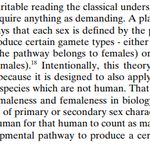




not sure what you mean by "an organism's sex can be in of itself a disorder"? i think the organism's sexual development is disordered, but i wouldn't say "the sex is the disorder" (i don't know what that would even mean)
1
21
yes, but "reproductive category as determined by karyotype fixed at conception" doesn't. so then we're back to having to define it differently for each species. so how would we decide the reproductive category of say a chicken
1
8
that after all is the justification for the gamete view in the first place - if we wanted a definition limited to humans only, the cluster view would do just as well
9
and yeah i do think that when we talk about "an organism's sex" we are talking about an emergent property of the organism - because i would like a concept of sex that works across species and doesn't have to be limited to humans
2
21
so what i'd say is that what we mean by "the organism's sex" is different depending on the organism's life stage. before sex differentiation, a fetus would be "sexless" in one sense (phenotype) but have a sex in another sense (chromosomal)
2
21
i agree with this point broadly speaking even though i'm not entirely sure if i agree on the specifics!
4
and this is probably the point at which people would start clarifying that they mean "chromosomal sex" or "phenotypic sex" or whatever, because there would be some potential for confusion if you're calling the XX Sry+ person female
1
20
but yeah if you wanna classify everyone by karyotype and say XX Sry+ with testes and entirely male-typical anatomy is female that doesn't seem wrong in any way to me. it probably wouldn't be as helpful/predictive as other classifications though
1
10
no gonads/ovotestes are cases where i'd say "sex" as a property applied to the whole organism breaks down. like i'm not particularly insistent on classifying every individual human as either male or female! "has no sex" or "belongs to both sexes" is acceptable to me
2
19
like you do realize i'm not saying it's non-obvious that karyotype has something to do with sex, right? i'm saying the strength of the causal link and the degree to which the lack of ability to produce viable gametes is fixed is non-obvious
anyway interesting conversation!
11
oh because imo all of that could be explained by a weaker causal link (for example, maybe something goes wrong with the environment that supports gamete formation that could be fixed with some sort of intervention) so it's non-obvious that the causal link is that strong
1
7
which, sure, that seems consistent to me. i just don't think that the "organized around" definition decouples sex from gamete type, it just places it at one remove (the sex of the phenotype still depends on the gamete that a typical organism with that phenotype would produce)
1
22
i mean the "irrespective of physical development" is the part i'm finding confusing. you seem to be saying that once we know a human's karyotype, we know something teleological about that human (so an XY person who never develops testes and never produces sperm is male)
2
18
also btw the reason i'm mentioning other species is just the first half of what you said here. i think it's extremely non-obvious that karyotype is linked to fertility so strongly and it's not bizarre at all not to know it!
but still, good to learn
xitter.gq/Kindun526/status/21255…

The idea that we would have sex chromosomes that mean nothing in of themselves is an idea so bizarre i cannot believe people entertain it.
Ask yourself for a moment why we have them while species whose sex determination mechanisms are environmental do not.
The gamete type our germ cells can form is fixed from conception. Because our sex determination mechanism is by karyotype. Other species have germ cells that can form either gamete based on gonadal environment.
1
20
and i'm not disagreeing with you that sex is *causally* determined by chromosomes, i'm just saying it's not *definitionally* determined by them, which you seem to agree with. we're just arguing over the details of what constitutes "organization"
2
27
the "third sex chromosome" is just the mutated X - the reason it results in females is that that mutation silences the activity of the Sry, which would otherwise make it male. you can call this a different mechanism or not, at this point i think this is just semantic
1
20
it literally says "meiotic disruption and loss of unviable YY embryos" - a YY embryo can only form if you have a Y oocyte!
and the "distinct" sex determination mechanism *is* the X-linked gene in question, from what i can gather. it's not fundamentally different
1
21
i have a pretty strong feeling you're just posting AI-generated replies to everything now (since your replies don't make sense or address anything i ask) so i'm just gonna stop engaging
if you want to learn more about your field of study, the roughgarden rec stands
1
2
19
butler never engages with the concept of sex as evolutionary biologists understand it, anywhere
if you can show me where, please do
and try joan roughgarden (trans woman and evolutionary biologist and not a sex denialist unlike butler)
1
1
35