
PhD student in computational biology @gagneurlab
Joined May 2017
- Tweets47
- Following253
- Followers96
- Likes1.6K


Johannes Hingerl retweeted

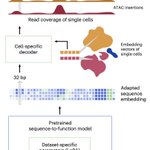
Single-cell atlases continue to map the diversity of cell states, but how can we use them to interpret non-coding genetic variants?
Excited to share AlphaGenome 2, our model for predicting cell-type-specific regulatory activity and variant effects from DNA sequence.
deepmind.google/blog/alphage…

Johannes Hingerl retweeted

This week we're releasing a preprint exploring state space models for long-sequence genomic prediction, alongside Cerberus, a set of open PyTorch models built on this work. biorxiv.org/content/10.64898…

Johannes Hingerl retweeted

After a long wait, tangermeme is out @naturemethods!
tangermeme implements the primitives of genomic sequence-to-function modeling with efficient, tested, and composable functions.
I use it every day in my work, and I hope you find it useful too.
nature.com/articles/s41592-0…

Johannes Hingerl retweeted

We are thrilled to share that our GPN-Star manuscript is now published and freely available:
doi.org/10.1038/s41586-026-1…
(1/n)

Johannes Hingerl retweeted

Excited to release AlphaGenome Atlas 🧬 We used AlphaGenome to predict the regulatory impact of all 9B possible SNVs in the human genome. We collaborated with amazing scientists to analyze and apply it, and developed a portal to browse the genome using this new lens 🔬
🌐 Portal: alphagenome.google/atlas
📖 Blog: goo.gle/4heuCvn
📄 Preprint: deepmind.google/blog/alphage…
🧵 1/6
Johannes Hingerl retweeted

Just want to give a shout-out to David Kelley @drklly who I think often does not get the credit he deserves (outside our core community).
I want to highlight why I think he is such a fantastic scientist and leader in regulatory genomics. 1/
Johannes Hingerl retweeted
AlphaGenome is out in @nature today along with model weights! 🧬
📄 Paper: nature.com/articles/s41586-0…
💻 Weights: github.com/google-deepmind/a…
Getting here wasn’t a straight path. We sat down @googledeepmind to discuss the story behind the model, paper & API: youtu.be/V8lhUqKqzUc

Johannes Hingerl retweeted

Excited to share Nona: a unifying multimodal masking framework for functional genomics.
Models for DNA have evolved along separate paths: sequence-to-function (AlphaGenome), language models (Evo2), and generative models (DDSM).
Can these be unified under a single paradigm? 1/15

I'm excited that our paper, "scooby: modeling multimodal genomic profiles from DNA sequence at single-cell resolution," has been published in Nature Methods! scooby is a new deep-learning framework to understand how DNA sequence shapes gene expression in individual, single cells.

Paper link: nature.com/articles/s41592-0…
Scooby github: github.com/gagneurlab/scooby
1
54
Many thanks to co-first author @lauradmartens for this fun collaboration, and to @AlexKarollus, @trevmanz, @JD_Buenrostro, @fabian_theis and @gagneurlab for their contributions and guidance!
2
75
Happy to share that Flashzoi is now published!
We enhanced Borzoi with RoPE & FlashAttention for >3x faster training/inference & 2.4x reduction in memory usage.
This brings large-scale genomic analysis and fine-tuning within reach of academic budgets.
📄: doi.org/10.1093/bioinformati…

The speedup does not come at the cost of accuracy:
Flashzoi matches or improves upon Borzoi’s performance across benchmarks, including RNA-seq coverage prediction, variant effect prediction (GTEx eQTLs), and enhancer-promoter linking.

1
81
Big thanks to co-authors @AlexKarollus & @gagneurlab , and to Borzoi authors @jjohlin @drklly et al!
Flashzoi is available on github and on pip: github.com/johahi/borzoi-pyt….

1
59
Johannes Hingerl retweeted

Recent performance prediction models have made great advances in accurately predicting the execution time of database queries. See how we achieved the same accuracy with a 10,000x faster model, T3.
We are happy to present our work on T3 at SIGMOD'25.
db.in.tum.de/~rieger/papers/…

Johannes Hingerl retweeted

1/ DNA sequence models like Borzoi predict gene expression and variant effects across 1000s of tissues — but what if your data comes from a custom experiment? @drklly @jjohlin and I propose a lightweight solution: parameter-efficient fine-tuning (PEFT). biorxiv.org/content/10.1101/…
Johannes Hingerl retweeted

Can DNA sequence models predict mutations affecting human traits?
We introduce TraitGym, a curated benchmark of causal regulatory variants for 113 Mendelian & 83 complex traits, and evaluate functional genomics and DNA language models. Joint work w/ @gokcen and @yun_s_song 🧵👇


Benchmarking DNA Sequence Models for Causal Regulatory Variant Prediction in Human Genetics biorxiv.org/content/10.1101/… #biorxiv_genetic
Johannes Hingerl retweeted

The Borzoi manuscript is now out in Nature Genetics: doi.org/10.1038/s41588-024-0…
Borzoi predicts RNA-seq profiles in many tissues & cell types from DNA sequence as its only input. With it, we can score the impact of genetic variants on a number of gene-regulatory functions. 1/
