
Interpretability researcher @GoodfireAI.
San Francisco, CA
Joined February 2023
- Tweets42
- Following87
- Followers263
- Likes94

tdooms retweeted

Excited to share our work on BioReason-Pro 2!
Protein models encode coevolutionary signals and structure; LLMs learn from papers / bio texts. I think interp has a lot to offer in tracing this fusion of knowledge and guiding how we improve it. Would love feedback! (1/n)

We improved a model that helps us understand proteins, giving us better predictions that held up in wet lab experiments.
Working with @NVIDIAHealth and @arcinstitute, we strengthened BioReason-Pro 2’s usage of multimodal information - and we can now interrogate its reasoning to confirm how it’s using protein inputs.
tdooms retweeted

We’re announcing an embedded assessment with @OpenAI to advance safety and alignment at the frontier.

tdooms retweeted

Excited to share this new result on EVEE, interp generated hypothesis actually reclassifying VUS. Want to share a bit about how this happened 🧵 (1/n)
We identified a gene variant behind hearing loss, a big step for interpretability in medicine.
In April, our interpretability system EVEE scored all 4.2M variants in ClinVar, the NIH's variant database. MEPE c.209_212del scored particularly high, so we built a case and had it successfully reclassified as "likely pathogenic."
~2M variants are still "uncertain," but we believe interpretability can help us understand many more!
tdooms retweeted
We built cybersecurity monitors for Kimi K3 and GLM 5.3 — more accurate, 50x faster, & 50x cheaper than an optimized LLM judge.
External red-teaming from @farairesearch found that our monitor greatly reduces universal jailbreaks. 🧵


tdooms retweeted
3 months ago, we used interpretability to predict which of 4.2 million genetic variants cause disease.
Now, we've validated several of those predictions with real-world datasets, including a national biobank, clinical data, and RNA sequencing data.
4 examples: (1/6)
We achieved state-of-the-art performance in predicting which of 4.2 million genetic variants cause diseases by interpreting a genomics model, in a new preprint with @MayoClinic.
We're now releasing an open source database for all variants in the NIH's clinvar database. 🧵(1/8)

tdooms retweeted

Already gave this a rip for some VUS and Suspected Pathogenic variants that I have previously done deep analysis on, and can confirm that EVEE posits many of the same findings and conclusions that I have found in terms of prediction and suggested failure mechanism
Examples:
VUS (for which *I* am the only ClinVar entry) for one of my heterozygous mutations in DNAH5 that could play a ~small~ factor in the overall root cause of my PCD
My Variant of CLCN1 that gives me a rare muscular disorder (which makes me look like Wolverine without needing to go to the gym, so not all bad 🤷♂️)
EVEE is a nice tool for variant interpretation!


We achieved state-of-the-art performance in predicting which of 4.2 million genetic variants cause diseases by interpreting a genomics model, in a new preprint with @MayoClinic.
We're now releasing an open source database for all variants in the NIH's clinvar database. 🧵(1/8)
tdooms retweeted
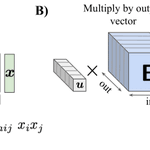
New research: we propose *covariance pooling* as a better replacement for mean pooling that improves probing for sequence-level properties.
E.g., genomic model embeddings are often mean-pooled to understand genes - but that throws away all info about feature co-occurrence! (1/3)

tdooms retweeted
We've identified a novel class of biomarkers for Alzheimer's detection - using interpretability - with @PrimaMente.
How we did it, and how interpretability can power scientific discovery in the age of digital biology: (1/6)
