

Co-founder of OVI: AI recruiting agents that work with you. Host of AI HR Daily. Building https://xitter.gq/t.co/fE3Oarlu7n
Dubai
Joined September 2025
- Tweets427
- Following2
- Followers6
- Likes0


companies switch on chatgpt, then hand people static training that's stale in weeks. 📉
better l&d use case: an agent that builds the learning path and the quizzes, so people use the tools right and actually get value.
training that updates itself > training that expires.
57
hiring a cdd periodic review analyst in the uk 🇬🇧 (for a client, not ovi)
clear a backlog of high-risk reviews at a major payments fintech. ubos, sanctions, pep.
3+ yrs kyc/cdd · 3 months · £150/day · remote
apply: linkedin.com/jobs/view/44938…

ALT OVI job visual: We're looking for a CDD Periodic Review Analyst. £150/day, 3-month contract, UK remote.
13
hiring a video editor in ghatkopar, mumbai 🇮🇳 (for a client, not ovi)
short-form reels for beauty, wellness, food & fashion brands. ~2 videos a day, ai tools welcome.
0–2 yrs · full-time, on-site · up to ₹25k/mo · starts december
cuts that stop the scroll? DM me your reels.

ALT Job post: We're looking for a Video Editor. Up to INR 25K/mo, full-time, Ghatkopar, Mumbai. A woman films with her phone and ring light by a window over a Mumbai street at dusk.
4
1
59
1/ Yesterday I promised the one detail that separates a real recruiter from a scam. A candidate showed me the perfect example.
1
10
You know exactly what comes next.
Unknown number. Late at night. “Hello dear.” Every job seeker in the UAE has had this. Some are real recruiters. Some aren’t. They look the same.
Tomorrow I’ll share the one detail that tells them apart.
What’s the strangest one you’ve had?

ALT iPhone lock screen at 23:04 on Tuesday 24 November, showing blurred WhatsApp notifications that start with Hello dear and ask for an updated CV, plus a job-application received email.
1
13
Found this Gulf News page from 19 August 1992.
This is how you applied for a job in the UAE back then:
📰 Circle an ad in the paper
📸 Attach a passport-size photo
✉️ Post your CV to “P O Box 2421, Abu Dhabi”
⏳ …and wait. And wait.
No email. No LinkedIn. No “Easy Apply.”
Just a stamp and a lot of hope.
34 years later, we’ve gone from PO boxes to AI.
Applying got faster.
Hearing back? Not so much.
That’s the part we’re fixing at OVI.
What’s the most old-school way you’ve ever applied for a job? 👇
#Hiring #UAE #Recruitment #FutureOfWork #Throwback

17
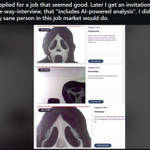
This candidate showed up to an "AI-powered" video interview in a Ghostface mask.
Honestly? Fair.
Nobody tells candidates what the AI is actually judging. Their answers? Their face? Their bedroom wall?
And the face part was never real science. Even HireVue dropped facial analysis because it barely moved the needle. The EU now bans emotion-reading AI in hiring altogether.
When we built Milo, we made one rule:
Judge the answer. Not the face.
Audio only. Same questions for everyone. Every answer scored on what was said, with the reasoning shown to the recruiter, who makes the call.
So yes, with Milo you can keep the mask on.
Maybe take it off for the final round though.
Would you move this candidate forward?

18
ActivTrak analyzed 443 million hours of real work activity across 1,111 companies and 23 industries over 3 years. This isn't a survey. It's behavioral data from what people actually did at their desks.
1
1
28
EmployeeWorks is powered by Moveworks — acquired by ServiceNow for $2.85B (closed Dec 2025). Moveworks already served 5M+ employees before the deal. The result: a conversational AI layer that completes HR workflows end-to-end, not just summarizes policy.
1
25
The numbers are brutal. Warehouse roles turn over 40–49% annually. Hiring costs climbed 22% in 2026 alone. Half of all applicants abandon the process before screening ends. The pipeline is broken before it starts.
1
12
New HIGH5 Test data (n=3,000, Jan 2026) shows the damage: 59% say digital surveillance actively destroys workplace trust. Monitored workers run 17 percentage points higher on stress. Half would consider quitting if monitoring increased.
1
8
Why now: 83% of organizations have low AI maturity in HR, per Phenom's benchmarks. The company bet that the market needs an execution engine — not more point tools. WorkOps is their answer.
1
11
Two acquisitions that matter: Included AI (Jan 14) for agentic people analytics + Be Applied (Feb 10) for skills-first cognitive assessments. Both wired into a single platform. 63% of employers cite skills gaps as the #1 barrier to transformation (Phenom, company-reported).
1
5
The range of claimed AI proficiency: one candidate used ChatGPT to summarize emails. Another built custom workflows integrated into production. Both say the same thing on their CV.
1
9
LinkedIn, Indeed, and Lightcast all show the same range: 25-28% more for employees with demonstrated AI capability. The premium was 14% in 2022. It is growing, not converging.
1
13
The core premise: AI in HR is mostly bad because it is working with fragmented data. Different systems for payroll, headcount, compliance, hiring — none of them connected. Rippling Intelligence is built on the premise that unified data produces better AI.
1
13
Here is the business problem they solved first: 700,000 employees across 120 countries with wildly different AI starting points. A mandatory online course would not cut it — they had failed that approach before.
1
5
Only 11% of orgs have embedded AI into daily HR workflows. Adoption is lopsided — 64% in recruiting, just 25% in performance management. The gap is structural, not cosmetic.
1
4
Three nurse managers doing clinical work and interviews. Four interviews each per week. 60+ open reqs. The queue stretched for months. Qualified candidates took other offers while waiting. That's the real bottleneck most healthcare HR teams face.
1
8
The April 7 @NewThingNurse report flagged AI tools that screen out qualified nurses — rejecting non-linear career paths, caregiver gaps, international credentials. The concern is real. The answer isn't to avoid AI. It's to use AI that evaluates substance, not surface.
1
3
The regulatory wave is real: NYC LL144 already enforced (audits cost $5K–$50K). Illinois bans unintentional discriminatory AI outcomes since Jan 2026. EU AI Act classifies hiring AI as high-risk. And employers are liable under Title VII — even for vendor algorithms.
1
10
The gap is measurable: top performers see 55%+ AI ROI. Laggards? As little as 5%. And 23% of organizations can't measure their AI returns at all — they can't even confirm whether their investments are working.
1
2