

Board Cert. Emergency Physician. Chair, Emergency Med. Policy Inst. Past Pres Alameda Contra Costa Medical Assn & CaliforniaACEP. tweets=my views. Hockey fan.
Wilmette, IL
Joined January 2012
- Tweets2.5K
- Following518
- Followers714
- Likes1.7K



Tom Sugarman, MD, FACEP, FAAEM retweeted

We’ve been saying this for a long time. I am thankful that others are now listening with the @nytimes publishing the data and story today.
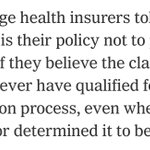
Insurers are openly breaking the law. They have asked employers to go along with it, and most have. This is an administration that has focused on law and order. Let’s see that same focus applied to the No Surprises Act

One new-to-me detail we learned in the course of our reporting: when Congress wrote the No Surprises Act, it ported over many parts of federal arbitration law.
It did not, however, bring over key enforcement provisions. Without an enforcement mechanism, supposedly binding arbitration decisions are being ignored.
nytimes.com/2026/11/03/us/in…

Tom Sugarman, MD, FACEP, FAAEM retweeted

🚨 ED overcrowding is not an emergency department problem.
It is a health system failure.
The new CAEP position statement argues that hospital access block, not inappropriate ED use, is the primary driver of crowding. Patients waiting for inpatient beds experience worse outcomes, while clinicians face increasing burnout and moral distress.
Key messages:
✅ Overcrowding is a patient safety crisis
✅ Access block is the main cause
✅ Boarding harms patients and staff
✅ Hospitals need occupancy targets, flow accountability, and discharge capacity
✅ Governments must expand acute, long-term, community, and mental health care capacity
The solution is not "fixing the ED."
The solution is fixing patient flow across the entire health system.
#EmergencyMedicine #HealthPolicy #PatientSafety #AccessBlock #EDCrowding #CAEP #MedTwitter #FOAMed #CJEM
link.springer.com/article/10…

Flouting Consumer Law, Insurers Refuse to Pay Medical Bills for Emergency Care nytimes.com/2026/11/03/us/in… via @NYTimes

Tom Sugarman, MD, FACEP, FAAEM retweeted

UnitedHealth Group’s profits just jumped 75% to *$4.1 BILLION* in a single quarter.
Earlier this week, I dug into its latest earnings report and what executives said on their call with Wall Street analysts.
Here's what stood out:
healthcareuncovered.substack…


Private insurers are driven by profit motivation. Look at how much money the top 6 insurers make very year. They deny, delay, and defer care to pad their pockets.


Tom Sugarman, MD, FACEP, FAAEM retweeted

Your doctor went to medical school for 12 years. The person denying your claim went through a two-week training module.
Big Insurance is trying to gut the No Surprises Act thehill.com/opinion/healthca…

Tom Sugarman, MD, FACEP, FAAEM retweeted
The country is $40T in debt
Our medical costs are expanding at least in part due to consolidation of physicians into insurers and hospitals
Fixing budget neutrality and meaningfully tying physician payment would significantly help turn the tide on medical expenses through pushing doctors into independent practices and out of more expensive practice arrangements.
Medicare Advantage takes nearly half of its money from the physician fee schedule. Rewriting the rules would save $1T over 10 years, only a fraction of which would be needed to fix budget neutrality and physician payment. The rest could be used for other debt reduction projects. It’s time for action.
CBO Analysis suggests $1T in Medicare Advantage Overpayments
crfb.org/blogs/cbo-analysis-…

Big Insurance is trying to gut the No Surprises Act thehill.com/opinion/healthca…
Tom Sugarman, MD, FACEP, FAAEM retweeted
TY to the chairs of the GOP & Democratic Doctors Caucuses—
@RepJohnJoyce @RepGregMurphy @RepKimSchrier —along with 23 original cosponsors, for introducing the Patients First Act (H.R. 9693), a comprehensive, bipartisan proposal to reform the #Medicare physician payment system. 🧵

The 5th Circuit Court rules in favor of the Texas Medical Association. QPAs are artificially low because insurers are illegally gaming the system. acep.org/news/acep-newsroom-… 1/2

Tom Sugarman, MD, FACEP, FAAEM retweeted
Day 2: Why MSO’s are Necessary
An MSO, when properly structured, does not practice medicine. It handles everything surrounding the practice of medicine so physicians can focus on what they trained and are licensed to do.
The services that flow through a management services agreement typically include revenue cycle management and billing compliance, EHR implementation and optimization, facility leasing and management, HR administration for non-clinical staff, marketing and patient acquisition, credentialing and payer enrollment, IT infrastructure, financial reporting, shared vendor purchasing, and strategic business development including value-based care contracting support. The physician-owned professional entity retains exclusive authority over clinical decisions, physician hiring and supervision, and clinical standards. While that is the design, in practice it can work much differently.
For small and mid-sized independent practices, these services address a real and growing problem. The administrative burden in medicine has expanded dramatically as payer requirements have multiplied and the technology investment required to participate in quality reporting and value-based contracts has grown well beyond what a small office can manage internally. A three-physician primary care group or a single-specialty surgical practice cannot afford a full revenue cycle team, a compliance officer, a population health analyst, and an IT director. An MSO spreads those costs across dozens of practices and delivers the capability at a fraction of what each group would spend building it independently.
Capital access matters just as much. Independent practices that want to grow, through adding providers, opening additional sites, acquiring technology, and building out ancillary services face a financing environment that is not designed for them. Hospital systems access tax-exempt bond financing and health system credit. Private equity-backed platforms have institutional capital. Independent physician groups have bank loans against personally guaranteed assets. An MSO partnership with real capitalization can change that equation, letting a group invest in growth without selling the practice or accepting employment.
Scale for payer negotiation is the third benefit, and increasingly the most important one. A physician-owned MSO that aggregates twenty or thirty independent practices has a fundamentally different payer contract conversation than any of those practices could have individually. The concentration problem I described yesterday does not go away, but the gap narrows when physicians operate at meaningful scale in the same ballpark as hospitals or insurers (but clearly substantially smaller).
The benefits are real, and independent practices that access them through well-structured MSO relationships can survive and grow in a market that is otherwise structured to push them toward consolidation or employment.
The problem is that every single one of those benefits is also what makes independent practices attractive acquisition targets. The same structure that can preserve independence can be engineered to eliminate it. Tune in tomorrow for more discussion on the downsides.

Tom Sugarman, MD, FACEP, FAAEM retweeted

If “providers” are abusing the IDR process, how are thry winning so much?
How is it the payment the arbitrator agrees to is 8.9X the insurance company “benchmark”?
RT if you think these health insurance cos. are out here trying to rip EVERYONE off!
fiercehealthcare.com/regulat…


Tom Sugarman, MD, FACEP, FAAEM retweeted

Physicians deeply care about their patients. We need Congress to reform Medicare physician pay to safeguard physician practices and patient access to high-quality care. Learn more.
bit.ly/3NCjXv9
Tom Sugarman, MD, FACEP, FAAEM retweeted

Thank you Dr. Murphy, fighting for NC hospitals, physicians and patients against @UHC & their latest ploy to squeeze more $ from the aforementioned.
At a +2$B run rate of profits (based on their Q1 ‘26 earnings report), UHC will stop at little to raise that run rate even higher and the physician community must fight back.
