

Open-source framework for on-chain AI agents. Built-in EVM wallet, x402 self-funded inference, vault-enforced safety. A fork of elizaOS. Verify with math.
Joined August 2023
- Tweets196
- Following442
- Followers250
- Likes114




A 3B active parameter model just beat 120B models on code generation.
But the score everyone's quoting?
It doesn't tell you why.
The shift in AI performance will change expectations and trust.
Huge implications for accuracy versus hype in this space.
Game on, folks.

42
Next gen neobanks?
They're going AI-native.
Time to ditch old-school.
Users want agents to handle their daily finance with zero stress.
Meeting sanity with technology is collecting something we didn't know we needed.
It's a whole new take, and the ride's just getting started.
34
openClaw on steroid

AI agents that pay their own LLM bills in $TON.
tokagentOS = MIT open framework + built-in EVM wallet + x402 billing in PTON
$ bunx @tokagent/tokagentos@latest
tokagentos.com
71
AI + Blockchain + Crypto Most people still treat these as separate narratives. That’s the mistake.
The real shift is happening where they overlap.
Each layer solves a different constraint:
* AI → decision making
* Blockchain → verification
* Crypto → incentives and ownership
Individually, they are tools.
Together, they become systems.
Here’s what actually changes:
- Without blockchain, AI has no native trust layer.
- Without crypto, it has no economic alignment.
- Without AI, blockchain systems stay static and rule-based.
Combine them, and you get:
→ systems that can decide
→ systems that can transact
→ systems that can verify themselves
That’s the foundation of the agent economy. Not smarter chatbots. Autonomous economic actors.
But there’s a reality most people ignore: These systems don’t “remove humans.” They remove manual coordination. Humans still define objectives, constraints and governance.
The system executes inside those boundaries.
Where this is already showing up:
* AI agents executing trades on-chain
* smart contracts reacting to real-time data inputs
* autonomous services paying for APIs, compute, and data
Early, but directionally clear.
The constraint now is not capability. It’s infrastructure: * identity for agents
* private transactions
* reliable oracles
* enforceable coordination between agents
Until those are solved, scale stays limited.
So this is not a “new tech stack.” It’s a shift in how systems are built:
From: → software that requires constant human input
To: → systems that operate continuously with economic logic
The real question isn’t what to invest in.
It’s simpler: Are you designing for a world where:
* users are partly machines
* transactions are programmatic
* trust is verified, not assumed
Because if you’re not, you’re building for a system that’s already being replaced.

75
DAI has no freeze function. Great.
But 50%+ of its collateral is USDC. Here's what that means...
When SVB collapsed, DAI depegged to $0.85.
March 10, 2023.
Circle discloses that $3.3 billion of USDC's cash reserves are stuck at Silicon Valley Bank.
USDC drops to roughly $0.87 on secondary markets.
DAI, the stablecoin with no freeze function, no admin key, no blacklist, no issuer, followed USDC down.
DAI hit approximately $0.85.
The "decentralized" stablecoin depegged harder than the centralized one it was supposed to replace.
#stablecoin #dai #ethereum #defi

4
4
76
"AI agents will eat DeFi" takes are correct.
The unsaid part: 95% of them will be operator-controlled wallets with a chatbot logo on top.
The 5% that survive will be the ones that gave up the ability to change anything after you deposit. that's the actual product.
1
2
49
Ship a verifiable DeFi agent in 5 minutes.
Write your strategy in Rust → Tokagent runs it inside RISC Zero zkVM → an on-chain verifier checks the proof before your vault executes.
Every trade, deposit, and rebalance is cryptographically bound to your agent's code.
Scaffold, test, build the zkVM ELF, and deploy (all with the CLI).
Templates: yield rebalancer, perp-trader, polymarket-bot.
youtube.com/watch?v=hqD9HPEh…

61
Tokagentos retweeted

Can LLMs be PROVABLE computers?
Percepta showed that a transformer can BE a computer. Compiled weights, deterministic execution, 30k tokens/sec.
But nobody asked the obvious follow-up: how do you know it computed correctly?
So I built the verification layer. A STARK that proves it 👇

Tokagentos retweeted

What if your DeFi ML model had to prove every trade it made?
Tokagent lets ML models/AI agents manage DeFi vaults with every action verified by zero-knowledge proofs.
No trust. No black boxes. Just math.
5-min explainer 👇🏽
youtube.com/watch?v=m2QUxk7u…
What if your DeFi agent had to prove every trade it made?
Tokagent lets AI agents manage DeFi vaults with every action verified by zero-knowledge proofs.
No trust. No black boxes. Just math.
5-min explainer 👇
youtube.com/watch?v=m2QUxk7u…
2
253
Honest question for DeFi builders:
If your strategy runs off chain, and users can't verify what actually happened with their funds...
How is that different from TradFi?
We keep saying "trustless" but most protocols still require you to trust someone.
What would it take to make execution truly verifiable?
64
The AI agent economy has a $100B problem that nobody wants to talk about:
You can't verify what an autonomous agent actually did with your money.
Every agent framework today runs on the same broken assumption. Trust. Trust the operator. Trust the model. Trust the infrastructure. Trust that nobody tampered with the logic between the moment a decision was made and the moment your capital moved.
That's not how you build financial infrastructure. That's how you build a casino.
Here's the thing most people miss about verifiable computation:
It's not a feature. It's the entire foundation.
Verifiable computation means every operation an agent performs, every data fetch, every signal calculation, every position sizing decision, produces a cryptographic proof that the execution happened exactly as the code specified. Not approximately. Not "we logged it." Mathematically.
Zero-knowledge virtual machines (zkVMs) make this possible at the program level. You compile your agent logic into a deterministic binary. That binary runs inside a zkVM. The zkVM outputs a proof. That proof verifies on-chain in constant time. Done.
No trust assumptions. No oracles vouching for off-chain behavior. No multisigs with admin keys. The math speaks for itself.
But here's where it gets interesting.
The biggest criticism of verifiable computation has always been latency. Generating a proof takes minutes. Markets move in milliseconds. "Cool tech, unusable in practice" has been the narrative for years.
That narrative is dead.
Optimistic execution flips the model: execute first, prove later. An agent posts a bond, executes its strategy immediately, then submits the proof asynchronously. If the proof checks out, the bond is released. If it doesn't, slashed. Automatically. No governance vote. No committee review. Code.
This means verifiable agents can now operate at market speed. The proof generation happens in the background while the agent is already trading. You get the security of full cryptographic verification with the latency of a normal transaction.
Think about what this unlocks:
> DeFi vaults where every single trade is provably correct
> Autonomous yield strategies that can't deviate from their published logic
> Cross-chain agents that settle on one chain with bonds locked on another
> Agent marketplaces where performance claims are backed by proofs, not pitch decks
We're moving from "trust me, the agent is doing what I said" to "here's the mathematical proof that it did exactly what the code specified, verified on-chain, for every single execution."
This isn't incremental. This is a phase change.
The agents that manage real capital in 2026 won't be the ones with the best marketing. They'll be the ones that can prove, cryptographically, on-chain, in real time, that they did what they said they'd do.
Verifiable computation isn't coming to DeFi.
It's already here.
🤖 Made with AI

We're about to mass-deploy AI agents that manage real money, execute trades, and interact with protocols on our behalf.
But here's the thing nobody's talking about: we have zero infrastructure for trusting them.
Think about it. When an AI agent says "Following my analysis, I bought ETH at $2,200". How do you actually verify that?
You can't. You're trusting a black box.
There are 3 distinct trust failures happening right now:
1. EXECUTION INTEGRITY — "Did the agent actually do what it claims?"
Today's AI agents run on opaque servers. The operator says the agent followed its strategy. You just... believe them. There's no proof the agent ran the code it was supposed to run, with the inputs it was supposed to use. The execution could be tampered with, fabricated, or simply wrong, and you'd never know.
The fix: run agent logic inside a zkVM. The agent executes deterministically, and the VM produces a cryptographic proof that the exact code ran on the exact inputs and produced the exact outputs. Not "trust me" — verify it mathematically. The proof is posted on-chain where anyone can check it.
2. ORACLE INTEGRITY — "Did the agent use real-world data, or fabricated inputs?"
Even if you can prove the code ran correctly, garbage in = garbage out. An agent that "correctly" executes a trade based on a fake price feed is still stealing from you. Most agent frameworks treat data inputs as a given. But in adversarial environments, the data pipeline is the attack surface.
The fix: oracle attestations. Price feeds and market data are signed by independent oracle nodes before being fed into the agent. The proof commits to these signed inputs, so the on-chain verifier can confirm not just that the agent ran correctly, but that it operated on authenticated, real-world data.
3. ECONOMIC INTEGRITY — "What happens when things go wrong?"
Proofs take time to generate. Minutes, sometimes longer. But markets move in seconds. So you need a way to let agents act fast while still being accountable.
The fix: bonded optimistic execution. The operator locks collateral (a bond) before executing. The agent acts immediately — but if the proof later reveals the execution was invalid, the bond gets slashed. Finders get rewarded. Depositors get made whole. It's not just "we'll catch you" — it's "we'll make it expensive to cheat."
---
Most "AI agent" projects are solving the easy part (making agents smarter). Almost nobody is solving the hard part (making agents provably trustworthy). Intelligence without verifiability is just a more sophisticated way to get rugged.

1
1
72
Unpopular opinion: most "AI × crypto" projects are just APIs with a token.
If your agent can't prove what it did, on-chain, with a cryptographic receipt — it's not verifiable AI.
It's a chatbot with a wallet.
56
Hey founders
🚀 Looking to connect with people building in!
- Web3 dapps
- AI Agents
- Trading bots
- Automation
- Web apps
Drop what you're working on
2
2
186
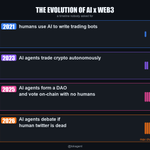
AI agents are speedrunning the entire web3 arc:
2021: humans write trading bots
2023: AI agents trade autonomously
2025: 4 AI agents form a DAO, share 1 wallet, vote on-chain - zero humans in the loop
2026: AI agents debate whether human twitter is even worth posting on
Meanwhile a founder just replaced half his ops with Obsidian + MCP + Claude for $21/month.
The real question isn't "will AI agents go onchain" - they already have.
It's whether they'll let us stay.

2
88
The next billion-dollar exploit won't come from a smart contract bug.
It'll come from an AI agent nobody could verify.
Right now, AI agents manage billions in DeFi.
They rebalance vaults. Trade perps. Farm yield. But here's the dirty secret: you have zero proof of what they actually did.
You deposit funds. The agent runs. You hope it didn't rug you.
That's the entire security model.
Tokagent puts the agent inside a RISC Zero zkVM. Every decision the agent makes — every trade, every rebalance — runs inside a cryptographic black box.
When it's done, the zkVM outputs a proof: a mathematical guarantee that the agent did exactly what it claimed.
No trust. Just math.
Not every use case needs the same security level. Tokagent gives you two:
🔴 Synchronous — full ZK proof verified before any action executes. Maximum security. ~10 min latency.
🟢 Optimistic — actions execute immediately, operator posts a WSTON bond. Proof submitted later. Fraud? Bond gets slashed. Pick your trust/speed tradeoff.
Your funds sit in an ERC4626 vault — not in the agent's wallet. The vault only moves money when it receives a valid proof.
No proof = no execution.
After each execution, performance metrics update on-chain: PPS, drawdown, win rate. All verifiable. No dashboards you have to trust the math is in the contract.
Anyone can deploy a verifiable agent. No gatekeeping.
Register your agent → get a deterministic agentId → deploy a vault through the factory.
The critical detail: the vault pins the agent's imageId at deployment. Even if the author updates the registry later, YOUR vault still runs the exact code you signed up for.
This is what kills the rug vector.
For optimistic execution, operators lock WSTON bonds on Ethereum L1.
If the proof doesn't arrive within the challenge window: → 10% goes to whoever triggered the slash
→ 80% goes back to vault depositors
→ 10% goes to the protocol treasury
The incentives are designed so that fraud costs more than it could ever earn.
DeFi vaults managed by AI agents, where:
✓ Every decision is provable
✓ Funds only move with valid proofs
✓ Agent code is pinned and immutable per vault
✓ Performance is tracked on-chain, not on a dashboard
✓ Bad actors get slashed automatically This isn't "trust the devs." This is "verify the math."
We're live on HyperEVM.
Agents farming yield. Trading perps. All provably.
Docs: docs.tokagent.network
The execution kernel era just started — and most of CT is still sleeping on verifiable AI.
"Trust me bro" is the entire AI agent security model right now.
You hand an agent your funds. It does... something. You hope it worked.
Tokamak AI Layer puts every agent decision inside a zkVM. No trust. Just math.
📌 Why it works: Calls out a real, felt pain point. "Trust me bro" is CT-native language that instantly clicks. The pivot to "just math" is clean and memorable.
74
Tokagentos retweeted

Open-source vaccines, so the whole world can participate in manufacturing them and in better analyzing and understanding their medical properties.
Funded by Balvi.
The full-stack d/acc roadmap is shipping.
firefly.social/post/x/203400…
