

Serious about Growth, unserious about everything | Art lover | @RialoHQ enjoyoor
Somewhere on earth
Joined February 2024
- Tweets1.2K
- Following223
- Followers194
- Likes1.3K




Rialo Builder Hub is where the builders show up 🛠️
Every week, you get to see what people are building on @RialoHQ, hear new ideas, and get feedback from the community + team.
If you’ve been thinking about building something on Rialo, this is your sign to stop thinking and start building.
Join the Discord → discord.gg/rialoprotocol

2
20
Tom | retweeted
The hidden tax killing every blockchain app
Ever wonder why building a "simple" DeFi app somehow requires 6 different vendors? Oracle. Bridge. Keeper network. Indexer. RPC provider. Data availability layer. There's an economic reason this is broken, and Rialo actually wrote a really good breakdown of it.
It's called double (or compound) marginalization. Classic economics: when multiple independent middlemen each take a margin on the same value chain, the end cost is higher than if one integrated player captured the whole thing.
In crypto this plays out literally. Every middleware layer (oracle, bridge, automation network) optimizes for its own revenue, not for the health of the app sitting on top of it. Costs stack. Reliability doesn't.
Worse: coordination between these layers is nobody's job. When your oracle updates late and your keeper bot misses the window, who's responsible? Nobody, that's the point, they're all separate businesses with separate incentives.
Rialo's bet is that folding these functions (data access, automation, privacy) directly into the protocol removes the toll booths entirely. Fewer intermediaries, fewer places for costs and failure points to hide.
This is the actual thesis behind everything else Rialo builds. Once you see it, you start noticing which chains are quietly still assembling their stack from rented parts, and which ones own the whole thing.
🤖 Made with AI
Tom | retweeted
These are some Legit guys out there I have worked with:
You can give them your outlier and handshake accounts for management
@Ceejayprosper @crypton11te @BrownBehaviour @nix_techbro
You guys can retweet
Don’t let gullible people fall for @thebest36y6 scam
Proof available if you need it

This guy is a scammer guys dont deal with him‼️ he claims to write outlier and handshake assessments for people then ghosts after getting paid
deal with him at your own risk !!
his former username was @focusweb3766
now he has changed his username to @thebest36y6
outlier handshake mercor micro1
These are some Legit guys out there I have worked with:
You can give them your outlier and handshake accounts for management
@Ceejayprosper @crypton11te @BrownBehaviour @nix_techbro
You guys can retweet
Don’t let gullible people fall for @thebest36y6 scam
Proof available if you need it
This guy is a scammer guys dont deal with him‼️ he claims to write outlier and handshake assessments for people then ghosts after getting paid
deal with him at your own risk !!
his former username was @focusweb3766
now he has changed his username to @thebest36y6
outlier handshake mercor micro1
Tom | retweeted
This guy is a scammer guys dont deal with him‼️ he claims to write outlier and handshake assessments for people then ghosts after getting paid
deal with him at your own risk !!
his former username was @focusweb3766
now he has changed his username to @thebest36y6
outlier handshake mercor micro1
This Post is from a suspended account. Learn more

Tom | retweeted
RISC-V + SVM: the weird combo that makes @RialoHQ fast
Rialo's smart contracts run on RISC-V with Solana VM compatibility. If that means nothing to you, stick with me, this is actually one of the more interesting engineering choices in the space right now.
Most L1s pick one lane: either a brand new VM (learn our language, rebuild your tooling) or full EVM compatibility (safe, familiar, but you inherit EVM's constraints too).
RISC-V is an open instruction set architecture, not a blockchain-specific VM. Using it as the execution base means Rialo isn't locked into the design tradeoffs of any single existing chain's virtual machine.
Layering Solana VM compatibility on top means devs coming from the Solana ecosystem aren't starting from zero. Familiar programming model, different underlying execution environment optimized for Rialo's real-world connectivity features.
Why does this matter practically? Because the interesting stuff (reactive transactions, native privacy, direct API calls) needs a fast, flexible execution layer underneath it or none of it performs at Web2 speed. The VM choice isn't cosmetic, it's load-bearing.
This is the kind of decision you only make if you're building for the next decade, not the next hype cycle. More on what that connectivity actually looks like tomorrow.
Tom | retweeted
What even is a "Real World Chain"?
"Real World Chain." Every project claims to bridge Web2 and Web3. Most just mean "we have a bridge contract." @rialoHQ means something different. Let me break it down.
The core problem: blockchains are islands. They can see their own state perfectly but they're blind to everything outside it (prices, weather, API responses, real world events) unless a third party feeds it in.
That third party is usually an oracle network, a bridge, or a bot army. Each one is a separate trust assumption, a separate point of failure, and a separate fee. Rialo calls this pattern "compound marginalization," basically death by a thousand middleware cuts.
Rialo's answer: merge L1 execution, L2 style scaling, and middleware into one system. Smart contracts can make validator attested API calls directly. No oracle network in between. No bridge. No bot polling a price feed every 3 seconds.
The chain itself uses RISC-V for smart contracts and is compatible with the Solana VM, so it's not asking devs to learn a brand new language from zero, it's asking them to build the same apps with fewer moving parts.
End result they're going for: dApps that feel like Uber or Instagram instead of feeling like, well, most dApps. Web2 responsiveness, Web3 guarantees.
Tomorrow, the actual tech stack (RISC-V + SVM) and why that combo is a genuinely unusual choice.

Tom | retweeted
REACTIVE TRANSACTIONS EXPLAINED ON @RialoHQ
Every DeFi protocol you use has a bot working night shifts it never told you about.
Lending protocols need something watching collateral ratios to trigger liquidations. AMMs need something adjusting parameters as volatility shifts. Perp exchanges need something updating funding rates continuously.
None of this happens on its own, because blockchains only execute logic when a transaction is submitted. Everything else gets bolted on through keepers, cron jobs, and monitoring services running outside the chain's trust model.
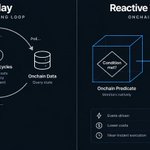
Reactive transactions change the model itself. A developer defines a predicate, a logical condition stored onchain, and attaches a transaction to it. Every validator continuously evaluates that predicate as part of block execution.
Balances shift, an oracle updates, an event fires, and if the condition becomes true, the transaction triggers automatically, inside consensus, with no external system watching for it.
Think of it less like polling and more like how a bank waits for a settlement window, or how ordinary software waits for a callback instead of checking in a loop. Most real computation is event-driven, not continuous. Blockchains were the exception. Now they don't have to be.
The workflow can even suspend, wait days for a condition, and resume, all natively.
What's the first bot or keeper in your stack you'd happily delete?
Meet RIALO
Bitcoin proved digital scarcity works. Ethereum proved programmable trust works. A decade of "faster" chains followed, and adoption still didn't move the way anyone promised.
@rialoHQ starts from a different premise: the blockchains we have are islands. They can't read the real world, can't act on it automatically, can't touch private data without breaking transparency, and don't let users bring an identity they've already built elsewhere.
Rialo is a real world blockchain, meaning those capabilities are native to the protocol rather than assembled from third party services:
Real world data, through a one line HTTPS call from inside a smart contract. Real world reactivity, through onchain predicates that trigger transactions automatically, no bots required. Real-world privacy, through confidential execution built into the base layer. Real-world identity, through email, SMS, and social logins instead of a seed phrase as the only door in.
None of these exist in isolation. Rialo calls this supermodularity: capabilities that amplify each other because they were designed to work as one system, not stitched together after launch.
The TESTNET is live and you can already get a feel of the product through the playground at playground.rialo.io
Build faster. Ship smarter. Get real.

1
46
