

CTO/CIO. Entrepreneur who built and sold an IT firm. Ex-NTT DATA. Moving AI from pilots to real adoption. 30+ years in tech. Sailor, Cyclist, Photographer.
Oakville, ON Canada
Joined November 2008
- Tweets3.4K
- Following694
- Followers721
- Likes189





Citi, PNC and Citizens told customers this week that anything a third-party AI agent does with their login counts as authorized, even after a hack. JPMorgan and Bank of America made similar moves in October. The risk does not go away. It moves to the customer, who sees the least of what the agent does. So before handing an agent a banking password, ask one question: read-only, or the right to move money?
techcrunch.com/2026/11/18/mo…
#AI #Banking #CIO #CX

13
Fed Governor Michael Barr says major banks are already seeing AI agents try to act in customer accounts without verified consent. His fix is strict authentication, consent for each action, and limits on what an agent can do. That is the same work that gets AI out of pilots: a clear owner and a control built into the process.
federalreserve.gov/newsevent…
#AI #Banking #CIO #AgenticAI

19
A CIO's view of AI in banking: from black box to boardroom.
It's episode 1 of my new series, “A CIO's view of AI, one industry at a time.”
It looks at three decisions:
• What evidence makes a model acceptable
• What an agent is allowed to do
• How a pilot gets into daily use
The first one is already a boardroom question. @SASsoftware and FT Longitude found that 63% of banking leaders surveyed would be willing to use a black box model for better performance.
Read the full episode: linkedin.com/pulse/cios-view…
Where does your bank get stuck moving a pilot into daily use?
#Banking #AI #AIGovernance #CIO

2
10
Fed Governor Michael Barr warned in remarks for a conference in Milan today that AI agents could speed up bank runs.
Customers once had to move money themselves. Agents could spot a better rate or a stability signal and move deposits in minutes, faster than liquidity plans and regulators are built to respond. He also said major banks already see AI agents trying to take unauthorized actions in retail accounts.
That makes agents a liquidity and risk question for banks, not only a channel question.
The question needs an answer: How fast can our bank see and respond when customers' agents start moving money at once?
news.bloomberglaw.com/bankin…
#AI #Banking #AIAgents #RiskManagement #CIO

1
62
The Fed's new Financial Stability Report puts AI at the top of its risk survey, up from third in the spring.
The market contacts it surveyed named three AI worries: stretched valuations, cyberattacks made easier by AI, and complex AI financing. Several warned that a disruption to trading, settlement or payment systems could damage confidence in financial institutions.
For bank CIOs, that puts resilience inside the AI business case, not in a later phase.
The question needs an answer: What is our fallback if the AI vendor or model behind our payment and settlement systems is attacked or goes down?
federalreserve.gov/publicati…
#AI #CIO #Banking #FinancialServices #Cybersecurity
1
32
This week's Microsoft 365 outage is a good test for every CIO running AI on top of email, calendars and files.
The assistant can be up while the work is down. When a connector can't reach your data, the task fails even though the model still answers.
The Frontier take shared by @dhinchcliffe puts it well: resilience now sits in the workflow, not the product.
Two questions I would ask this week:
1. Which of our critical workflows depend on the same connector?
2. How do we switch to the manual fallback when that connector goes dark?
#AI #CIO #Microsoft365 #Resilience #Microsoft #MicrosoftOutage
xitter.gq/dhinchcliffe/status/21…

The huge Microsoft outage continues, and is becoming a major operational issue for many enterprises.
Our take on what’s occurred and what CIOs and CISOs can and should do for their increasingly large and interdependent cross-cloud estates:
thisisfrontier.ai/news/micro…

2
116
Two days at Info-Tech LIVE 2026 in Toronto with @infotechRG gave me one clear test for AI: does it change an action the business takes?
The session that stayed with me most showed why. Nysa Zaran Evagelinos of Info-Tech Research Group walked us from data as a product to the data value chain: data, insight, decision, action, value. Her point was that data only creates value when it changes an action. The organizations that get there start with the outcome they care about and work back to the data, not the other way around. Her UPS example made it real. The ORION routing system saves UPS $300M to $400M a year, but only because drivers trust it and act on it. She called that leap from decision to action the place where data culture lives.
I also came to Info-Tech LIVE with three questions about getting AI out of the pilot. Here is what I heard.
1. Who owns AI once it is live? @CarleneMcCubbin put the owner first in her four tests for a production ready agent, ahead of bounded, guarded and observable. @enterprisehubai added that the owner should be whoever owns the workflow, such as the AP lead for invoice approvals, while IT enforces the limits and can revoke access. @CioAmaro put it simply: an agent needs a name, a budget and someone who picks up the phone at 3am.
2. How are teams changing the work, not just adding a tool? @SheetalJaitly asked me to find out which approval, handoff or report went away. The clearest answers came from the builds in Carlene's keynote. HR onboarding went from 40 touchpoints to 8, service desk work from 23 minutes to 1 minute, and credit evaluation from 75 days to 480 seconds. Each one came with an annual savings figure, because the value showed up when the work changed.
3. How much are people letting AI agents do on their own? It depends on how confident the agent is. In Carlene's confidence routing, a high confidence task like a password reset is done and logged, a medium one is drafted for a person to approve, and a low one is flagged for a person to take over. When an agent tried to issue a $2,400 refund on a $200 order, a guardrail blocked it and a person issued the correct $200 refund.
So my answer after two days is this. AI gets out of the pilot when it has an owner, a measure and a changed process. The test is whether it changes an action that creates business value.
Which action in your business would you hold your next AI use case to? I ask because that action is where the value will show up, or where it won't.
On Remembrance Day, @GeneralHillier spoke to us about leadership through complexity, uncertainty and change. It was a fitting way to mark the day. Lest we forget.
Thanks to Nysa Zaran Evagelinos, Carlene McCubbin, General Rick Hillier, Ramy Nassar, Andrew Sharp, Gord Harrison and the Info-Tech Research Group team.
xitter.gq/tuncertan/status/21197…
#InfoTechLIVE #AI #AIAdoption #AgenticAI #DataStrategy #CIO #CIOCAN


This week I'll be at Info-Tech LIVE in Toronto. I'm going with three questions, and they're all about what happens after the pilot.
1. Who owns AI once it's live? Once the project team moves on, who is left with monitoring, cost and drift?
2. How are teams changing the work, not just adding a tool? People stop using a new tool when the work around it stays the same.
3. How much are people letting AI agents do their own work? I want to hear what earned that trust.
If you were there, what would you want me to ask?
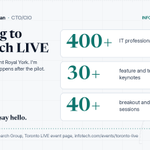
Those three questions sit at the center of the event. @infoTechRG expects more than 400 IT professionals at the Fairmont Royal York from Nov 10 to 12, with 30+ keynotes and 40+ breakout and workshop sessions.
One of their seven IT Playbook tracks is about moving AI from experimentation toward measurable value, the same gap I wrote about in my last post: xitter.gq/tuncertan/status/21187…. Agentic AI implementation has its own speaker on the list, so I'm hoping for real practice, not demos. I'll share what I heard the week after.
I'm also looking forward to Geoff Nielson's keynote, Become an Exponential CIO. It's about how governance, funding and metrics built for a different era can hold CIOs back. That's a conversation worth having out loud.
On Wednesday I'll join the industry dinner, which includes Financial Services.
If you'll be at the dinner or at the conference, let's say hello.
Sources: Info-Tech LIVE Toronto event page: infotech.com/events/toronto-… | Info-Tech press release (Aug 18): infotech.com/about/press-rel…
#InfoTechLIVE #AI #AIAdoption #CIO #ITLeadership #Toronto

Day 1 at Info-Tech LIVE 2026 in Toronto with @infotechRG. The theme is Agentic IT: From Hype to Value.
The numbers set the tone. 42% of organizations have AI adopted across departments with measurable impact. Where a governed AI strategy exists, 60% see measurable impact, against 19% with none. Only 50% have a board-approved one.
In my earlier post I promised I would seek answers to three questions about what happens after the pilot. Here is a glimpse of each.
1. Who owns AI once it is live? Carlene McCubbin put a named owner first on her list of tests for a production-ready agent.
2. How do teams change the work, not just add a tool? Info-Tech's HR onboarding build cut 40 touchpoints to 8.
3. How much are people letting AI agents do on their own? That depends on how confident the agent is, and where a person steps in.
My full answers will be in my Info-Tech LIVE recap on Friday morning.
Which of your agents has a named owner today?
Thanks to Carlene McCubbin, Andrew Sharp, Nysa Zaran Evagelinos, Gord Harrison and the Info-Tech Research Group team.
xitter.gq/tuncertan/status/21197…
#InfoTechLIVE #AgenticAI #AI #CIO #CIOCAN #AIStrategy #AIGovernance #AIAdoption #DataGovernance #DigitalTransformation


This week I'll be at Info-Tech LIVE in Toronto. I'm going with three questions, and they're all about what happens after the pilot.
1. Who owns AI once it's live? Once the project team moves on, who is left with monitoring, cost and drift?
2. How are teams changing the work, not just adding a tool? People stop using a new tool when the work around it stays the same.
3. How much are people letting AI agents do their own work? I want to hear what earned that trust.
If you were there, what would you want me to ask?
Those three questions sit at the center of the event. @infoTechRG expects more than 400 IT professionals at the Fairmont Royal York from Nov 10 to 12, with 30+ keynotes and 40+ breakout and workshop sessions.
One of their seven IT Playbook tracks is about moving AI from experimentation toward measurable value, the same gap I wrote about in my last post: xitter.gq/tuncertan/status/21187…. Agentic AI implementation has its own speaker on the list, so I'm hoping for real practice, not demos. I'll share what I heard the week after.
I'm also looking forward to Geoff Nielson's keynote, Become an Exponential CIO. It's about how governance, funding and metrics built for a different era can hold CIOs back. That's a conversation worth having out loud.
On Wednesday I'll join the industry dinner, which includes Financial Services.
If you'll be at the dinner or at the conference, let's say hello.
Sources: Info-Tech LIVE Toronto event page: infotech.com/events/toronto-… | Info-Tech press release (Aug 18): infotech.com/about/press-rel…
#InfoTechLIVE #AI #AIAdoption #CIO #ITLeadership #Toronto
1
1
49
At Info-Tech LIVE today with @infotechRG. The question I'm bringing to every session: who owns the AI result once the pilot ends? I'll share what I hear tomorrow. #AgenticAI #AI


30
The Real-Time Rail is live. @PaymentsCanada runs it and @bankofcanada oversees it. Banks that reconcile overnight won't feel the speed. Value needs an owner, a measure, and a changed process. Full article on my LinkedIn. #PaymentsModernization #RealTimeRail #DigitalTransformation

1
35

Most AI pilots don't fail. They just never end.
The demo works, the team likes it, and then it sits there for months because nobody owns the next step. Nobody decided who is accountable when it's wrong, what number it has to move, or which old step goes away when it goes live.
Getting AI out of pilots is mostly an operating decision, not a technology one. The model is rarely the problem. The missing pieces are an owner, a measure, and the willingness to change the process around it.
I'm at Info-Tech LIVE this week, and that's what I'll be listening for. Not which tools people picked, but how they moved from a good pilot to work that runs every day.
If you're there too, I'd like to hear what got your first use case over the line. And if it's still stuck, what's holding it?
1
37
This week I'll be at Info-Tech LIVE in Toronto. I'm going with three questions, and they're all about what happens after the pilot.
1. Who owns AI once it's live? Once the project team moves on, who is left with monitoring, cost and drift?
2. How are teams changing the work, not just adding a tool? People stop using a new tool when the work around it stays the same.
3. How much are people letting AI agents do their own work? I want to hear what earned that trust.
If you were there, what would you want me to ask?
Those three questions sit at the center of the event. @infoTechRG expects more than 400 IT professionals at the Fairmont Royal York from Nov 10 to 12, with 30+ keynotes and 40+ breakout and workshop sessions.
One of their seven IT Playbook tracks is about moving AI from experimentation toward measurable value, the same gap I wrote about in my last post: xitter.gq/tuncertan/status/21187…. Agentic AI implementation has its own speaker on the list, so I'm hoping for real practice, not demos. I'll share what I heard the week after.
I'm also looking forward to Geoff Nielson's keynote, Become an Exponential CIO. It's about how governance, funding and metrics built for a different era can hold CIOs back. That's a conversation worth having out loud.
On Wednesday I'll join the industry dinner, which includes Financial Services.
If you'll be at the dinner or at the conference, let's say hello.
Sources: Info-Tech LIVE Toronto event page: infotech.com/events/toronto-… | Info-Tech press release (Aug 18): infotech.com/about/press-rel…
#InfoTechLIVE #AI #AIAdoption #CIO #ITLeadership #Toronto
Today I'm starting a series I'll continue over the coming months: A CIO's view of AI, one industry at a time.
Each piece will look at how a sector is actually putting AI to work, what gets in the way between a working pilot and real use, and what I would do in the CIO seat. I'll draw on public research I trust, then give you my read of it.
Most AI pilots work in testing, but very few make it into the day to day business.
Only 25% of organizations have moved 40% or more of their AI pilots into production, according to @Deloitte's State of AI in the Enterprise 2026, a survey of 3,235 leaders. In a @zapier survey of 835 US leaders this May, 38% said their longest running AI pilot had been stuck in testing for over a year.
The technology is rarely the problem. A pilot can skip the hard parts: connecting to real systems, security and compliance reviews, someone owning it, and people actually changing how they work. Production can't skip any of them.
Here's the five-stage roadmap I recommend. I'll use this same lens as I go industry by industry.
1. Pick the problem, not the tool. Business result, named owner, and a baseline number.
2. Get the data and guardrails ready. The data owner and risk say yes in writing before the pilot starts.
3. Run a pilot that can grow. Use real users and real work, with the same controls you'll need later.
4. Change how the work gets done. Adjust the process, roles and training. Don't just switch the tool on.
5. Keep watching it, then let it do more. Track performance and cost, make sure you can explain its decisions, then expand one area at a time.
In my next post I'll look at the banking sector.
Which stage is your team stuck at right now, and what's holding it there?
Sources: Deloitte, State of AI in the Enterprise 2026: deloitte.com/us/en/about/pre… | Zapier AI pilot survey, May 2026: zapier.com/blog/ai-pilot-sur…
#AI #AIAdoption #DigitalTransformation #CIO #CTO #AIStrategy

4
3
279
Today I'm starting a series I'll continue over the coming months: A CIO's view of AI, one industry at a time.
Each piece will look at how a sector is actually putting AI to work, what gets in the way between a working pilot and real use, and what I would do in the CIO seat. I'll draw on public research I trust, then give you my read of it.
Most AI pilots work in testing, but very few make it into the day to day business.
Only 25% of organizations have moved 40% or more of their AI pilots into production, according to @Deloitte's State of AI in the Enterprise 2026, a survey of 3,235 leaders. In a @zapier survey of 835 US leaders this May, 38% said their longest running AI pilot had been stuck in testing for over a year.
The technology is rarely the problem. A pilot can skip the hard parts: connecting to real systems, security and compliance reviews, someone owning it, and people actually changing how they work. Production can't skip any of them.
Here's the five-stage roadmap I recommend. I'll use this same lens as I go industry by industry.
1. Pick the problem, not the tool. Business result, named owner, and a baseline number.
2. Get the data and guardrails ready. The data owner and risk say yes in writing before the pilot starts.
3. Run a pilot that can grow. Use real users and real work, with the same controls you'll need later.
4. Change how the work gets done. Adjust the process, roles and training. Don't just switch the tool on.
5. Keep watching it, then let it do more. Track performance and cost, make sure you can explain its decisions, then expand one area at a time.
In my next post I'll look at the banking sector.
Which stage is your team stuck at right now, and what's holding it there?
Sources: Deloitte, State of AI in the Enterprise 2026: deloitte.com/us/en/about/pre… | Zapier AI pilot survey, May 2026: zapier.com/blog/ai-pilot-sur…
#AI #AIAdoption #DigitalTransformation #CIO #CTO #AIStrategy
4
2
167
Ask a bank that hasn't launched AI agents what's holding it back, and you'll hear legacy systems. Ask one that has, and you'll hear regulation.
New research from @AmerBanker and @i2cinc, a survey of 160 people at banks, credit unions and payments companies, shows the shift clearly.
Among institutions still exploring customer-facing AI agents, 43% say legacy systems hold back personalization. Among active deployers, it's 16%. Regulatory concern goes the other way: 24% of non-users raise it, compared with 47% of active deployers.
My read: the blocker you plan for usually isn't the one you end up spending your time on.
Three lessons I'd take from it:
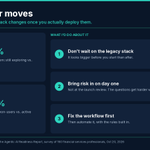
1. Don't let the legacy stack stop you from starting. It looks bigger from the outside than it does once you're working with it.
2. Bring risk and compliance in at the start, not at the launch review. The regulatory questions get harder once real customers are involved, so start answering them early.
3. Fix the workflow before you automate it. The report makes the same point: rethink the process first, and build the rules into it.
This isn't only a banking pattern. Most regulated industries will hit the same switch.
What turned out to be your real blocker once you went live?
Sources: i2c and American Banker research (Oct 20): i2cinc.com/agentic-ai-readin…
#AgenticAI #DigitalTransformation #Banking #CIO #AIAdoption

4
2
61
63% of banking leaders say they'd use an AI model they can't explain, if it performed better than one they can. I think that's the wrong trade.
That number comes from a new survey by @FTLongitude, the Financial Times' research arm, for @SASsoftware. They asked 300 banking leaders in 31 countries. The same study found 76% expect AI to make credit and risk decisions on its own within five years. Only 18% have AI governance fully built into how they work today. And 92% say at least one large language model in their bank already sits outside formal governance.
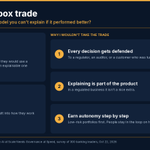
Here's my problem with the trade. A model you can't explain is only better until the first decision you have to defend. To a regulator, to an auditor, or to a customer who was turned down and wants to know why.
In a regulated business, being able to explain a decision is part of the product. It isn't a nice extra.
I liked how Nishant Taneja, Head of Credit Risk at @TangerineBank, put it in the report. In retail credit, more than 90% of their decisions are AI-based, with very little human in the loop. In high-risk portfolios, they've kept a person in the loop on purpose, until they trust the technology more.
That's the right instinct. Earn autonomy one portfolio at a time.
I hear the similar approachin my advisory calls with fellow CIOs and CTOs. It usually comes down to a judgment call: accept some ambiguity today for pilots, in exchange for more accurate results down the road. That can be the right call, as long as you can still explain the decision when someone asks.
Would you take the black-box trade? Where would you draw the line?
Sources: SAS press release (Oct 22): sas.com/en_us/news/press-rel…
#AI #Banking #CIO #CTO #AIModels #AIGovernance

51
Spent Wednesday night at @Perimeter in Waterloo with the @CIO_CAN, and I'm still thinking about it.
Perimeter is in its 25th year, started by Mike Lazaridis as a place where physicists just get to explore, and everything they find is shared freely.
Jorge Gonzalez-Outeirino runs IT and security there. Researchers need room to experiment, and the admin side needs things to just work. His answer is "trusted freedom": controls built so people can keep exploring. Research computing is kept separate from admin, AI tools come from an approved list with clear rules on data, privacy and cost, and one team's mistake can't take down everyone else.
Then Benjamin MacLellan, a Perimeter PhD now Chief Science Officer at Ki3 Photonics, made quantum feel a lot less abstract. What stuck with me:
1. Quantum networking isn't a new internet. It runs over the fiber we already have, next to today's traffic.
2. Use cases will arrive in stages. Chemistry and risk modelling need far better machines, and ideas like portfolio optimization are still unproven.
3. The bar isn't "quantum works." It's quantum doing the job better or cheaper than the classical option.
4. Error correction is moving fast. He said the physical qubits needed for one reliable qubit have dropped from about 10,000 to about 25.
5. The encryption risk is already here. Attackers can store data today and decrypt it later. Canada wants critical systems on post-quantum encryption by 2031, everything by 2035.
He also brought @OpenQuantumDes's fully open-source trapped-ion quantum computer. Seeing one on the table helps.
My takeaway for CIOs: quantum isn't next year's project, but your encryption inventory should be.
Thanks to everyone I met there for a great evening.
#CIO #QuantumComputing #AI


1
78
86% of CIOs say AI risk is growing faster than AI value. On average, about four times faster.
That number came out of Gartner's (@Gartner_inc) opening keynote at IT Symposium in Orlando this week, delivered by Daryl Plummer and Kristin Moyer. Their point: companies are adding AI faster than they are adding the controls to manage it.
Gartner calls the right kind of friction "good drag": governance, security, accountability and spending discipline. The wrong kind, bureaucracy and rework, just slows you down.
That matches what I've seen. Most organizations put the friction in the wrong place. A low-risk internal pilot waits months for approval, but once an agent is live and dealing with customers, there are almost no checks.
My rule of thumb: add friction where a mistake is expensive or hard to undo, and remove it everywhere else.
Where I'd keep good drag:
1. High-risk transactions. Payments, account changes, anything a customer would notice if it went wrong. Either a person approves it, or there's a hard limit the agent can't cross.
2. Get your data AI ready. Before an agent uses a new data source, someone checks that it's accurate, current and allowed to be used. Call it good d-RAG (pun intended): bad data in, confidently wrong answers out.
3. Handoffs between teams. When one team's AI output feeds another team's decision, someone has to own the review.
4. Giving agents more autonomy. Letting an agent go from suggesting to acting should be a deliberate decision, not something that just happens.
Where I'd remove drag: long approvals for read-only pilots, reviewing the same vendor again and again, and sign-offs nobody reads.
Good drag in the right places is what lets you move faster everywhere else.
Where is the friction in the wrong place in your organization?
Sources:
Gartner keynote recap: gartner.com/en/articles/it-s…
Gartner press release (Oct 19): gartner.com/en/newsroom/pres…
#CIO #AIGovernance #AILeadership #GartnerSYM #DigitalTransformation

36
92% of North American CIOs expect IT to take the blame when an AI tool a business unit bought on its own goes wrong. Only 21% say AI budgets sit with IT.
You can't govern AI by permission. Make the safe path the fastest one, and let accountability travel with the budget.
Sources:
prnewswire.com/news-releases…
thoughtworks.com/en-us/insig…
#AIGovernance #CIO #ShadowAI

22