

I am once again asking you to expect more from the tools you use every day. OK: English, हिंदी, ગુજરાતી; limited 日本語, 中文. Avatar by @evatrice. He/Him.
- Tweets5.9K
- Following492
- Followers1.2K
- Likes23.5K

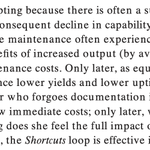





ALT Shortcuts are tempting because there is often a substantial delay between cutting corners and the consequent decline in capability. For example, supervisors who defer preventive maintenance often experience a “grace period” in which they reap the benefits of increased output (by avoiding scheduled downtime) and save on maintenance costs. Only later, as equipment ages and wears do they begin to experience lower yields and lower uptimes (see section 4). Similarly, a software engineer who forgoes documentation in favor of completing a project on time incurs few immediate costs; only later, when she returns to fix bugs discovered in testing does she feel the full impact of a decision made weeks or months earlier.


ALT Opus response: The complexity floor — why you can't just write M down as a program. For the domain-ω codings, there's a sharp sandwich: Upper bound: the completions of ZFC form a Π⁰₁ class, so the low basis theorem gives a model whose atomic diagram is low, hence Δ⁰₂ — computable from the halting oracle 0′. So M is "one jump up from computable." Lower bound: M is never computable (Δ⁰₁). The Henkin models are nonstandard in their arithmetic, and Tennenbaum's theorem (1959) forbids computable nonstandard models of PA — and a model of ZFC contains a model of PA as its arithmetic. So computable-M is out; Δ⁰₂ is the realistic floor for the ω-coding, and transitive models like L_{α₀} sit far higher in complexity than that.


ALT GitHub contribution chart style tiles but brown


ALT View of the ocean from Suspenso in Lisbon

ALT JJ Con venue


ALT Starry night on the Rhône by Van Gogh

ALT Nocturne in black and gold by James McNeill Whistler


