

The Space Sciences Laboratory (SSL) @UCBerkeley (UCB) is a preeminent university lab for space research and has participated in 50+ NASA missions since 1959.
- Tweets508
- Following155
- Followers1.8K
- Likes407


ALT Three UC Berkeley Space Sciences team members are edited to stand in front of a background featuring the upper edge of a planet in space. The image features details on their upcoming Reddit AMA event.

ALT A rendered image courtesy of Rocket Lab, showing the ESCAPADE mission's two identical satellites — “Blue” and “Gold” — orbiting around Mars.


ALT Photo of a Hall thruster identical to those on NASA’s Psyche operating in a vacuum chamber at JPL during tests. A ring of blue light emits a hazy stream of glowing material. The blue light is generated by xenon ions being accelerated through an electromagnetic field, which gives the spacecraft a gentle but steady acceleration. NASA/JPL-Caltech
ALT Three UC Berkeley Space Sciences team members are edited to stand in front of a background featuring the upper edge of a planet in space. The image features details on their upcoming Reddit AMA event.
ALT A rendered image courtesy of Rocket Lab, showing the ESCAPADE mission's two identical satellites — “Blue” and “Gold” — orbiting around Mars.


ALT UC Berkeley Space Sciences Lab engineers Chris Smith (left) and Bradley Pafchek (right) guide the COSI detector assembly toward its baseplate on July 08, 2026. Credit: UC Berkeley/Alan Toth

ALT John Tomisck, COSI’s principal investigator, and project systems engineer Ellen Taylor watch through a window as engineers Bradley Pafchek and Chris Smith guide the COSI detector assembly toward its baseplate on July 08, 2026. Credit: UC Berkeley/Alan Toth

ALT Engineers Bradley Pafchek and Matt Rubly examine the COSI (Compton Spectrometer and Imager) detector assembly at Space Sciences Laboratory on July 15, 2026. COSI is an upcoming mission that will measure gamma rays, the highest-energy form of light, to help scientists study energetic phenomena in the Milky Way and beyond. Credit: UC Berkeley/Alan Toth

ALT The COSI gamma-ray detector assembly rests on its baseplate on July 08, 2026. The gold part of the box is one of two thermal shields the mission will use to keep the detectors cold. Credit: UC Berkeley/Alan Toth


ALT Side-by-side comparison of two views of the gas giant Saturn, labeled “August 29, 2025” at the top left corner. At left is a straight-on view of Saturn, a globe with pale yellow horizontal bands at the equator and orange and pink at the mid-latitudes. Some bands towards the north and south pole have a light blue hue. There are prominent horizontal rings circling at the equator. At right, labeled “Saturn’s south pole,” the south-polar view of Saturn shows concentric bands in its atmosphere, mostly tan and orange, surrounding a dark central region that has a 10-sided outline. A small, dashed circle at the very center of the pole with an “X” inside denotes missing data.



ALT Against black space, Earth appears at left as a thin white-green crescent lit along its right edge. The Moon, slightly smaller and dimmer, sits at upper right as a matching tan crescent lit on the same side. Only a sliver of each world catches sunlight; the rest of both disks is lost in darkness.

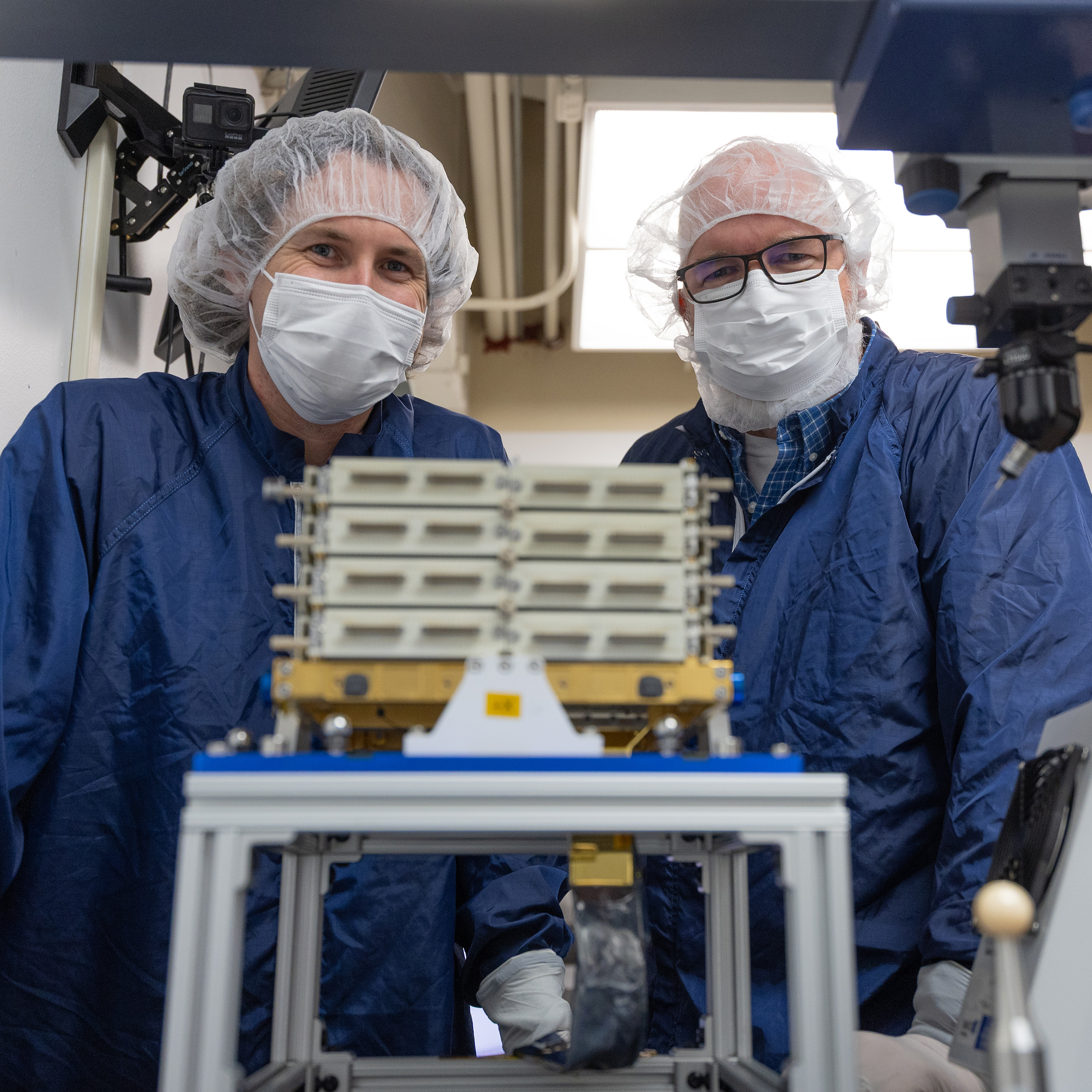
ALT Aerospace instrumentation mechanical engineer Matt Rubly (left) and senior aerospace engineer Christopher Smith (right) in cleanroom attire posing with germanium detectors in an SSL cleanroom.

ALT Aerospace instrumentation mechanical engineer Matt Rubly in cleanroom attire measuring germanium detectors in an SSL cleanroom.

ALT Gloved hands inserting screws into the rack containing COSI’s 16 germanium detectors.

ALT Aerospace instrumentation mechanical engineer Matt Rubly in cleanroom attire inserting screws into rack containing germanium detectors.


ALT This body of work by artist Martha Quirie is called Carrier Craters and is intended to be a functional dining set for four, based on the imagined craters of 16 Psyche. The bowls are all unique and intended to mimic the unique impact craters. Each cup is made with dimple “handles” that look like mini craters for better handability and more consistent connection to the surface of Psyche.


ALT A crescent-shaped Mars against the darkness of space. Within the thin illuminated crescent, the reddish surface and some clouds can be seen.
