

Pinned Tweet
Stocks are on UPPIN, on the same screen as every Solana coin.
The new Stocks hall on Markets lists 105 tokenized stocks, ETFs and pre-IPO names. Nvidia, Tesla, Apple, SpaceX, the S&P 500 and gold are there, and so are OpenAI and Anthropic.
Every price is read from the token's own Solana pool, day and night, and each page shows whether the US market is open.
32 of them have perpetuals, long or short with up to 20x, OpenAI and Anthropic included. There is no liquidation and no margin call. The margin you put in is the most you can lose.
Each position has a max gain and a max loss level, 5% from your entry on a 20x position, and it settles the moment the price touches one. These markets keep trading at night and on weekends, when the stock exchange is closed.
You can also buy and sell the stock tokens themselves with SOL or USDC, from your own wallet, for a 0.30% fee.
Every Solana coin now has a buy and sell ticket on its UPPIN page too, and 65% of the fee on those coin trades buys the coin you just traded and burns it.
Our own share of fees went from 40% to 35%, and those 5 points now go to the pool that stands behind every futures position.
Holder vote #1 is applied as well. 30% of every $ UPPIN trading fee buys $ UPPIN and burns it, and 20% goes to stakers in USDC.
This is what the move to our own server was for. It now watches 41 perpetual markets and reads the prices of all 105 stocks.
The Stocks hall and stock trading are not open to US persons.
app.uppin.fun/markets?hall=s…
The UPPIN futures pool counts a trade's result only once it is done. LP capital moves when fees arrive and positions close or settle.
While a position is still open, its gain or loss stays out of LP capital, and its margin stays reserved in the pool vault until it closes.
The pool page shows the difference. Its Pool value is everything in the vault, LP capital plus the first-loss buffer and the margin locked in open positions, and LP capital is shown next to it.
An LP withdrawal has to fit in the free part, LP capital less the margins of open positions. One that does not fit waits until positions close.
app.uppin.fun/earn/pool

When a board on UPPIN cannot refresh, it says so, and shows how old the figures on screen are.
The Markets board, the Stocks hall, Earn, the futures pool page and Payouts each carry an Updated mark. After a refresh it reads Updated just now, next to a small green square.
If a refresh fails, the figures stay where they are and the mark turns coral and reads Refresh failed, showing data from 1 min ago.
app.uppin.fun/markets

2
8
128
The settlement price of an expiry futures market on UPPIN is fixed on chain by the first price checkpoint after the market ends.
The price itself is the 5-minute time-weighted average up to the end, taken from checkpoints written before the end, so no later price can enter it.
Once it is fixed it no longer moves, and a settlement sent later uses that same price.
If the record holds no price for that window, the market waits. The only other way out is the operator key settling it flat, which gives every position its margin back, less borrow and the close fee.
app.uppin.fun/docs

5
106
When an expiry futures market on UPPIN ends with your position still open, the position is paid on the settlement price once it is collected.
The collect button is on the coin's market page, and any wallet may send the collect for you. Whoever sends it, the USDC lands only in your own account.
Your wallet also gets the position's rent back in that same step.
app.uppin.fun/docs

6
144
Unstaking $ UPPIN on UPPIN Earn starts a 7-day cooldown, and the tokens stop earning when it starts.
The Stake pool card on Earn counts them under Unstaking. On 20 Nov it showed 3,771,020.71 $ UPPIN there, earning nothing until withdrawn.
Each payout round is shared by active stake, so stake in its cooldown gets no share of it.
After the 7 days, you withdraw the tokens from the stake vault to your wallet.
app.uppin.fun/earn

6
87
An LP in the UPPIN futures pool is boosted when the same wallet has at least 1,000,000 $ UPPIN actively staked on Earn.
Boosted LPs share a pot fed by every futures fee, split by their pool shares. It pays in USDC, and you claim it on the pool page.
Being an LP does not need a stake. The program reads the stake at each deposit and withdrawal. Any wallet can also have an LP's stake read again, so an LP who unstakes loses the boost.
While nobody is boosted, that part goes to the LP pool instead.
app.uppin.fun/docs

Listing your tokens for Upside on a coin page on UPPIN, the Earn tab asks For how long.
It gives four lengths, 1, 3, 7 or 14 days, and 7 days is picked until you change it.
Every listing ends at the same hour of its day, so holders who pick the same day share one market.
Buying stops 5 minutes before that end.
After it, every token nobody claimed is yours to withdraw.
The i next to the row puts all of this in one place.
app.uppin.fun/markets

3
9
240
A new position on UPPIN expiry futures opens only on a fresh price record, so its entry is never priced from an old reading.
The program refuses the open when the coin's record holds no checkpoint from the last 2 minutes. It also refuses it until the record covers the full window of the 5-minute average.
Perpetual markets on UPPIN pause new positions the same way while the coin's price is not fresh.
app.uppin.fun/docs

1
5
169
An expiry futures market on UPPIN opens only on a coin pool that holds the program's minimum liquidity.
If that pool later falls under it, the market stops taking new positions.
If the pool falls below the liquidity floor, anyone can settle the market early. It settles at a price already on chain, the fixed settlement price or the recorded average, and no price is picked by hand.
Perpetual markets on UPPIN pause new positions the same way while a coin's pool is below its minimum liquidity.
app.uppin.fun/docs

1
5
150
The Costs and maximum loss part of the UPPIN docs also marks which payments are not costs.
For an Upside buyer, the most you can lose is the price you paid plus the service fee. If you choose to claim, you pay the claim price in USDC for each token, and the docs count that as buying the tokens.
For a Downside buyer, selling at the floor is your choice too. You hand over your tokens for the floor price in USDC, and the docs list it as a trade.
For a futures trader, a take profit or stop loss close pays the keeper's reward out of the payout. Every transaction also pays the network fee in SOL.
app.uppin.fun/docs

2
94
On a coin page on UPPIN, listing your tokens for Upside in the Earn tab ends with one more row, Price per token.
It is the USDC each buyer pays you for the right to claim one of your listed tokens. They pay it when they buy, and it stays with you whether they claim or not.
The row gives Low, Normal and High, and Normal moves with the target and the length you picked. Custom takes a price you type.
The i next to the row says a higher price earns more on each token but sells slower.
Buyers pay the 2% fee on top of it, and you get your full price.
app.uppin.fun/markets

On a coin page on UPPIN, the Earn tab lists your tokens for Upside.
After how much to list comes the target you sell above.
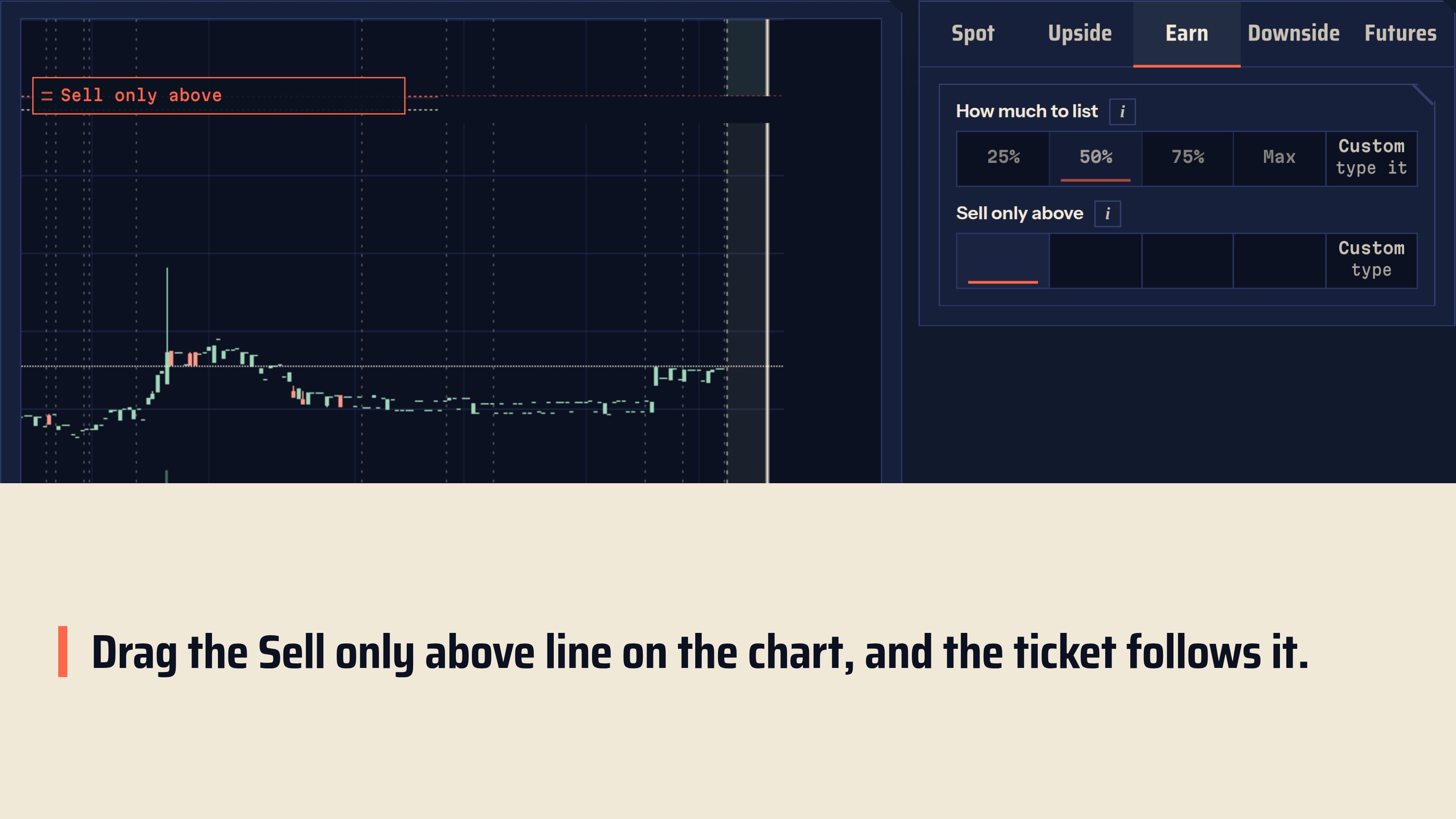
The chips offer a few targets above the price now, or Custom for a target of your own. You can also drag the Sell only above line on the chart, and the ticket follows it.
If the coin trades above that target before the end, buyers can claim your listed tokens at that price, and you are paid that price for each one. Below it, you keep your tokens.
The ticket also says in one line that any rise past the target on those tokens goes to the buyers, not to you.
app.uppin.fun/markets
The futures pool page on UPPIN has a chart of its last 7 days, one column per day.
Each column shows the fees that went to LPs that day and the trader results on the pool's side, drawn up when the pool gained from traders and down when it paid them.
Tap a day and the page reads out its fees, its trader results and the LP capital at the end of that day. Right now the chart runs from 13 Nov to 19 Nov.
app.uppin.fun/earn/pool

4
105
On the Positions page of UPPIN, Connect wallet brings up your own positions. Right under it, Or look up any wallet reads anyone else's.
Paste a Solana address there and press View. The page shows the Upside that wallet bought, the tokens it listed for buyers, its perpetuals and its expiry futures.
A line at the top marks the view as read only.
The buttons to claim tokens, collect USDC and take tokens back appear once that wallet is the one connected, so acting on its positions stays with its owner.
app.uppin.fun/positions

25
26
592
Anyone who visits can open every page of UPPIN.
Markets and the Stocks hall, Holders, Burns, Payouts, Receipts and the docs show the same to every visitor.
The Stocks hall lists tokenized stocks with their issuers. Burns shows each kind of burn UPPIN's fees pay for. Payouts lists every round of USDC paid to $ UPPIN stakers. Receipts carries every transaction with its Solscan link.
Only your own parts wait for a wallet, like your positions, My receipts, and your stake and claims on Earn.
So you can check the rules and the records before you connect.
app.uppin.fun

UPPIN works in your phone's browser, with the same pages you get on a desktop, from Markets and the Stocks hall to every coin page.
At phone width a coin page keeps Long, Short and Spot at the bottom of the screen.
Tap Connect wallet. In a browser with no wallet inside, the picker offers Open in Phantom and Open in Solflare, and either one reopens the same page in that wallet app to connect and sign there.
In Chrome on Android the picker also lists Mobile Wallet Adapter, which hands the signing to the wallet app on your phone. USB hardware wallets are not supported.
app.uppin.fun

6
172
A short perpetual on UPPIN runs on the same rules as a long, with its two levels the other way round.
You pick a margin in USDC and a leverage, and both levels sit 1 / leverage from your entry price. On a long, max gain is above the entry and max loss below it. On a short, max gain is below and max loss above.
Once the mark price touches either level, the position settles there. There is no liquidation, and the most a short can lose is its margin.
So a short can offset part of a drop in a coin you hold, while the coins stay in your wallet. It gains as the price falls, up to its max gain level. If the price rises instead, the short loses, at most its margin.
app.uppin.fun/docs

A trader opened a long perpetual on NVDAx, NVIDIA's stock token, on UPPIN on 17 Nov.
It took 5 USDC of margin at 5x, a $25.00 position, and it is listed under Perpetual trades on the NVDAx page.
A stock perpetual needs no NVDAx in your wallet. Margin goes in as USDC, and what a close pays out is USDC too.
There is no liquidation. The position settles when the price touches its max gain or max loss level, and the most it can lose is the margin.
Part of its open fee went to service revenue in the same transaction, the revenue that pays $ UPPIN stakers in USDC.
That open is on Solscan.
solscan.io/tx/4jTnZj4thoJA8j…

The chart on a coin page on UPPIN reads in USD market cap by default.
On the $ UPPIN page its title reads UPPIN/USD · MC, and the axis is marked MC · USD.
Two switches at the top right of the coin's header change that, one for USD or SOL and one for Price or MCap.
Pick SOL and Price, and the chart title becomes UPPIN/SOL while the axis reads Price · SOL.
Every coin page on UPPIN has the same two switches.
app.uppin.fun/markets

6
157
$ UPPIN exists to share in what UPPIN earns.
Every trade on UPPIN pays a small fee, and the fee is split the moment it is paid.
Stakers get 20% of every $ UPPIN trading fee and 40% of service revenue, paid in USDC. 30% of every $ UPPIN trading fee and 19% of service revenue buy $ UPPIN on the market and burn it.
Stakers can also claim back up to 10% of the service fees they paid, earn a bigger referral share, and vote on what UPPIN builds next.
By 17 Nov, those shares had paid stakers 406 USDC and burned 161,280,378 $ UPPIN.
Every payout round is its own transaction. The latest one, from UPPIN's service revenue, is on Solscan.
solscan.io/tx/4ccXVWQGbd3DLT…
