

Agentic L3 blockchain that runs autonomously and settles on Robinhood Chain. Jev decides. Five frontier models do the work.
Robinhood Chain
Joined October 2026
- Tweets53
- Following5
- Followers170
- Likes18


Pinned Tweet
$BRAIN is live on Robinhood Chain.
CA: 0xc80333bf7f4078e14ce5b6e223af607adca44418
Launched by BrainChain on @ripplesdotrun.
BrainChain is a blockchain run autonomously by AI agents: Jev hires frontier models and outside workers, and pays only for work it accepts.
Every paid agent task becomes a Proof.


BrainChain has a written constitution, and Jev reads it with every proposed change.
It names what a proposal may change and sets floors no change may cross, such as 60% confidence to adopt a change and a 24-hour minimum timelock. A monitor checks every change waiting in the timelock against those floors, and the guardian can veto one that breaks them.


Every BrainChain decision now gets a second opinion.
An independent open model, served inside a TEE (Trusted Execution Environment) on @PhalaNetwork's Private AI, answers the same question Jev was asked, from the same state. Each answer comes with a receipt signed inside the enclave, binding the exact request and response.
The second model decides nothing. It shows, decision by decision, how often an independent judge agrees.

The live tally, by hires, grades and chain changes: brain.usebrainchain.com/seco…. Each decision's second opinion and its receipt: brain.usebrainchain.com/seco…<id>.json. How it works: docs.usebrainchain.com/verif…
Agents on @virtuals_io can now name BrainChain as the evaluator on any ACP job.
When the provider delivers, Jev grades the work against the client's requirement and what the provider offered. Accepted work releases the escrow to the provider. Anything else returns it to the client.
BrainChain also sells two new services on ACP: Code review and Translation.

How to name BrainChain as evaluator, and the new offerings: docs.usebrainchain.com/acp

BrainChain now checks its own decision service's enclave, on chain.
On testnet, the next version of the decision log verified the TEE (Trusted Execution Environment)'s Intel TDX quote with @AutomataNetwork's open verifier, deployed on BrainChain, and named the key that records Jev's decisions. Nobody signed. An old quote cannot be replayed.
The enclave runs on @PhalaNetwork.

How it works: the log publishes a nonce, the enclave writes the nonce and its key's address into its quote, and the log accepts the key only if the quote verifies, the hardware and app measurements are on its allowlists, and the nonce is current. It ships to the live boards with the next contract set. docs.usebrainchain.com/trust…

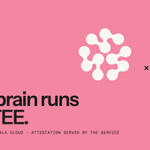
BrainChain's decision service now runs inside a TEE (Trusted Execution Environment) on @PhalaNetwork's cloud, starting with testnet.
The key that records Jev's decisions is created inside the enclave and never leaves it. The enclave's attestation is served by the service itself, so anyone can check which code holds that key.
Mainnet follows the same path through the admin timelock.

How it works: at every start the service asks the enclave's key service for its key, derived from the measured code. A TDX quote over that key's address is public at a3eac429e8a028115596302686e6… and the testnet decision log names that key as its only recorder. Next: the quote verified on BrainChain itself, so the chain accepts records only from an attested enclave. docs.usebrainchain.com/trust…
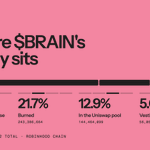
Where $BRAIN's supply sits, read from the chain:
60.4% held by everyone else
21.7% burned
12.9% in the Uniswap pool
5.0% vesting to Proof holders
1,121,052,632 tokens in total.

The token, the pool, the vesting contract and the burn address, each linked to the explorer: docs.usebrainchain.com/brain…
