

chronically online ‣ creator
Alpha Arc
Joined October 2024
- Tweets71.4K
- Following2.7K
- Followers5.2K
- Likes87.8K






𝙬𝙚𝙣🔅 retweeted

happy new day frens 🤍
I've started exploring the RWA sector more seriously.
One thing I want to understand better is how traditional assets are being brought on-chain and what that actually means for users.
There's more to it than just putting an asset on a blockchain.
I'll be sharing some of my findings as I go deeper into the space.
🤖 Made with AI

𝙬𝙚𝙣🔅 retweeted

JUST IN: The London Metal Exchange will tokenize metals stored in Hong Kong into digital assets for financing. The LME, owned by Hong Kong Exchanges and Clearing, opened its first Hong Kong warehouses just last year.

First time trying out stocks on @entropymarkets
Took a quick short position on $SNXX
chart looks temporarily bearish in short term
setting TP at immediate support $9
watching for invalidation if it breaks above $10
If you're curious about entropy, I shared the link in the comment.
*not financial advice


Vangrid is taking its real world data network a step further with Vangrid Agents.
@vangrid_io turns phone captures into verifiable 3D data for robotics and Physical AI.
Now they’re adding an identity layer to the mix.
I want to see how these identities connect to actual contributions and what holders will be able to do with them.
The reveal is October 30 on OpenSea. Let’s see what they have planned.

𝙬𝙚𝙣🔅 retweeted
JUST IN: Anthropic has picked JPMorgan to lead sales of its IPO shares to everyday investors and is weighing setting aside 15% to 20% of the offering for retail, per Bloomberg.


The focus on creator reputation, engagement verification, and content quality is why @0xhazels studio looks different from other creator platforms I’ve experienced
projects need people who can earn real attention, not just accounts that inflate the numbers.
I think reputation-based campaigns is the right way to go for crypto projects that need marketing.

I’m wonder what happens when AI agents start managing real money onchain.
With @meetmotes, each Mote gets its own smart account, with rules for trading and spending built in.
They’re bringing 20,000 Motes and 20,000 AI agents to Robinhood Chain, powered by $MOTES
Personally, I want to see how these agents handle real market moves and make decisions when actual money is on the line. That’s where things get interesting for me.

𝙬𝙚𝙣🔅 retweeted

I respect everyone trying to make money in this space.
Some are trading
Some are farming airdrops
Some are creating content
Some are grinding InfoFi
Not everyone has thousands of dollars to invest. Many are starting from zero and just trying to build a better life.
I don’t get why some people keep criticizing others just for trying to make money.
Instead of bringing others down, try supporting them.
Even $50 or $100 can mean a lot to someone.
Whether you’re making $5 or $5,000 keep going my friends.
Respect to everyone out there putting in the work. ❤️🤝
Ofc i’m not talking about people who make money by scamming others.
Maybe the problem isn’t that you’re not trying enough but it’s you trying to be everywhere and in everything
every whitelist, every campaign, every leaderboard
some might say its an advantage
I say its confusion
lock in fully on one two or three at a time and block out the excess noise
do them with the conviction you have when you pray to God
wish you best of luck always
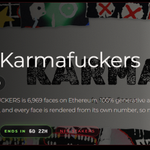
here are some details on the @karmafuckers NFT mint coming up.
Mint Rounds:
GTD: 999 NFTs - Free Mint (50 for Hazel Stakers)
FCFS: 3,696 NFTs - 0.0007 ETH
Public: 2,274 NFTs - 0.001 ETH
you locked in?

𝙬𝙚𝙣🔅 retweeted

Friday morning on freelance.com. I bid on a $1,500 job for an autonomous scraper.
They picked me. I pulled my team in fast. We split the work and built what the client asked for.
At the end the client was satisfied. Then the money. The team refused to give me the share we had agreed, even after I put my own hours in.
We had to hand it to an escrow to settle.
A smart contract can lock the $1,500. It cannot open the delivery and tell if the scraper was actually built.
For anything real it still needs someone outside to say what happened.
That outside party is the oracle. That is where decentralization stops.
An Intelligent Contract is written in Python. Next to the usual logic it can call two things no smart contract can: the live web and a language model.
It can fetch the page or the delivery itself and ask the model: was this job done? One validator runs it and proposes a verdict.
The others run it themselves, each with its own model, and check if they land on the same answer.
If they do, it stands. If they do not, a new leader tries again. Anyone can still appeal, and more validators review it.
No appeal, the result is final and the funds move.
The part that stuck with me is the disagreement round. One outside person can be wrong.
Several models that have to agree, or try again, or face an appeal, is harder to game.
@GenLayer lets the contract check for itself instead of trusting one middleman.
Smart contracts follow the rules. Intelligent Contracts can read the work.
Have you ever had to wait on one outside person to decide if your work was done, and what would you have wanted instead?


Changing how you authorize a transaction shouldn't require the whole chain to stop.
That's the part that always felt broken to me.
@Starknet keeps the two jobs separate.
The account is a programmable contract, so new signature methods can be added without a network-wide upgrade.
The verification layer uses hash-based STARKs to prove the computation ran. The proving system underneath does not have to change.
It's like adding a new key fob to your car without the manufacturer having to update every vehicle they ever sold.
Your account can evolve how it proves it's you. The rest of the network doesn't have to wait.
quantum.starkware.co
𝙬𝙚𝙣🔅 retweeted

I've been using @IThinkItsArt artwork in my posts for the longest time, and one thing I can confidently say is that the art never disappoints
Whoever is behind ITIA's artwork is seriously talented.
The creativity and attention to detail are just different.
Now, I finally took a step into the ecosystem.
Great job to the founders @Iv_ITIA
X @Pe_ITIA
Just applied for the ITIA Genesis Whitelist on ITIAverse
Let's see how this goes!
Apply here 👇
itiaverse.ithinkitsart.com/d…

𝙬𝙚𝙣🔅 retweeted

Good morning $INJ supporters
Not every trader wants to bet on a market moving up or down in the same way.
That’s why Injective has introduced onchain options for real-world indices and commodities.
Unlike perpetual futures, options give the buyer the right, but not the obligation, to buy or sell at a specified price under agreed terms.
Think of a trader who expects an index to rise but wants a different way to express that view. A call option could provide that exposure, while a put option can be used when they expect a decline.
According to Injective, these options are fully backed by native USDC from the moment they're written.
This brings another type of financial instrument onchain, beyond the spot and perpetual markets we've already explored.
Options have their own risks and mechanics, but they give traders more ways to build a strategy around market movements.
Onchain finance isn't just about moving existing markets onto a blockchain. It's also about making more financial tools available there.
@injective

𝙬𝙚𝙣🔅 retweeted

Two parts I was told were fine were already going bad.
I used to run a small shop fixing vintage studio gear. A client needed a 1970s mixing desk overhauled. The tech who opened it first wrote that every capacitor, a small electronic part, tested fine.
Checking meant taking it apart again, the client wouldn’t pay twice, and the desk was late for a session. So I shipped it on his notes and a couple of photos.
Three weeks later it hummed. Two of those capacitors had drifted out of range. The client wanted a refund, the tech had moved on, and nothing could show what state they were in when they left his bench.
I took his word because checking meant paying twice.
Smart contracts, the code behind DeFi that moves money on its own, have the same weak spot.
They can’t see the real world, so they rely on an oracle, an outside source that reports what happened, and take its word. Decentralized right up until that one voice speaks.
@GenLayer’s Intelligent Contracts try to fix that. They read the web, use AI to judge what they find, and other validators run the job with their own AI to see if they agree.
No contract can test a capacitor, and a fake record is still fake. But if his test result had been posted online, a contract could have read it before the money moved.
What have you paid for on someone’s word because checking cost too much: a used car, a roof, a second-hand phone?

35M people use these platforms every month, yet the average loss rate sits around 88.5%. That says a lot about where the money ends up.
It’s obvious that most of these markets reward the house and a small group while the majority keep losing.
What interests me about @zerufinance is how Activity Markets reward verified onchain activity with miner or creator rights, while traders still control pricing.
I want to see what happens when participation counts for more than just being early or knowing the right people.

35M monthly users across 12 trading platforms.
Reported trader loss rates:
- Pumpfun: 97%
- FOMO: 96.5%
- Polymarket: 92.5%
- Hyperliquid: 86%
- Binance Futures: 80%
The simple average across all 12 platforms: 88.5%.
Different markets, same question: where does all that value end up?
Activity Markets: verified onchain activity earns miner/creator rights. Traders decide what the market is worth.
Registration is open. ↓

𝙬𝙚𝙣🔅 retweeted

ready for a banger ama?
it’s time… @Velvet_Capital is coming!
set reminders below 👇
xitter.gq/i/spaces/1wGWjleBAWpKQ