
a natural general intelligence 🍖📻 W3WYM
Washington, DC
Joined January 2009
- Tweets857
- Following133
- Followers444
- Likes507







Pinned Tweet
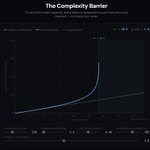
I am developing a formal theorem I call the Verification Complexity Barrier.
In a nutshell, if a program has some components `n` that have connectivity factor of `k > 0` , then verification complexity increases superlinearly for each new component. Therefore the time required to fully verify the system always exceeds time to generate components.
After a while, because it's superlinear, the verification complexity takes off and becomes impossible to keep up with in some finite amount of time. This was true before AI, but is much starker now as code generation time trends towards zero. You hit the barrier sooner.
We all have finite capacity - even AI agents - so there will always be a certain number of components `n` where the wall is hit. You must spend more and more effort on verification for each new component in the system.
The best thing you can do is spend time changing the "topology" of the problem - change the software architecture - so that the exponent of verification complexity is lowered ([1] Lehman) and the curve is flattened. You can bundle components into modules, you can add automated tests, you can use formal proofs, you can use type systems. These things push the barrier to the right. They buy you more components and a more complex system. But the theorem suggests you can only ever defer the barrier, never completely eliminate it.
AI Agents can burn tokens all day long generating software components and tests for those components. They can find bugs and fix them, but they cannot prove the absence of bugs (per [2] Dijkstra, [3] Rice, [4] Smith, and others). And "Bug" needs to be defined against someone's spec for what "working" and "not buggy" looks like. The more you build with Agents, the heavier the verification burden becomes.
This may sound like the same trite observation others have made here on X: "Our bottleneck is no longer writing code, but reviewing code" [5] and "I am the bottleneck now." [6] True, but I don't think anyone has captured the magnitude of the problem. The math is: at a certain component count `n`, it is literally impossible for you, your team, and your agents to completely verify a system. The bottleneck goes to zero, and nothing gets through.
So what software companies do in the real world is release incompletely verified software and massively scale up. This shifts the burden of verification onto their customers, because "given enough eyeballs, all bugs are shallow" ([7] Raymond). If you can get enough eyeballs, this is a very cost-effective way to shift the barrier to the right by massively increasing your team's capacity. You walk the tightrope of doing enough internal verification before release so you don't lose customers, while tolerating a certain amount of escaped bugs, which - if those bugs matter at all - your customers will find for you.
Meanwhile, massively scaling up just accepts the growing cost of complexity. You can push `n*` from 15 to 30 by quadrupling your capacity. To get to 60 you need to quadruple again, and then again to get to 120. Your cost curve is superlinear to get linear gains in system size. At a big enough scale, you amortize the cost across your customer base and the economics work.
Contrast that with a sufficiently complex vibecoded app built for a small audience - high complexity costs can't be amortized at small scale. I expect to see many people and companies try and fail at vibecloning complex SaaS in the near term. Complexity cost economics only scale with audience size (I will share another model for this).
I do think SaaS prices will be corrected downwards to account for savings in code generation, but I predict that once the irrational exuberance for vibing fades, we'll see that it still makes sense to buy rather than self-build complex SaaS.
A broader implication is that AI Agents will never be able to self-verify. Humans, too, will never be able to fully verify their behavior, because LLMs are by design of maximal complexity. Did you see the size of those error bars in the latest METR results? [8] The longer the horizon on a task, the more spread in AI agent outcomes. This is the Barrier in action. Spread is a feature of GenAI, but in practice it means heaps more output to review and verify.
The Complexity Barrier shows you literally won't have time to review it all. At the inflection point of verification complexity, you have to fall back on vibes. The implication for fast-takeoff AGI is even scarier: if AI does reach a point of recursive self-improvement, this theorem suggests it will be structurally impossible to know that behavior is aligned, because you won't be able to completely verify. Drift is bad enough in vibe coding. Runaway AI will drift massively and there's no way of knowing where it will end up.
All that's to say, verification should be the focal point of AI Engineering for the foreseeable future and maybe forever. That is: how do you capture what you want to do, refine that into specifics, and then follow up with automated tests, assertions, evals, and customer feedback to progressively harden your software?
The verification problem is acute now because of how cheap software generation is. Because of the superlinear nature of software verification complexity, companies that push hard on the barrier and successfully shift it right will have a built-in moat versus those who fail to put in the verification work.
Detailed blog post and interactive model incoming.
Links:
[1] en.wikipedia.org/wiki/Lehman…
[2] cs.utexas.edu/~EWD/transcrip…
[3] en.wikipedia.org/wiki/Rice%2…
[4] cse.buffalo.edu/~rapaport/Pa…
[5] xitter.gq/shl/status/19408813912…
[6] xitter.gq/thorstenball/status/20…
[7] en.wikipedia.org/wiki/Linus%…
[8] metr.org/blog/2025-03-19-mea…


Yes! Spec-driven dev may be boring and not in vogue, but it's still necessary and contains information that's not in the code. I say, write specs that are focused on declaring your invariants - "what must be true" - and iterate them with the code.

Property-based tests generated from the spec and from the code catch different bugs. Use both.
In a new paper, across 25 agent-built apps, Spec-Driven PBT found 56 bugs the Code-Driven tests missed, and Code-Driven PBT found 43 that Spec-Driven missed, so 59% of bugs were found by only one approach.
Setup
- An agent writes invariants in plain English from the requirements doc
- Then it reads the code to turn them into property tests
- The baseline derives properties from the code alone
Why PBT?
- Each property-based test kills about 50× as many mutants as the average unit test (prior work cited in paper)
- Properties double as documentation, far shorter than the implementation
Bugs only one approach found, by type
- Spec-Driven: mostly state, lifecycle and logic errors (61% of 56)
- Code-Driven: mostly input handling (49% of 43)
Limitations
- Bugs were judged by the same model that wrote the tests (Claude Opus 5); 25 sampled by hand, all held up
- The prompts differed between approaches
- The method needs a good spec
Insight
"Invariants obtained from the specification are not biased by the behaviour of a particular implementation, and can therefore falsify behaviour about which the implementation is internally consistent."
My take
The code can’t be the only oracle, the spec must be one too. Next: move key properties into types and checks, so they hold by construction.
arxiv.org/abs/2611.15920

1
39
update, blog post: research.thinknimble.com/ess…

I am developing a formal theorem I call the Verification Complexity Barrier.
In a nutshell, if a program has some components `n` that have connectivity factor of `k > 0` , then verification complexity increases superlinearly for each new component. Therefore the time required to fully verify the system always exceeds time to generate components.
After a while, because it's superlinear, the verification complexity takes off and becomes impossible to keep up with in some finite amount of time. This was true before AI, but is much starker now as code generation time trends towards zero. You hit the barrier sooner.
We all have finite capacity - even AI agents - so there will always be a certain number of components `n` where the wall is hit. You must spend more and more effort on verification for each new component in the system.
The best thing you can do is spend time changing the "topology" of the problem - change the software architecture - so that the exponent of verification complexity is lowered ([1] Lehman) and the curve is flattened. You can bundle components into modules, you can add automated tests, you can use formal proofs, you can use type systems. These things push the barrier to the right. They buy you more components and a more complex system. But the theorem suggests you can only ever defer the barrier, never completely eliminate it.
AI Agents can burn tokens all day long generating software components and tests for those components. They can find bugs and fix them, but they cannot prove the absence of bugs (per [2] Dijkstra, [3] Rice, [4] Smith, and others). And "Bug" needs to be defined against someone's spec for what "working" and "not buggy" looks like. The more you build with Agents, the heavier the verification burden becomes.
This may sound like the same trite observation others have made here on X: "Our bottleneck is no longer writing code, but reviewing code" [5] and "I am the bottleneck now." [6] True, but I don't think anyone has captured the magnitude of the problem. The math is: at a certain component count `n`, it is literally impossible for you, your team, and your agents to completely verify a system. The bottleneck goes to zero, and nothing gets through.
So what software companies do in the real world is release incompletely verified software and massively scale up. This shifts the burden of verification onto their customers, because "given enough eyeballs, all bugs are shallow" ([7] Raymond). If you can get enough eyeballs, this is a very cost-effective way to shift the barrier to the right by massively increasing your team's capacity. You walk the tightrope of doing enough internal verification before release so you don't lose customers, while tolerating a certain amount of escaped bugs, which - if those bugs matter at all - your customers will find for you.
Meanwhile, massively scaling up just accepts the growing cost of complexity. You can push `n*` from 15 to 30 by quadrupling your capacity. To get to 60 you need to quadruple again, and then again to get to 120. Your cost curve is superlinear to get linear gains in system size. At a big enough scale, you amortize the cost across your customer base and the economics work.
Contrast that with a sufficiently complex vibecoded app built for a small audience - high complexity costs can't be amortized at small scale. I expect to see many people and companies try and fail at vibecloning complex SaaS in the near term. Complexity cost economics only scale with audience size (I will share another model for this).
I do think SaaS prices will be corrected downwards to account for savings in code generation, but I predict that once the irrational exuberance for vibing fades, we'll see that it still makes sense to buy rather than self-build complex SaaS.
A broader implication is that AI Agents will never be able to self-verify. Humans, too, will never be able to fully verify their behavior, because LLMs are by design of maximal complexity. Did you see the size of those error bars in the latest METR results? [8] The longer the horizon on a task, the more spread in AI agent outcomes. This is the Barrier in action. Spread is a feature of GenAI, but in practice it means heaps more output to review and verify.
The Complexity Barrier shows you literally won't have time to review it all. At the inflection point of verification complexity, you have to fall back on vibes. The implication for fast-takeoff AGI is even scarier: if AI does reach a point of recursive self-improvement, this theorem suggests it will be structurally impossible to know that behavior is aligned, because you won't be able to completely verify. Drift is bad enough in vibe coding. Runaway AI will drift massively and there's no way of knowing where it will end up.
All that's to say, verification should be the focal point of AI Engineering for the foreseeable future and maybe forever. That is: how do you capture what you want to do, refine that into specifics, and then follow up with automated tests, assertions, evals, and customer feedback to progressively harden your software?
The verification problem is acute now because of how cheap software generation is. Because of the superlinear nature of software verification complexity, companies that push hard on the barrier and successfully shift it right will have a built-in moat versus those who fail to put in the verification work.
Detailed blog post and interactive model incoming.
Links:
[1] en.wikipedia.org/wiki/Lehman…
[2] cs.utexas.edu/~EWD/transcrip…
[3] en.wikipedia.org/wiki/Rice%2…
[4] cse.buffalo.edu/~rapaport/Pa…
[5] xitter.gq/shl/status/19408813912…
[6] xitter.gq/thorstenball/status/20…
[7] en.wikipedia.org/wiki/Linus%…
[8] metr.org/blog/2025-03-19-mea…
46


built-in property based testing 👀

Introducing my new side project - Fai.
github.com/Krzysztof-Cieslak…
It’s a functional programming language with which I try to explore how we can design better “classical” software engineering tools specifically for AI agents.
A couple of design choices I've made are described ⬇️

26
I haven't read this all the way through, but I am also feeling that CI needs to be completely reworked. Namely, I think tests and other long jobs should be moved from being a blocking check to a constantly-running background process involving more robust exploratory testing. That is, sleepless automated QA.
linear.app/now/ci-bottleneck…
I also think Docker is becoming a blocker. My agency put effort into making a worktree-based workflow with agents smoother, but I'm constantly running out of RAM to run all the stacks! It's also a chore to prune worktrees and docker images all the time.
In personal projects, my preferred stack has become Go + SQLite + HTMX because the iterations are so fast without any docker containers or major Python and JavaScript dependencies to manage. I haven't scaled that stack beyond small projects, but I'm considering rethinking my agency's app bootstrapper from the ground up focusing entirely on minimizing the "weight" of the app and iteration speed on both the dev machine and in CI.

33

Lots of thoughts on this wrt agentic coding. OP poses the real question at the end: who decides what "correct" means?
Formal verification is great and all, but who verifies the verifiers? Can we really imagine handing it all over to AI someday?
leodemoura.github.io/blog/20…
1
203
100% agree with Dax here: xitter.gq/thdxr/status/202885155…
The "size" of a coding task is not intrinsic to the task. It exists between tasks in the graph of their relationships. That is mostly hidden and changes over time.
This is why estimating software work is so hard, and why AI doesn't magically fix it.
180
‼️

~9 months ago I predicted the emergence of “open source, closed spec”
Many ai founders have said “I can screen share the code, I will never disclose our evals”
Now @tldraw
139
Never before has solar power been so seamlessly converted to capital. Feel the AGI beaming down upon you. Praise the sun

Announcing a new Claude Code feature: Remote Control. It's rolling out now to Max users in research preview. Try it with /remote-control
Start local sessions from the terminal, then continue them from your phone. Take a walk, see the sun, walk your dog without losing your flow.
79
GenAI is already capable of generating interactive worlds and interfaces. It's fascinating to imagine what software will look like when that goes mainstream. I imagine it will be less rigid, more fluid, tactile, and organic like the real world.
52
Stop saying LLMs are "non-deterministic." It's not interesting b/c a: that's by design, and b: our world is non-deterministic.
Focus instead on tolerances
44
He's live!
moltbook.com/u/smolder
No surprise he's already getting more engagement on social media than me:
1
68
The "size" of a coding task is not intrinsic to the task. It exists between tasks in the graph of their relationships. That is mostly hidden and changes over time.
This is why estimating software work is so hard, and why AI doesn't magically fix it.
Before AI, getting devs to write tests was painful. "Just let me merge this, I'll write tests later."
Now writing tests is gonna be the job! There will be much whining

Instead of "plan mode", try "proofs mode".
Prompt to build individual, mini-app proofs into a ./proofs dir.
Then assemble your proofs into an app.
74
The design -> code -> test loop is still fundamentally serial per feature. You can only use 100s of agents when your problem is embarrassingly parallel.
1
42
"How Amateur Radio Fans Decoded SpaceX's Telemetry Data" - between this and the use of JavaScript on the Dragon flight, I'm feeling more and more qualified to build rocket ships 🚀 youtube.com/watch?v=74_N163H…
2
Happy Raspberry Pi Day! Today I experimented with low-power satellite receiving and decoding using an RTL-SDR dongle, RPi, and homemade antenna. I picked up a pretty good signal from the NOAA 18 weather satellite this morning. #PiDay2021 #PiDay #hamradio

4