

Nature lover. Interested in environment, wildlife, mental health, progressive politics, social justice, humanity and equality.
England
Joined February 2009
- Tweets20.9K
- Following2.2K
- Followers2K
- Likes4K




Nessie retweeted

There must be hundreds of thousands of people in this position. And I completely get it.
Life is a fucking slog. Now, more than ever. And for those who depend on healthcare and welfare support, many are already living on the very brink of existence.
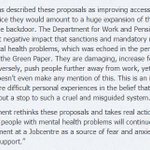
And as part of all of this "debate", the sheer irony of anxiety being dismissed as a "mild" condition, while threatening to strip away the very support people depend on to survive.
WHAT THE FUCK DO YOU THINK THAT'S GOING TO DO TO THEIR MENTAL HEALTH?!
How can we possibly expect people to recover, find stability or improve their circumstances while systematically dismantling the support that makes any of that possible?
It's beyond cruel. It's utterly self-defeating.
I keep saying, every few months, that this country must surely have hit rock bottom.
But somehow, WE KEEP FUCKING DIGGING.
To anyone reading this who is frightened, overwhelmed or struggling to see a way forward, please know that YOU ARE NOT ALONE.
You DESERVE dignity, security and support. You are NOT a burden, and your worth is NOT measured by your ability to work.
Please reach out to someone you trust, a support organisation or anyone who can help you through this. Don't feel you have to carry it all on your own.
Your life matters. And you deserve so much better than this.
#MilburnReview

Just casually helping friends contact the police over an X mutual planning to terminate themselves after the #MillburnReport
How do you sleep at night @andyburnham @patmcfaddenmp @JohnHealey_MP
We are a country governed by stone cold monsters.
This. Is. STILL. Democide.
Nessie retweeted

This is going to be the fight of our lives.
You might think it doesn't apply to you if you are over 25, can hold down a job, or are a home owner, but welfare reforms can and will affect any of us at any point in our lives.
Nessie retweeted

⚠️Labour commissioned Prof. Fonagy’s independent review and now hopes nobody reads it. Why? It proves rising mental ill-health is real & warns cutting income makes it worse—blowing a hole in their disability benefit cut plans. ⚠️
👇👇👇👇👇👇👇
gov.uk/government/publicatio…

Labour ordered two reviews. Clinical expert Proffesor Peter Fonagy found youth mental illness is real and cutting income worsens it.
Politician Alan Milburn, who has no medical background, wants to cut disability benefits anyway.
Why listen to Milburn over Fonagy? @andyburnham
Nessie retweeted

The manufacturing of consent for another round of welfare cuts is well under way. And frankly, the whole thing is becoming depressingly familiar.
Before Parliament has even seen Alan Milburn’s final report, we’re being treated to a steady drumbeat of media interviews, briefings and commentary telling us that painful choices are unavoidable. That radical reform is necessary. That anyone raising objections simply doesn’t understand the scale of the problem.
It’s all quite telling. Because increasingly, I don’t think Labour MPs are the real audience for this exercise.
The real audience is outside Parliament: the media commentariat, think tanks and, through their relentless promotion of these proposals as economic ‘common sense’, a currently sceptical public.
The objective, it seems, is to turn scepticism into grudging acceptance, then point to that acceptance as evidence that the reforms are politically viable, perhaps even desirable.
It’s a familiar process of manufacturing consent. A pincer movement: persuade the public there’s no alternative, then tell Labour MPs the public demands it.
And at the heart of it lies a particularly pernicious political trick.
Present people with a false choice, then insist they choose.
Either we cut financial support for some of the most vulnerable people in society, or we face economic ruin. Either we accept the reforms, or we condemn another generation to a lifetime on benefits.
Heads I win, tails you lose.
As any first-year debating student knows, once you’ve conceded your opponent’s premise, much of the argument is already lost.
But why should we accept the premise?
For fellow Star Trek fans, this is our government’s Kobayashi Maru moment. The seemingly impossible, no-win scenario. Kirk’s solution was famously to reprogramme the computer. He refused to accept that the rules of the simulation were the only rules possible.
And that’s precisely what we need to do with our political economy.
Andy Burnham has already identified the operating system that’s been running Britain for the past 40 years. It’s called neoliberalism. And he’s promised to end it.
An economic model that has progressively hollowed out our democracy, stripped communities of economic power, privatised public wealth, weakened organised labour and handed ever greater control over our collective future to financial markets and corporations.
A model that disciplines workers through insecurity, while insulating capital from the consequences of its own failures.
Indeed, what we’re living with now barely resembles the free-market capitalism its advocates once promised. It’s closer to corporate socialism: public money underwriting private risk, public services guaranteeing private returns, and the taxpayer picking up the bill when things go wrong.
Socialism for the powerful. Market discipline for everyone else.
And all the while, the same political and economic establishment tells us what is and isn’t possible. What we can and cannot afford. Which choices are ‘responsible’ and which are supposedly beyond the pale.
That’s the real significance of manufacturing consent. It’s not just about selling unpopular policies. It’s about narrowing the boundaries of political imagination until the public, and eventually Parliament itself, forgets that alternatives exist.
So what does reprogramming the system actually mean?
It means replacing an extractive economy with a productive one.
It means taxing accumulated wealth more fairly, restoring collective bargaining, taking back democratic control of essential infrastructure, and investing in the industries, services and communities that generate genuine prosperity.
It means rewriting fiscal rules that constrain long-term public investment, and ensuring institutions such as the Treasury, the OBR and the Bank of England serve democratically determined economic objectives rather than treating the preferences of financial markets as the final word.
It means being prepared to confront concentrated economic power, whether that sits in the bond markets, water companies, property monopolies or tech corporations.
And it means recognising that economic policy is not simply about distributing whatever crumbs are left after capital has taken its share. It’s about deciding how wealth is created, who controls it and who benefits.
Keynes famously observed that “anything we can actually do we can afford”.
That doesn’t mean resources are infinite. It means the real constraints on an economy are its productive capacity, people, skills and resources, not the fictional idea that a sovereign government operates like a household with a fixed pot of money.
Which brings us back to welfare.
Before asking how much we can cut from the social security bill, shouldn’t we first be asking why so many people need financial support in the first place?
Why do millions of people work yet still need Universal Credit to get by? Why are housing costs swallowing wages? Why are so many people waiting for medical treatment? Why are insecure employment, poor housing and ill health so deeply embedded in our economic model?
Some 3.1 million Universal Credit recipients were already in work in April this year.
That’s not evidence of a country overwhelmed by people unwilling to work. It’s evidence of an economy in which work itself too often fails to provide security.
Of course, Milburn is right about one thing. Too many young people are being failed. We urgently need better mental health services, apprenticeships, training, employment support and good jobs. And he’s right that this requires serious upfront investment.
But here’s the contradiction.
If poverty, poor health and lack of opportunity are keeping young people out of work, how does making some of them poorer solve the problem?
PIP isn’t an unemployment benefit. It helps disabled people meet the additional costs of living, including costs that can enable them to work.
Taking that support away and promising better opportunities later isn’t necessarily a route out of poverty. It risks creating another barrier to escaping it.
And that’s why this debate has to be about much more than the merits of one report.
There is sufficient wealth in this country to provide a decent social security system. What we lack is an economic model that distributes that wealth fairly, invests productively and gives working people genuine power over their lives.
Rising welfare expenditure is not simply the cause of our economic difficulties. Much of it is a symptom of an economy that isn’t working as it should.
Until we’re prepared to tackle that underlying failure, taking money away from people already struggling is neither economically convincing nor morally defensible.
A Labour government should not be taking a penny from people who need support while leaving the structures that generate poverty, insecurity and inequality largely intact.
This feels uncomfortably like the unfinished business of the Starmer government: the same old economic assumptions, dressed up in the language of unavoidable choices.
Andy Burnham has promised something different. An end to neoliberalism. A more democratic economy. A state that shapes markets rather than simply submitting to them.
Well, this is the test.
Because you cannot promise to change the economic operating system while continuing to accept its most damaging assumptions.
We don’t have to choose between supporting vulnerable people and building a stronger economy. Done properly, the former is part of achieving the latter.
The real choice is between continuing to manage the consequences of a broken economy, or finally having the courage to change the economy itself.
And that is the choice Labour should be offering the country.

Nessie retweeted

This is very important and something that needs to be really emphasised ahead of the Milburn report.
The Fonagy report is excellent, rigorously evidenced, devastating on the socio-economic-psychological causes of youth mental illness, and written with a striking humanity and sensitivity. Fonagy writes as a mental health professional who plainly cares deeply about people (including young people) and sympathises with their struggles. It is a rare and unexpected document, quite moving in its own right. It argues forcefully that the mental health crisis is real and offers a diagnosis based on a concrete understanding of its complex routes.
Milburn is not a mental health professional. He's a Blairite politician and administrator turned millionaire consultant with a penchant for Blairite reforms: who compresses complex behavioural pathways into a the idiot logic of the market. He was appointed by Starmer after Starmer had failed to push through devastating cuts to disability and welfare. Milburn's report will be the second bite Labour takes at this cherry.
The pre-briefing by Milburn shows he cares little for the disabled and those with mental health issues. If he did, he wouldn't be giving piecemeal briefings to the right-wing press about cuts that will inevitably make the anxieties of disabled people soar. It's cruel and thoughtless.
In the tale of two reviews, Fonagy should be the one we consider and talk about and digest, but I bet you've never even heard of it; and I bet it will be Milburn's review that drives government policy and media coverage and creates the "common sense" position.
The Blairites are back with their chainsaw, this time taking aim at the first generation that has come of age under austerity, Brexit, housing price spirals, inflation and ecological collapse. Their victory is not certain, and they will have to be resisted. Fonagy gives the evidence of why and how.
Labour ordered two reviews. Clinical expert Proffesor Peter Fonagy found youth mental illness is real and cutting income worsens it.
Politician Alan Milburn, who has no medical background, wants to cut disability benefits anyway.
Why listen to Milburn over Fonagy? @andyburnham
Nessie retweeted

Young people to no longer get main sickness benefit, PIP under Milburn plan.
Milburn/Timms reviews will cut social security. Spending, as % of GDP, static since 2013.
Silence on corporate welfare, £741bn of tax not collected over last 19 yrs.
Class war
independent.co.uk/news/uk/po…

Nessie retweeted

There can be fewer acts of dehumanisation as low as mocking cold wet children in flood water because they are Palestinian
Nessie retweeted

This little girl arrived at Al-Rahma Clinic yesterday with a note from another doctor. She had suffered burns some time ago and urgently needed her dressings changed.
There was nothing unusual about the treatment she required. Her wounds needed to be cleaned and dressed regularly, ordinary things in medicine that a doctor scarcely thinks of until he finds himself unable to provide them.
For several days, she had gone without proper dressing changes because of shortages of medical supplies. Her wounds had become infected, and her condition had deteriorated.
I have treated many children with burns, and I know how much they suffer. A child learns to fear movements she once made without thinking. Sleep becomes difficult. Even an affectionate touch may hurt.
Looking at her, I thought of the days she had spent waiting, not for an operation requiring extraordinary skill, nor for some medicine yet to be discovered, but for clean dressings.
There is something particularly cruel about suffering that could so easily have been prevented.
She will now return to our clinic regularly for treatment. But she is far from the only child who needs our help.
In recent weeks, neighboring clinics have begun referring patients they once treated themselves. They have run out of gauze, sterile dressings, antiseptics, and other basic supplies.
It is strange how little importance we attach to such things when they are plentiful. A piece of gauze is hardly worth mentioning. Yet take it away, and a wound that might have healed becomes infected, while a doctor discovers that his knowledge is of little use without the simplest materials.
When people speak of Gaza’s collapsing healthcare system, they think of ruined hospitals, empty operating rooms, and surgeries that can no longer be performed.
But there is another kind of destruction, less visible. It happens in small examination rooms, where a doctor must explain to a mother that he cannot dress her child’s wound because there is nothing left with which to dress it.
No building need collapse for such a tragedy to occur. A cupboard need only become empty.
Today, we were able to help this little girl. But our supplies are dwindling, and more patients arrive from clinics that have already exhausted theirs.
I wonder what will happen when our own shelves are empty.
Perhaps another little girl will arrive with a similar note, her mother believing that here, at least, someone will be able to help her.
They will examine her wound. They will know what treatment she needs.
But there may be no gauze, no clean dressing, nothing with which to begin.
There are few things more terrible for a doctor than to stand before a suffering child and discover that all his years of study and experience cannot provide her with something as simple as a clean bandage.
And the child will understand none of this. She will know nothing of shortages, destroyed supply chains, or the collapse of a healthcare system.
She will know only that she is in pain, that she has been brought to a doctor, and that the doctor has done nothing to make it stop.
#AlrahmaClinic


Nessie retweeted

Heavy rain has flooded shelters across Gaza, leaving families in another crisis.
Tents are ready outside Gaza, but Israeli restrictions are still limiting their entry.
Those restrictions must be lifted so essential shelter supplies and equipment can reach people now.
Nessie retweeted

In this video, I am documenting a heartbreaking scene that happened to us yesterday in Gaza.
If you are human and can feel our suffering, please share this video so our voices can reach the entire world. 🙏
Perhaps someone will intervene to save us!!
Nessie retweeted

These videos from Gaza are being suppressed by some, fearing the truth will be revealed, exposing their false humanity to the world.
A 10-year-old child cries after losing his tent and shivers from the cold.
Don’t let them silence this.
Share these clips, let the voices of our children be heard, let the world see the full truth… without any masking, without any distortion.
Nessie retweeted

Helen, Helen, Helen
Let me explain this to you in plain and exceedingly simple English.
Disabled kids are most likely to have been born with their disabilities or conditions (as I was). I know this might be shocking to you Helen, but we don't just stop being disabled at 18. Being born with a disability is usually a lifetime deal.
I tell you what, care to swap? You can have my cerebral palsy (and the benefits that you say come with it) and I'll take your fully functioning extremities and become an MP. Not a Tory one though, because I'm not a horrible bastard.
By the way, if you accept my offer, good luck trying to wipe your backside, put your own clothes on, wash any part of your body or doing any sort of cookery (since you won't be able to hold a knife properly) are, and one more thing, forget about rolling yourself over in bed at night, you'll have to get somebody to help you with that as well. But yeah, apart from that, a lifetime on benefits is really fucking easy isn't it?

Nessie retweeted

“No one calls me mum” 🥲
The mother of my martyred friend Yousef.
Israel killed her entire family: her husband and all of her children.
She speaks from her heart about the sorrow, grief, and oppression left behind by this monumental loss.
The worst loss anyone can ever live through is to be a mother and lose one of your children.
Nessie retweeted

Stop judging people with chronic illnesses by how you think they should look or behave. Dr Amir Khan once again hits the nail on the head. #ME #chronicillness
Nessie retweeted

BBC News spent Sunday referring to Jim Ratcliffe as one of Britain's richest men, except, he's an immigrant in Monaco, having moved there to avoid paying £4 billion in tax.
They screen him complaining about those on benefits, even though he grew up in a council house, went to state school, had free university education, and has taken hundreds of millions in public state support from the UK, French and German governments.
They screen him talking about broken Britain which is poor, but don't mention that he is a Brexiter, and Brexit has made the country poorer.
Our national broadcaster should have spent the day providing context to his criticisms, instead they wrapped it in a bow, pushed it out, to stoke further division in society.
I remember when the BBC was so much better than this, and I hope one day it will return to having better standards, than to simply churn out divisive nonsense masquerading as news and analysis.
Nessie retweeted

Imagine waking up every day feeling like this, this is the reality of disability & now we're also facing the fear we will be forced into further misery & poverty because it looks like @patmcfaddenmp & @stephenctimms are being influenced by the wrong voices, ignoring disabled charities, people’s experiences & misunderstanding what PIP is actually for.
#TheTimmsReview is a joke. They've drawn conclusions from the Good Growth Foundation, whose figures come from a questionable poll targeting only 1000 people, that half of PIP/ESA/LCWRA recipients would give up cash for "services" & "targeted support"
Their suggestions of “targeted support” already exists, but it’s underfunded & minimal. We've seen suggestions that disabled people should give up money for job coaching or job training the Jobcentre already provides for free to everyone else. Therapies like CBT, which is thrown at us for every diagnosis or condition. So why should we have to pay for these because we're disabled, if everyone else gets them for free? Why should we lose the financial support we rely on to cover the extra costs of being disabled for "targeted support" that won't be targeted or personalised in any way.
They’re also proposing services that don’t exist, meal services, voucher schemes & hinting at changes that could hit carers too, as if PIP should be swapped for imaginary or inadequate services.
I suppose my underlying question is this - Who is going to profit from it?
Disabled people deserve better.

We've all been there. You wake up feeling unwell, try to get an appointment, and before you know it half the day has disappeared.
When you're sick, the last thing you should be worrying about is how you're going to get the help you need.
That's why we're expanding Pharmacy First. The idea is simple:
Qualified pharmacists can assess patients, dispense medicines and prescribe treatment for a range of common conditions, helping people get care quickly and close to home. So you don’t have to go to hospital, and you don’t need to book a GP appointment. Just walk into your local pharmacy and get the treatment you need right there, right then.
These services make a huge difference, especially for older people and those who are vulnerable.
That's why we invested a further £340 million in community pharmacies, including to deliver Pharmacy First.
Six million consultations have been delivered since the launch of the scheme.
GPs and NHS 111 have referred three million people to their local pharmacy.
And pharmacists have provided more than three million urgent medicine supplies.
We’re making it possible for qualified prescribing pharmacists to treat five more common health conditions this autumn, like migraines and ear infections, so access to treatment is easier than ever. And what we’re announcing today will make it easier to see a GP for those who need it.
I know how hard our NHS works, how much pressure staff are under and how tough it can be for people to access the care they need from my time as Health Secretary. And I know things have only got tougher in the last 15 years.
As Mayor of Greater Manchester, I saw firsthand how important it is to put more firepower in the frontlines and give people more control over their own lives.
Every place and every person matters. So we’ll make sure people can get the care they need, where they need it. That’s what this is all about.
Faster treatment. More services. Better care for patients. And less pressure on hospitals and GPs.
One less headache for people to worry about.
Nessie retweeted

Time to say goodbye:
This is a Cerulean paradise flycatcher, one of the rarest birds in the world.
For more than a century it was believed to be extinct—known only from a single specimen collected in 1873—until one was found in the last fragments of its ruined forest in the 1990s.
The few found since live only on the island of Sangihe, Indonesia, where the Baru Gold Corp has finally obtained permission to mine the island.
On September 8, 2026, the CEO, Terry Filbert, issued this statement: "Baru’s team of mining and finance professionals boasts extensive experience in starting and operating gold and coal assets. Baru is positioned to become Indonesia’s next gold producer."
The locals have fought this for years, fearing for their settlements and water supplies, but they and this beautiful and unique little bird don't matter to the Indonesian government as it continues its large-scale environmental destruction.

Nessie retweeted

Public opposed to disability benefit cuts, major survey suggests bbc.in/3UKBeJi

Nessie retweeted

The worst type of information distortion the BBC do isn't the biased way they manipulate reports. Omission, not acknowledging something exists, is the most damaging thing they do.
A perfect example from today's news. The PM has tough financial decisions to make. His only options according to the BBC: raise taxes on all of us or cut spending hitting all of us. Implication being that we, the public, have to carry this burden. No one else.
No mention that other options exist:
- Wealth tax on the richest
- Financial transaction tax
- Higher VAT on luxury goods
- Ending corporate welfare for big companies like the major supermarkets
- Ending tax subsidies for fossil fuel giants
- Closing loopholes on corporate profit shifting
- £500bn uncollected by HMRC since 2010
And don't assume this is just the BBC. Sky, ITV, LBC and every national newspaper are doing exactly the same. These alternative choices simply don't exist in the national conversation.
(List via @premnsikka with some edits)
#BrokenMedia #BBCBias
