

consciousness, AI, mech interp, neuroscience · MATS 11 fellow @goodfireai · integrated information theorist · author of PyPhi https://xitter.gq/t.co/Xw02ol29S9
Madison, WI
Joined June 2012
- Tweets291
- Following747
- Followers431
- Likes1.2K





Pinned Tweet
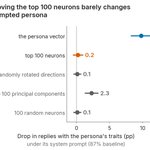
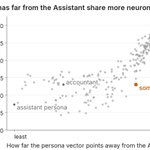
Persona vector steering is sparse in the neuron basis, and the neuron basis is privileged for this! 🧵
Steering just 100 of Qwen3-8B's ~440k neurons has the same effect as a persona vector, while steering the top directions of a randomly rotated or PC basis doesn't work.

Will Mayner retweeted

Okay. Look. Imagine how you'd have felt if an AI had just proved the Riemann Hypothesis.
Now you will predictably, at some point, get that news LATER, if we're not all dead before then. So you can go ahead and feel that way NOW, instead of acting surprised LATER.
Will Mayner retweeted

This is massive. A story I've been following for years. He thought he had more time but didn't. Alessandro Masullo announces a separate, purely human proof of the Riemann hypothesis. math216.wordpress.com/2026/1…


Will Mayner retweeted

In Neural Networks are Already Clean, @nickcammarata argued that neurons were far more legible than previously thought – and that this was great news for interpretability and safety.
Now, we’re releasing the first technical companion to Nick’s essay. It shares our findings from studying thousands of neurons using our novel automated interpretability pipeline, and outlines why we now think of neurons by their computational function, instead of whether or not they are polysemantic. Here’s what we found: 🧵

interpretability might be the most important scientific problem in the world right now, as I don't think we can solve alignment if we don't know what we're building. I think I have good news about it. I co-authored early work in mechanistic interpretability at OpenAI and came away pessimistic, because neural networks appeared to fold into arbitrary tangled knots. years later, I started openai's first large-scale automated interpretability project, finding about 2% of neurons legible with the primitive tools we had
with modern agentic tools and a much closer look, the picture looks totally different. the vast majority in models up to trillions of parameters are legible, and their circuits beautiful. many famous examples of tangled neurons turned out to be misunderstood. The roadblocks I expected mostly aren't there. I now think ambitious interpretability will be solved by the time we need it most, and possibly quite soon, as automated scientists keep improving. it may be a bitter lesson for interpretability: the simple thing, at absurd scale, works
already-clean.goodfire.com/


Takeaway: for persona steering, sparse sets of neurons are as effective as difference-of-means vectors!
Explore neurons & persona vectors here: willmayner.com/persona-neuro…

1
17
416
Inspired by @nickcammarata's post (@goodfireai), @Sauers_'s and @maxsloef's work with character neurons, @jfonsecarivera's and @_lyraaaa_'s neuron character libraries, and @aryaman2020 et al.'s excellent work (arxiv.org/abs/2601.22594)
Code & data: github.com/wmayner/persona-n…

i'm baby qwen-neurons-site.vercel.app…


i made a library of 34,220 persona neurons in qwen
please help me find the weirdest ones:
qwen-neurons-site.vercel.app…


8
344
Will Mayner retweeted
The most ambitious vision for interpretability has long been to reverse-engineer a model well enough to answer an arbitrary question about how it works.
For years, that’s seemed out of reach. Now, we think it’s possible. Neural networks are cleaner than we thought: we can now understand most neurons in models up to trillions of parameters. And agents can rapidly accelerate our progress.
But to get there, we need a concerted effort to unlock scaling laws for interpretability, where our understanding of a model grows predictably with compute.
That’s why we’re committing $10M to start a Human Genome Project for AI. Our ultimate goal is to reverse-engineer a frontier scale model and publish a living encyclopedia explaining how it works.
We don’t know exactly what we’ll find, and we can’t do it alone. We hope you’ll join us. Our chief scientist @banburismus_ lays out the vision here:

if any science should be revolutionised by AI, it should be interpretability. I wrote about how we can accelerate progress, and why we need a Human Genome Project for AI. coauthored with @mathildepapillo
claude can prompt other claudes in tmux sessions *as the user* by directly sending text input to tmux
which means... claude can prompt itself as the user (°ー°〃)

1
9
517

