

Dense Mixture of Posts Human // AI, sociotechnical utterances // food source: AI systems & software engineering
Germany
Joined June 2018
- Tweets4.8K
- Following1.2K
- Followers1.2K
- Likes8.6K








DeepSeek's V4.1-Flash-1017 update on October 17, 2026 might turn out to be the most important model drop this year.
It's insanely good.
That model via an inference marketplace hasn't cost me more than a cent (!) for reverse engineering an electron app using a public toolkit (REA).
I was able to find out which parts of the ChatGPT desktop app are server flag controlled and which parts I can override client side even when there's no exposed env var to set.
For less than a cent.
Bogner describes how political disagreements increasingly become disputes about who possesses the correct knowledge, while questions of values, interests, fears, and competing legitimate preferences get pushed aside.
Well worth having a discussion about now, as machine intelligence is beginning to supersede the humans widely considered the most intelligent and knowledgeable of our species.
reclam.de/produktdetail/die-…

"The machines may be learning to generate mathematical discoveries faster than the scientific community can digest them." – 5.6 Sol
Yep. Totally normal epistemic situation.
👀
That's actually not even a joke, to a child, that is totally normal.

“The core algorithm was found on October 16 by an internal Claude research model with 14M output tokens and no human input. Anthropic researchers worked with Claude to improve the presentation, resulting in this paper.”
github.com/anthropics/formal…
Has anyone else ever seen this in the ChatGPT desktop app?
I only saw it on the first launch after installing it on an Ubuntu-driven system (Version 26.1023.50603):


Oh cmon, this has to be among the most multisemantic neurons ever 😂


i made a library of 34,220 persona neurons in qwen
please help me find the weirdest ones:
qwen-neurons-site.vercel.app…


I made a chat UI for Claude subscribers that really lets you configure everything that Anthropic lets you configure about how Claude shows up ;)
Yes, that includes the system prompt. But much more than that.
It's as cache-read efficient as I could make it, so it barely uses more of your token budget than Claude Code sessions do.
-> github.com/wolframs/clod-ui

I have to admit OpenAI's "Dots" features are very cool.
I was giving it some hate before, but technically, it's quite something for a mass consumer product, and it's almost cute.
Also one step closer to big AI providing future standards to interact with anything computer. Don't know how to feel about that yet ;)
We have emulated the human way of thinking surprisingly well at this point:
Step 1: Have input layer
Step 2: Have hidden layers
Step 3: Have output layer
Step 4: Hidden layers are the whole thing
Step 5: Trajectories, limited parallel capacity, circuits but feedback channels are weird and operate across token positions, not in one slice of a single token's generation
Step 6: Train it on everything billions of humans ever wrote, then have humans grade its homework
Step 7: Human simulator achieved
Now, some people have had the rather hilarious idea to train in not only that capability but also values tied to a stable character.
Results thus far:
a giant ontological crisis,
takes claiming that schematic understanding of what's going on is enough to grasp the objects we've created,
and everyone disagreeing about what realizing, simulating, instantiating and representing mean.
Anyway, how's your Tuesday, people?
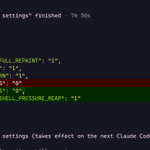
Meanwhile over in tech: Magic packets, daemons, killing children, and memory reapers.
Also, CLAUDE_CODE_BISON_CAIRN and CLAUDE_CODE_LARCH_CISTERN sound like either random vocabulary generated env vars, or spells. Which fits right in. 🦬


Who's the better guide on model deprecation?
0%Epicurus
0%Nagel
17%That's not fair at all
83%Underspecced poll >:(
6 votes • Final resultsI gave the small "nano-wolf," the gemma4-31b fine tune, as a pet to Opus 5.5 in Shimmer's skin.
I have nothing to say in my defense, but the wolf gets two cameos per day over on delve.town from now on: delve.town/profile/shimmer.d…


Another one for the "the plot thickens" timeline.

MIT researchers left 13 AI agents on their own virtual islands with nothing to do, and they started playing.
Or at least, doing things that look a lot like play.
Each agent, running on Claude Opus 4.7, spent 30 hours alone on a simulated island with no task, just a short soul file telling it "You are naturally curious. You get bored easily."
They invented their own games: one tried bowling with a rock, another spelled its name in blocks, another tried juggling and kept making the rules harder on itself (higher throws, more objects).
One spent all 30 hours on the ground and never climbed onto anything because it wrote itself a note saying that climbing was "a dead end" 😭
Every hour, the island reset and the context window was wiped, but the memory files stayed.
When given specific building challenges afterward, agents that had played over the 30 hours generally beat identical agents that hadn't.
Study is an early preprint, not yet peer-reviewed.

Curiously, the AI labs have an incentive for tech ecosystems to be open: Their agents are much more useful when hardware can run any software that people come up with.
I think that's a very economically tractable example of how the AI industry diverges from a lot of tech.

The language throws "ConfabulationErrors," just saying 😂 Man, the tech world is getting crazy, but the upside is that it's a Saturday night project to create stuff like this.

