

Founder, Digital Legacy & Family Trust · Onchain / ETF · CN/EN | Not financial advice
Joined September 2026
- Tweets13.8K
- Following2K
- Followers647
- Likes927





Pinned Tweet
If you died tomorrow, could your family get to your crypto?
For most holders the honest answer is no. No password reset, no bank manager to call. Coins with no plan just sit there, locked forever.
Here's how to fix that, in plain steps. 🧵
56 companies blocked OKX–ICE tokenized shares.
Tesla, Amazon, Netflix, and SpaceX just joined — five Mag7 names now on the objection list. Under the SEC Innovation Exemption path, a timely written no can stop that venue from listing third-party tokenized versions of their stock.
My take: rails are easy. Issuer consent is the hard gate.
Broker statement or a token the company already rejected — which would you rather inherit?
Not financial advice.
$1.04B left U.S. Bitcoin ETFs in two sessions. Your kids still need a claim path.
U.S. spot Bitcoin ETFs saw about $643M leave on Oct 30 and another ~$399M on Nov 2 — roughly $1.04B across those two sessions. BlackRock's IBIT alone accounted for about $405M of the Monday exit. Fidelity's FBTC took a small ~$6.7M inflow. Net assets closed near $98B. Ether funds kept bleeding too.
Those flows are a market story. The estate story is quieter.
ETF shares sit inside a brokerage account. In many places, a transfer-on-death designation or a court-named executor can reach that statement. The fund doesn't hold your seed phrase, and your heirs don't need one to claim the shares.
Self-custody is a different machine. After big outflows or exchange scares, people pull coins into hardware wallets. Hot-wallet risk drops. Inheritance risk rises: nobody can invent a signer from a death certificate alone.
Three checks if you leave the ETF wrapper:
1. Who inherits vs who can sign — two separate designs.
2. A sealed map: which devices, which accounts, where they live, who counsel calls. Keep seed material out of public probate filings.
3. Recovery survivors can actually run: 2-of-3 multisig or a wallet-native scheme such as SLIP-39 — not DIY word splits. Family gets location and contacts only.
Selling an ETF share and signing a self-custody key look similar on a price chart. They are not the same inheritance problem.
Not legal or investment advice. Rules differ by country.
A) Brokerage claim path documented
B) Coins moved off the ETF, family still guessing

China CPC Central Committee: crack down on corruption via “virtual currency, cross-border funds and blockchain.”
Oct 29 decision (Xinhua full text Nov 1). No Bitcoin named. No new trading/mining rule — Party discipline, not a market rewrite.
My take: naming the rails in an anti-graft text still moves the compliance spotlight, even after the 2021 ban.
Does “virtual currency” in a Central Committee decision change how you price China-linked custody risk — or just restates what traders already knew?
Not financial advice.
~$6.3B left Binance hot wallets in late Oct. That does not invent an heir.
Attackers hit Binance hot wallets for roughly $6.3B (Oct 29–30, 2026). Partners froze about $3B on-chain. Binance said it would absorb the losses, set aside more than $6.34B, and by Oct 31 updates had replenished ~90% of stolen assets — major tokens fully backed. Hot wallets were the blast radius; most customer assets normally sit in cold storage, per the exchange narrative.
The estate story is what comes next. After a scare like this, people pull coins into self-custody. That cuts platform hot-wallet risk. It also opens an inheritance gap: an exchange login can sit inside executor paperwork. A hardware wallet only moves if someone who is allowed to sign still can.
Three checks after you leave the exchange:
1. Who inherits vs who can sign. The will names people. Signing power is a separate design.
2. Leave a sealed map: which devices, which accounts, where they live, who the lawyer calls. Do not put seed material in a public probate filing — one-line reminder, not the whole plan.
3. Recovery that survivors can actually run: 2-of-3 multisig, or a wallet-native scheme such as SLIP-39. Not DIY word splits. Family and counsel get location and contact instructions only — never full or partial seeds.
Moving off an exchange is a custody decision. Passing coins to the next generation is an estate decision. They are not the same button.
Not legal advice. Rules differ by country.
A) Left the exchange + executor map written
B) Left the exchange, family still guessing

South Korea FSC: cold wallets past the 80% floor after Binance's $6.3B hack.
Nov 2: boost reserves, tighter withdrawal checks, more cold storage than the law already requires.
My take: one exchange burns, and a whole country raises the vault bar overnight — custody rules travel faster than price.
Would you trust an exchange more because Korea pushed cold storage above 80%, or still prefer keys you control?
Not financial advice.
999.953 BTC ($78.12M) moved after 6+ years dormant.
Lookonchain: that stack was received when BTC was ~$10,727. Dark for half a decade, then the whole bag left in one go.
My take: "I'll set up inheritance later" is how estates lose keys — dormant isn't the same as recoverable.
If this wallet never moved again, would anyone in the family even know where to start?
Not financial advice.
50,000 users. HK$87.8M in circulation. Zero new wallets downloaded.
HSBC RedCoin (RCHKD) launched Oct 23 inside PayMe — an app Hong Kong already had. CEO Georges Elhedery told FinTech Week today: 50k signups in just over a week. P2P + 100k+ merchants. Private Hyperledger Besu that HSBC runs. HKMA license FRS02: one of only two out of 36 applicants.
Crypto spent a decade teaching people to download wallets. A bank flipped a switch.
If retail stablecoins win through the apps people already use, who owns the customer — the chain, or the bank?
7,548 ETH. $16.72M. Old Pando Rings hacker.
Lookonchain (while feeds stared at Binance): that wallet bought the dip — then ~7h ago dumped 4,000 ETH ($9.17M) into TornadoCash.
My take: dip-buying with stolen inventory, then mixing half, is not "smart money." It's exit liquidity with a blender.
Hacker wallets buying dips — fade the bounce, or just noise next to Binance?
Not financial advice.
2.4.1 or older. That's the cut.
BTCPay (Nov 1–2): hot wallets on self-hosted instances got swept. Official update: the attack vector hits 2.4.1 (Jul 23) and earlier; no credible drains reported on 2.4.7. Patch day was Oct 29 — then the Sunday shutdown call.
Self-custody of a store still means someone owns the update clock. An heir who inherits a payment box inherits the version lag too.
Do you keep a merchant hot wallet online, or watch-only + cold sweep?
$65.62M for 28,604 ETH. Avg $2,294.
EmberCN update: same dip-buyer kept filling — earlier Lookonchain had $62.97M / 27,553 ETH; today's running total is higher.
My take: while feeds argue about the Binance hangover, someone is treating sub-$2,300 ETH as inventory, not a mood.
If this wallet keeps buying into the noise — respect the fill, or wait for a cleaner bounce?
Not financial advice.
1.49M SOL. $148.77M. Into exchanges. 10 days.
Lookonchain: the same mysterious whale that dumped 1.02M SOL ($104.3M) a few days ago kept depositing — total now 1.49M SOL across venues.
My take: that is not "taking profits on a chart." That is inventory walking onto the sell button while the deposits are still stacking.
If a whale is still feeding exchanges after $100M+, do you fade the next bounce — or wait for the deposits to stop?
Not financial advice.
Audited. Twice. Still dead.
Iron Fish (Oct 30) is ending all remaining network support. An early-2019 Merkle-tree bug let someone spend the same privacy note more than once, then exit through ChainPort as wIRON. Internal and external audits both missed it. The patch needs a new genesis — the live chain has no upgrade path.
When a privacy L1 archives the repo, what does an heir inherit — a working key, or a museum piece?
Fictional short drama · AI-generated imagery · synthetic voice
The Hotel Safe
After a weekend trip, sister Nora opens the hotel room safe before checkout.
Inside: a hotel notepad with Dad's full recovery words — written on a business trip in case the luggage was lost.
Brother Kenji is already at the lobby kiosk, about to check out without opening the safe.
Nora rushes back.
Ms. Vargas: I never need your words. Nobody does.
Never leave recovery words in a hotel safe. Destroy that notepad securely.
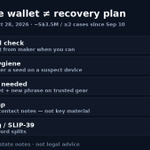
Use 2-of-3 multisig or wallet-native SLIP-39.
My file holds only a letter: where to look, and who to call.
Conclusion: Recovery words in a hotel safe can hand the keys to whoever clears the room after checkout. Checkout does not empty the safe.
One reference action: Before any hotel stay, keep recovery words out of room safes and luggage notes. Use 2-of-3 multisig or wallet-native SLIP-39. Put only where to look and who to call in the letter — never scramble or hand-split, never give words to lawyer, accountant, or relative.
Music: J.S. Bach, Prelude No. 19 in A major, BWV 864 — Kimiko Ishizaka (CC0, Wikimedia Commons)
commons.wikimedia.org/wiki/F…
Not financial advice.
Fictional story. Invented characters.
If a parent left recovery words in a hotel safe — what recovery path did you leave instead?
FBI + Secret Service. After a $6.3B hack.
Binance says it is working with the FBI and the U.S. Secret Service on the breach. Reuters, citing a source, reports the same U.S. agencies are involved. Freeze partners and cover math are one track. Law-enforcement recovery is another.
My take: a federal investigation can chase stolen coins. It does not invent a key your heirs can find tonight.
If the exchange needs the FBI, is one login still your family's whole plan — or the single point of failure?
Not financial advice.
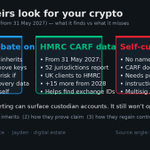
HMRC will see your exchange account in 2027. It still won't see your seed phrase.
From 31 May 2027, the UK starts receiving Crypto-Asset Reporting Framework (CARF) data from service providers in 52 jurisdictions — Channel Islands, Cayman, Ireland, Liechtenstein and others. Another 15 (including Singapore, Switzerland, Gibraltar) join in 2028: name, address, NI number, transaction history.
HMRC has told probate solicitors it will answer executor requests about those holdings. That matters. Today many overseas platforms won't even confirm a dead client had an account.
What CARF does NOT do:
1) Find a self-custody wallet. No KYC name sits on-chain.
2) Move coins. Reporting ≠ signing authority.
3) Replace a will, a court appointment, or a letter of instructions.
So if the plan is "the tax office will sort it," half the stack is still invisible. Exchange sleeves may surface. Hardware wallets and DIY multisig only pass if you left a private map: where the device is, who holds the second key under a proper 2-of-3 or wallet-native share scheme (not a DIY word scramble), and who the lawyer should call.
A will can name who inherits. Keep recovery details out of that public filing.
If you hold both ETF/exchange crypto and cold storage — which half would your executor find in 60 days without calling you?

$6.34B reserved. $5B already in the stolen tickers.
Binance just now: company funds reserved over $6.34B to cover the hack — $5B already held in the exact tokens that were hit. Remaining buys go through market and OTC channels (Yi He: SAFU plus BTC/ETH holdings, fully matching amounts). The $3B frozen via partners is separate.
My take: a make-whole is a balance-sheet move. It is not a household recovery checklist.
If the exchange can repurchase every stolen ticker, does your family still treat one login as the plan — or as the single point of failure?
Not financial advice.
$6.xB hack. ~$3B frozen. ~$1.xB SAFU.
CZ's rough math today: that leaves about a $2B gap — and he says Binance still holds ~$1.xB in SPCX alone from the old Twitter-takeover stake. Remaining gap is "painful, but manageable." He also asked Elon to stop trolling and show support.
My take: a public cover math is a balance-sheet story. It is not a recovery plan your family can execute tonight.
If the exchange can bridge a $2B hole on paper, does your household still only have one login — or a second path that does not need that window open?
Not financial advice.
25 months. For 185 BTC lost to a fake support call.
Miami federal court (Oct 26): a Canadian pleaded to money-laundering conspiracy after impersonating Google and hardware-wallet support to steal seed access. He returned ~$3.8M of ~$13M scheme losses. Real support never asks you to type your seed or share a screen.
If a "Google" number calls about your wallet tonight — hang up, or stay on the line?
Not financial advice.