

founder and ceo of @LaunchpadBuild and @KiwiPower (acquired); angel investor
Los Angeles / London
Joined April 2008
- Tweets506
- Following563
- Followers1.1K
- Likes47







yoav zingher retweeted

I’m so angry about this. Who the fuck is advising these people?
We shouldn’t “duplicate what our friends are doing” - literally all economic activity is downstream of intelligence. It’s like not having electricity. There is no other boat.
It’s completely nuts. Fix the copyright issue; make more funding available for those who want to make domestic models (since the UK has no tech giants to bankroll it); stop with the defeatist guff.
There are 10+ foundation model companies in China. The UK doesn’t have a single one. It’s a national disgrace.
@KanishkaNarayan

UK AI Minister @KanishkaNarayan tells @JuliePace he doesn't see a UK frontier model “as a matter of necessity as long as we have trusted interdependence and access.”
Oh Gemini. You try so hard. You apologise so nicely. You explain exactly what went wrong.
Then you send me to Delhi again.
You beautiful fucking idiot.


1
189
I’ve been thinking about the different levels of working with AI.
Prompting AI is like managing an employee. Orchestrating agents is like managing a team. Designing a harness is like designing an organisation.
Each requires a higher level of abstraction, and being good at one doesn’t mean you’ll be good at the next.
As models improve, the advantage of being good at each level starts to disappear. Prebuilt harnesses will eventually manage agents better than most humans, and presumably AI will get better at designing harnesses too.
So everyone becomes more productive, but the opportunities to be better than everyone else at using AI keep shrinking.
Perhaps the real skill is being able to keep moving up a level of abstraction as the previous one gets automated.
I wonder how many levels there are, and whether there’s one where humans will retain an advantage.
Britain says it wants to be a global leader in AI.
I recently experienced Tesla FSD in America. Extraordinary technology.
Back in Britain, I asked why we can’t use it.
The government’s response? A lengthy explanation of regulations, committees and reviews, with no clear timeline.
This is how countries lose their competitive edge. Not because they lack talent or technology, but because their institutions can’t move at the speed of innovation.
If it’s unsafe, show us the evidence. If the regulations are outdated, change them.
We can’t build an AI economy with a pre-AI regulatory mindset.


Genuine question: has anyone in the export control / semiconductor policy world clocked what Taalas means for China?
Hardwire distilled models into ASICs on mature nodes. No HBM, no EUV, no GPUs needed. SMIC can do this today.
What am I missing?
3
4
256

yoav zingher retweeted
this is the largest machine we've ever built!
it will assemble window frames at scale in America.


yoav zingher retweeted

Blessed dinner with the Gundo fellas reindustrializing America
Thanks @tamarackglobal , @KingJamieLee , and @AlexHeckler for helping the deep tech ecosystem grow 🫡


🇺🇸 10 tech firms = 25% of stock market, ⬆️4x from 2010
🇪🇺 10 luxury goods firms = 15% of stock market, ⬆️3x from 2010
Concentration in a productive vs. unproductive sectors.
5/7 The result? Major urban centers with large factories are experiencing labor shortages. It's a clear example of how societal shifts can impact labor markets and the need for adaptive solutions.
6/7 Automation can address these shortages in both countries. It's not about replacing human labor, it's about filling the void where labor isn't available. Automation technologies are becoming a necessary tool to maintain production levels and growth.
3/7 This growing vacuum in our manufacturing industry presents a challenge, yet also an opportunity. The traditional human element is vital, but with it receding, automation steps up as a necessity, not just an option.
1
8
649
2/7 In the U.S., fewer individuals are willing to work in factories when similar wages are offered by Uber and Amazon for less physically demanding roles. As older workers approach retirement, the human element in factories is diminishing.
1
7
503
1/7 A compelling comparison exists between the labor shortages in the American and Indian manufacturing sectors. These unique scenarios illuminate a shared solution: automation.
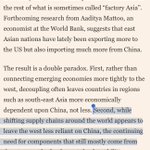
Disappointingly short-sighted article in the @FT about decoupling manufacturing from China. The basic argument is that, even if we move manufacturing, we still need to import components from China. But there’s no magic in making components, we need to reshore those too!

5
5
538
The true value of robots and automation lies not just in their capabilities compared to humans, but in their ability to operate 24/7 on specific tasks, freeing up humans to focus on more important work.
With the rise of automation, we must ensure that humans are not simply replaced, but rather that their skills are elevated to focus on higher-level work that only they can do.
2
3
290