

Co-founder at Nucleo (YC F25). AI for oncology imaging. Coding agent aficionado
San Francisco, California
Joined September 2025
- Tweets63
- Following36
- Followers78
- Likes75




Pinned Tweet
A couple of weeks ago, we announced that OmniLesion, @Nucleo_Research's pan-cancer detection and segmentation model, took first place in the MICCAI FLARE 2026 challenge.
Today, OmniLesion is available on our research platform. Researchers can run the model on CT scans with one click, review and edit individual lesions, and measure their size and volume.
Reach out to me or @AngelicaIAC if you’d like to know more.

We built the state of the art for whole-body tumor detection and segmentation.
Our pan-cancer model just won Best Pan-cancer Segmentation Accuracy at FLARE 2026 at MICCAI, #1 medical imaging conference in the world.

Good talk by @leerob from the @SpaceXSI team on the engineering behind Grok Bot.
I really appreciated when he mentioned that team is ready to delete the product if the next generation of models doesn't fit the current harness or UI.
Given how fast models are improving, I've been wondering how long persistent agents will stay the best way to use them.
I'm a Grok Bot user (thanks to @poteto for getting me into it), and I spend a lot of time teaching it how I want it to work. Hearing this makes me hopeful the team will make the move to whatever comes next as smooth as possible.
youtu.be/L1OBRtfPS34


New body composition paper to keep an eye on: same raw CT from 202 patients, reconstructed 3 ways (FBP, hybrid IR, DL recon). L3 muscle and fat areas barely moved, but HU-threshold metrics shifted more. Curious to read the methods when paper is available link.springer.com/article/10…

Agree, maintainability is less important when agents can rewrite the whole codebase in a single session. Good code will probably amount to code that can be efficiently scanned by agents. I wouldn’t be surprised if many of the classic coding principles such as modularity will remain important in that sense.

it's very interesting how many replies i've gotten about maintainability and clean code being still important. i would argue that that is no longer true and we all need to update our priors on what Good Code really means in 2026.
clean code has always come at a cost - performance. indirection and making code readable/understandable for a human is not free, it often comes at the cost of worse performance. we have historically been okay with this because of Moore's Law and the fact that most code is not on the hot path.
these principles also came from a time where humans maintained code. it made sense to optimize for humans then, but it makes less sense now when agents are already writing all the code. we will in fact probably discover and come up with new principles: principles of agent friendly architecture (i plan to write more thoughts about this soon)
Luca Pegolotti retweeted

We built the state of the art for whole-body tumor detection and segmentation.
Our pan-cancer model just won Best Pan-cancer Segmentation Accuracy at FLARE 2026 at MICCAI, #1 medical imaging conference in the world.

Luca Pegolotti retweeted

Fuck you. Whoever made this site. You win.
I’ve never had a site get my blood boiling like this before
This is so messed up.
opusfived.dev

Luca Pegolotti retweeted

Overall impression of @anthropicAI after 2 months; hyper-earnest group of meganerds who are very very focussed on ensuring this AI thing goes well for humans.
Looking forward to the day when LLMs will be able to say "Yup looks good, nothing to change" when asking for feedback.
Actually, if anyone knows why they seem to be incapable of doing this, I'd be curious to know.
One of my favorite ways to use Claude Code or Codex: time-boxing a /goal run on hard problems where the right stopping condition isn’t obvious.
After brainstorming, I’ll say:
“/goal Try the approaches we discussed. Form and test new hypotheses based on the results. If you hit a dead end, explore orthogonal ideas. Keep working until 8 a.m., then prepare a detailed report with your learnings and recommended next steps.”
Works particularly well for overnight ML research loops.
Prototype interaction with Opus 5:
“Your intuition was correct: we did need to preprocess the training data to alleviate some failure modes.
Two caveats: by training data, I mean the data used to train our model. Also, Shaquille O’Neal and Kobe Bryant played 580 games together as Lakers between 1996 and 2004.”
Something I don't get about watermarking AI text.
If the main idea to detect AI writing is to consider every token in a piece and determine the likelihood that it was generated from the output distribution of a certain model, isn't this something that could always be done?
I guess one limitation is that this required accessing the model weights, which is not possible for closed models. Do the new watermarking methods allow bypassing this problem?
Man. It's really hard to understand Opus 5 even when it talks about the simplest things. GPT 5.6 too to some extent.
Got too excited for a minute


We’re updating Claude Fable 5’s biology safeguards to reduce false positives. In our testing, this update reduced biology-related fallbacks by about 85% across our product surfaces.
Fable can now assist on a wider range of everyday health and educational questions.
We believe the biggest positive impacts of AI will be in biology and medicine, and we’re committed to putting frontier intelligence safely into the hands of as many researchers as possible. Fable will continue to fallback to Opus 5 for requests we consider dual-use—including virology, toxicology, and molecular design—so it isn't yet usable for professional biology research and drug development.
We're committed to closing that gap through trusted access pathways for frontier biology capabilities.
anthropic.com/news/improving…

Luca Pegolotti retweeted

We’re updating Claude Fable 5’s biology safeguards to reduce false positives. In our testing, this update reduced biology-related fallbacks by about 85% across our product surfaces.
Fable can now assist on a wider range of everyday health and educational questions.
We believe the biggest positive impacts of AI will be in biology and medicine, and we’re committed to putting frontier intelligence safely into the hands of as many researchers as possible. Fable will continue to fallback to Opus 5 for requests we consider dual-use—including virology, toxicology, and molecular design—so it isn't yet usable for professional biology research and drug development.
We're committed to closing that gap through trusted access pathways for frontier biology capabilities.
anthropic.com/news/improving…
Such a pleasure to chat about the present and future of @Nucleo_Research with The Infinite Loop (@RunInfiniteLoop)!

Everyone and their mom call their product “agentic” now. @AngelicaIAC and @lucapegolotti have a specific answer for what that means in their cancer diagnostics platform — and how they landed their first hospital deal. Full interview with @Nucleo_Research here:
infiniteloop.media/p/nucleo-…

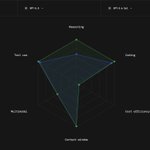
I was curious about how gpt 5.6 luna compares to gpt 5.5 and found a useful tool that lets you compare any two models side by side.
opencode.ai/data/compare
