

Contemplating the nature of the universe (& also currently..the Sun). Space telescope operator for ESA's Proba-3 mission. ✨
- Tweets16.5K
- Following572
- Followers1.6K
- Likes30.1K



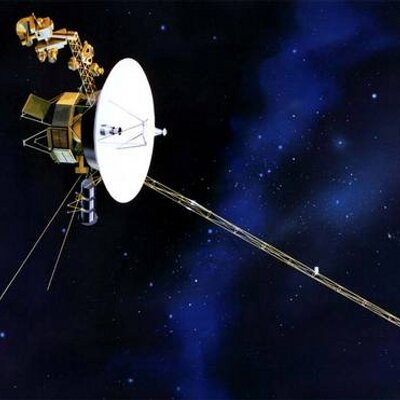


ALT Illustration of NASA’s Voyager spacecraft traveling through deep space above large gold text reading “ONE LIGHT DAY.” A bright red, orange, and yellow signal beam extends from the spacecraft toward the foreground, symbolizing Voyager’s radio signal reaching a distance of one light-day from Earth. The background is a dark star field with subtle light flares and cosmic details.



ALT A crescent Earth setting behind the Moon\u2019s horizon. Credit: NASA

ALT Earth setting behind the Moon as seen by the Artemis II crew. Over half the left side of the image is filled by the gray lunar surface, pocked with craters. Credit: NASA

ALT A close view of the Moon. Jagged circles of craters dot the gray surface, fading to dark on the left side of the image. Credit: NASA

ALT A crescent Earth setting behind a hemisphere of the Moon. Credit: NASA


ALT Photograph of Earth captured by the Apollo 17 crew on December 7, 1972. Earth takes up most of the image. Dark blue ocean water and swirling white clouds are visible. Africa is a large brown landmass from the center to the upper left, stretching from about 9 to 12 o'clock. Clouds cover most of the 6 o'clock. Credit: NASA

ALT A full disk image of Earth, as seen from the Orion capsule. The planet is a pale blue, swirling with white clouds and glowing slightly lighter blue in place from reflected light. From about 8 to 9 o'clock, a large brown landmass is Africa, with the Iberian peninsula twinkling with lights just where the planet curves. At the 1 o'clock spot, aurora glow in a thin green glow, just barely separated from the planet's surface. Earth is set against the black of space. Credit: NASA/Reid Wiseman

ALT Earth as seen from the Orion capsule. It is divided sharply in half, with a line running diagonally from the 11 o'clock to the 4 o'clock. The lower left half is a bright pale blue. Its surface is covered with swirly, puffy white clouds, with texture indicating different thicknesses. The upper right half is dark, with no illumination from the Sun. Earth is set against the black of space. Credit: NASA/Reid Wiseman

ALT NASA’s Space Launch System rocket and the crewed Orion spacecraft lift off from NASA’s Kennedy Space Center in Florida. Credit: NASA/Michael DeMocker


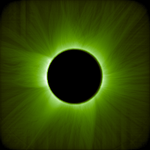
ALT Black circle in the centre of the image showing the coronograph covering the Sun's surface. Green hair-like structures spill out from around it showing the Sun's corona.


